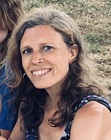
Guest Interview with Amanda Fox: Writer, Wonder, Activist
‘Refuse to fit into the box that others have tried to make for you.‘

It’s hard to introduce my latest guest on the blog, Amanda Fox, as I realise that she defies description in many ways. There’s something about her that helps me to feel, more than I feel with anyone else, that ‘You have to let the soft animal of your body love what it loves.’ (Mary Oliver). In other words, that we can’t separate ourselves from the animal kingdom.
I first met Amanda as a neighbour in the previous house I was living in. She is rarely to be seen without her dog Halo, a beautiful borzoi, and if he isn’t loping along regally beside her, he is whizzing along in a carrier behind her bike, his head poking out of the top as his ears flap in the wind, taking it all in. Amanda has a strong love of justice, of the natural and more than human world, of people, ideas and conversation. One thing our family were always struck by in coming to know her as a neighbour is her ‘can do’ attitude. She never sees any wall or challenge as insurmountable and in our household, if we’re faced with a difficulty, it’s become a catch phrase to say ‘think like Amanda.’
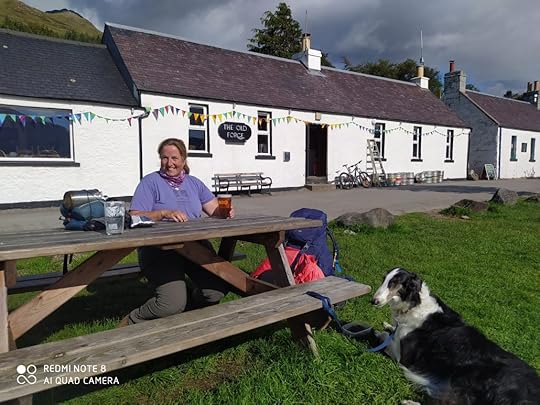
She never judges and is both fiercely gentle and gently fierce. Honestly? She is one of the reasons I initially stepped into activism, as I thought, I want some of what she’s got. And as a lovely aside, it was Amanda who told us about going to Knoydart in Scotland where she went walking with Halo, falling in love with its rugged beauty. And now, here I am, sitting precisely 110 steps (I counted last night) away from where she is pictured above, sitting in front of The Old Forge, the UK’s most remote pub.
Thanks for agreeing to come on my blog Amanda.
1) How long have you been writing for and what kind of writing do you do?
I had a teacher, Mr Benny, who would give me amazing feedback about my writing at primary school. As a result, I wrote lots of poetry and entered and won a poetry writing competition when I was ten. I journaled all the way through High School, and loved story writing but, coming from a working class background, my daydreaming was inevitably replaced by finding ways to make a living, how to bag a boyfriend, and whether or not the landlady at the pub would serve fourteen year old me.
In my consciousness, writers were people who had money and a posh education, so I just ditched my habit. Those things that we love in infancy don’t seem to completely go away though, and the longing to be able to shape words skillfully remained there as background music. Now, in my fifties I am finally nurturing what feels like a really important part of myself, by doing a degree in Literature with Creative Writing. I now can’t imagine not writing every day. My favourite module so far has been one on experimental writing. I love writing with that kind of freedom, rather than considering genre or audience. At the moment I am mostly trying to improve my prose and, by the time I complete my degree, I’m really hoping that my grammar and punctuation will have sorted themselves out. I am currently a comma criminal.
It’s still a challenge to consider myself a writer but it is now a daily practice. I love it and I am encouraging my skill level to catch up with my enthusiasm.
2) How does your activism inform your writing or vice versa?
Without activism I wouldn’t be writing. One of the most destructive acts of a class system is that societal views of your social class become so internalised at a young age, that children’s future’s are largely predetermined. So much creativity is lost because working class people have their confidence destroyed, or lack the financial freedom to contribute to the arts. It was activism that cracked my own internalised beliefs enough, for me to be able to see them clearly and begin to reshape myself according to a dialogue of my own choosing. When you become embedded in an activist community, like Extinction Rebellion, where everyone is consciously trying to dismantle structures of oppression, healing and empowerment become almost inevitable. Activism also teaches you resourcefulness and to find ways of living that you might not have previously considered. This is especially useful for creative writers, as many people who write have to have multiple things going on in order to be able to feed themselves. That learning and the safe footing of my activist community gave me the confidence to apply for the UEA degree course that I am now on.
Studying there is the most exciting period of my life so far. To some extent we all write what we know but, rather than activism informing my writing, the act of writing itself is my activism. The system that we live in never meant this outcome for me; this glorious immersion in art. Every morning when I sit at my laptop and begin typing, it feels like a revolutionary act.
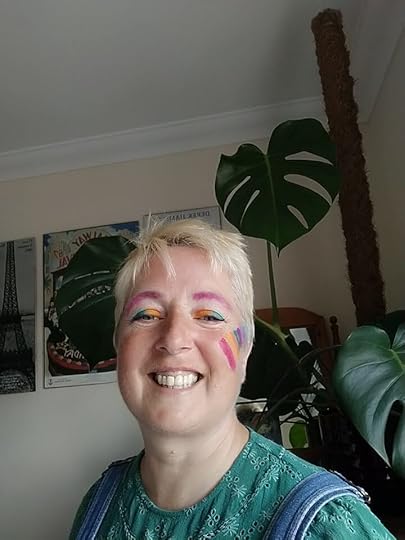
3) How does the natural world inform your writing?
The relationship that I have with the natural world feels too intimate to be able to write about it directly. I don’t think I have the language skills to do such a love affair justice. However, I do find that plants, insects and wild animals often infiltrate a piece of writing that I am doing, even if it starts off feeling a million miles away from that subject matter.
4) What are you most proud of in your life?
Breaking a window at Barclays. It is perhaps the occasion in my life when I was acting most authentically in line with my conscience and I felt very connected to my faith as I broke that glass.
5) If you were to press one or two books into the hands of everyone you know and say, you have to read this, what would it be?
Bridget Jones Diary, because it’s a super easy read and I find it hilarious, and To Kill a Mockingbird, because I just love Atticus.
…..although I am torn because I also want to say Chavs by Owen Jones, which is about the demonisation of the working class. Every word was relatable and every word made me angry.
6) Did you have a favourite book as a child?
I was fanatical about the Famous Five, even insisting that everyone call me George. All I’ve ever wanted is a dog, some reliable friends and a bit of an adventure. George had all that and an island of her very own and I lived vicariously through her.
I always fumed about Anne but now I also think, fuck being almost as good as a boy. We are so much better in so many ways and I reckon Ivor Cutler has it right with his song Women of The World.
7) Where do you feel most at home?
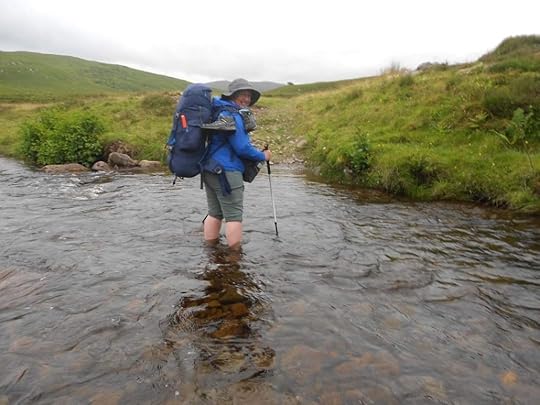
In a tent with Halo my dog…especially if my friends tents are nearby too.
8) Who or what inspires you the most?
My mum. I know it’s a boring answer but she seemed capable of the kind of enfolding love that St Julian describes in her Revelations of Divine Love. I think that mum came about as close to being a vehicle of divine love as it is possible for a mortal to achieve.
9) What work has been the most meaningful to you over the years?
I worked for fourteen years at a wildlife rescue and rehabilitation centre. The team just clicked. We loved what we were doing, we loved each other and the mix created this hotbed of pure happiness. There can be no higher purpose than magnifying joy and we nailed it. There were so many funny moments, so many moments of warmth and grief, that I felt like I had been planted, slap bang, into the best bits of a James Herriot novel.
10) What advice would you give someone who wants to write but lacks confidence?
There’s a reason that you lack confidence and it isn’t your fault. Whoever did that to you, fuck them. Write something and share it, just to get your own back. Refuse to fit into the box that others have tried to make for you. However scary it feels, you deserve to feel the freedom on the other side of that fear, and it will be less scary than a life half lived.
Squirrel
“Squirrel” I say, in an excited voice to Halo. The kind of voice that, in some dogs, would spark an explosion of fur and speed and teeth. Halo’s head doesn’t move off her front paws, on the sofa, but her eyes slide lazily in my direction.
“Squirrel!” I try again, seeing my sunflower hearts at the feeding station going down rapidly; the squirrel taking the piss really with the patio doors being wide open and a thirty kilo sight hound laying on the sofa just inside. I try a higher pitch and slightly louder. “Squirrel!”
Halo yawns, looks at me with resigned eyes, aware that she must do her duty. Slowly unfolding her limbs she stands up on the sofa but then circles as if about to lay down again, testing.
“Squirrel!” I insist.
Halo reluctantly steps off the sofa. Stretches a long and languid downward dog and ambles towards the door. The squirrel freezes comically, upside down on the feeder, like it’s trying to win a particularly competitive game of musical statues; one limb poking out to the side and a front paw stretched forward in mid air. Unblinking, it momentarily assesses the situation and then leaps. Its grey bushy tail is halfway across the garden before Halo breaks into a lope. Halo doesn’t intend to disturb the rhythm of her day by actually catching the squirrel and so it is over the fence after her eighth stride. Halo sighs deeply and walks back towards the house. Before she is even at the patio doors the grey head has appeared at the fence and the squirrel snips a defiant “tch tch” remark at the retreating hound who is too placid to respond, and besides, it is a Sunday afternoon and the sofa is calling.
I notice the slight stiffness of Halo’s hind legs as she walks and that the squirrel’s isn’t the only grey fur. I remember that Halo is eight years old and that the average lifespan of a borzoi is ten years. I curl up on the sofa beside her, noticing again, in the way that I have noticed with increasing frequency over the years – each year the noticing becoming more acute – how absolutely perfect she is. My hand rests on Halo’s warm, rising and falling chest, my own chest aching with the knowledge that one day I will joyfully shout “Squirrel!” and my words will be swallowed by a sinkhole of unthinkable proportions. It is Sunday afternoon and I have decided that I won’t leave the sofa today. Halo senses this and her facial features relax into the form associated with happiness. The dog equivalent of a contented smile. Not that obvious gawking mimicry that golden retrievers do. No, borzois have more subtle expressions, that only those that know them can properly decipher. When you know, you know. Physically and mentally connected, Halo and I watch the squirrel demolishing the sunflower hearts together, like an elderly couple who have been married for many years and no longer need conversation.

Thank you Amanda for this gorgeous snapshot of a precious moment, and thank you for featuring on my blog and being an inspiration to me and countless others.

Compliment this blog post with reading about Ruth Jenkins, spoken word poet and textiles artist & guest post with disabled writer Ann Young.
The post Guest Interview with Amanda Fox: Writer, Wonder, Activist appeared first on Rebecca Stonehill.