Victorian Anthologies of “True” Ghost Stories; Or, Beware of Anthologists
For a project that I’ll elaborate upon in the near future, I went searching for 25 allegedly true ghost stories. I wanted them all to have been published in the Victoria era and to involve a manifestation occurring in the same era. I’m pleased to say I found them, but — early in the process — I decided against using books that offer readers a handy collection of such stories, despite how much these would have made things easier for me.
One reason I made this decision is those anthologies are easy to find. (I list and link some of them below.) I wanted to recover some stories that aren’t so easily accessed, thereby adding to the body of literature featuring “true” Victorian ghost stories — if “body” and “ghost” belong in the same sentence.
Another reason is I stumbled upon one flagrant rewriting of an original story in anthology. This got me thinking about how the other anthologists might have been, if not revising the stories outright, at least selecting those that suited their purpose. Before explaining what I mean, let’s take a look at some sample anthologies.
Five Such AnthologiesI know there are more out there, but here are the primary anthologies I have in mind here. I tack on some notes about each anthologist’s bias.
The Night Side of Nature; or, Ghosts and Ghost Seers, Vol. 1 and Vol. 2., edited by Catherine Crowe (London: T.C. Newby, 1848). Crowe is part of a “push against” decades of skepticism that dismissed the reality of ghosts, and her choice of material almost certainly was shaped by this stance.Remarkable Apparitions and Ghost-Stories, edited by Clarence S. Day (New York: Wilson, 1848). Below, I discuss how Day’s radical revision of one ghost story got me thinking about anthologists’ biases and why I should be wary of the kind of books found in this list.Real Ghost Stories, edited by W.T. Stead (London: Grant Richard, 1891). Like Crowe, Stead was a believer in ghosts, and his choices of material was quite likely influenced by this.The Ghost World, edited by T.F. Thiselton Dyer (London: Ward and Downey, 1893). Thiselton Dyer was a folklorist, and I suspect his material was chosen — not to promote a belief in ghosts — but to illustrate specific elements of that widespread belief.The Book of Dreams and Ghosts, edited by Andrew Lang (London: Longmans, Green, 1899). Lang was famous for remaining neutral regarding the reality of ghosts (though still fascinated by the topic), so his selection of material might have been fairly balanced. He fits nicely beside Thiselton Dyer on the bookshelf.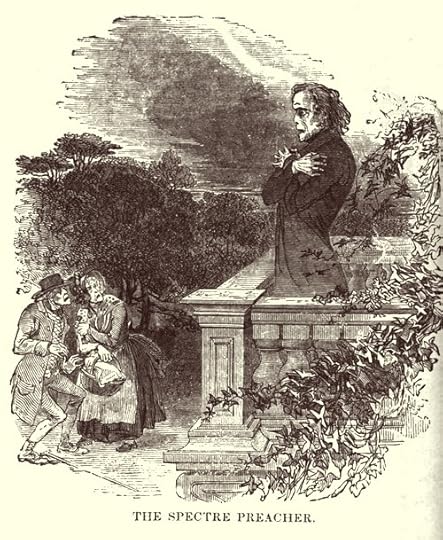 Despite the fact that Day appears to have fiddled with the original stories, his Remarkable Apparitions and Ghost-Stories anthology includes some pretty cool illustrations!Day Shines a Light
It was Clarence S. Day who really convinced me to find my 25 Victorian ghost stories without the assistance of an anthologist. I mentioned that I was seeking experiences that had happened in the Victorian period, and a lot of Day’s stories are set long before this. But then I spotted one that opens: “Some years ago…”
Day titles this anecdote “How the Ghost of a Young Woman appeared to a Clergyman who had seduced her.” Bit of a spoiler, that! Indeed, in the end, we learn that the clergyman — specified as Roman Catholic — was haunted by unconfessed guilt:
The phantom-lady, in all her visits to others, kept silence; no one but the clergyman ever heard her speak; perhaps, because no one else had the courage to speak to her. But what she said to him, he could never be induced to tell. So stood the matter when we were brought into contact with him. From other sources we have learned that he often passed his night in the open air, to evade the dreaded visitation....Finally, on his death-bed, he confessed the apparition which had haunted him so long and so painfully, was that of a young girl whom he had seduced many years before, and who had died of a broken heart, because he had refused to renounce holy orders and marry her.
One might wonder how the narrator had access to this confession, something generally protected by clergy-penitent privilege. But, hey, let’s ignore that!
A little digging showed me that Day probably copied the story from an issue of Dublin University Magazine that had been published a year earlier. Dublin. Ireland. A predominantly Catholic population. Not surprisingly, the story of the priest here ends very differently. The bulk of the story is the same, but the earlier version concludes this way:
From other sources we have learned that he often passes his night in the open air, to evade the dreaded visitation.... At such times, his village-parishioners often lie awake till the dawn, listening with a heart-clutching fear to the unearthly tones which his voice and his guitar conspire to send forth into the shuddering night.No deathbed confession here. The secret remains secret. And there’s something both unresolved and unnerving in that.
Who Changed What?One might argue that the Dublin University Magazine article carries the altered ending. However, in that article, the anonymous author introduces the story as one gleaned while personally traveling through Germany. This might be pure fiction, I suppose, but it certainly feels closer to the source than Day’s presentation of it.
Furthermore, Day, an American, was compiling his work when the U.S. was experiencing a wave of staunch anti-Catholic and anti-German/Irish immigration. It’s my strong hunch that Day found the Dublin University Magazine article and reworked the finale — maybe to provide greater resolution — but also to reinforce the socio-political leanings of many American readers in the mid-1800s. I’ll never know for sure. But the two endings of the single story serve as a very loud example of how an anthologist’s decisions can skew an anthology. If it hadn’t have been for you meddling editors!
Anthologist bias is not something I’ve worried about in the past. Maybe it’s time I do. At least, I should keep a sharper eye on it, and do my best to trace an anthology’s selections to their original sources.
— Tim