October 6–12, 2024 (Eastern): The Declaration
October 20–26 (Old Calendar)
Kingdom of God: Week 5
Uniting our Days to Jesus’ Days
We have followed Christ’s footsteps in the first four weeks of the opening Season of the Divine Calendar and through a week celebrating the Nativity of the Virgin Mary and the Elevation of the Holy Cross. This season focus on the major theme of the Bible, the Kingdom of God. Our goal is to unite the events of our days with the events in Jesus’ life, because everything Christ did was for our salvation. His birth, childhood, baptism, fasting in the wilderness, healing of the sick, every word He spoke and act He did are stored in His human nature—our new nature—as unlimited grace.
The Christians of the first centuries loved Jesus so much He became the center of everything they did. They sought to unite every day with Him because “of His fullness we have all received, and grace for grace” (John 1:16). Everything that happened in their days became chances to receive from His divine-human nature. We seek to follow Jesus like this in our journey through the Seasons of Salvation, but in a tiny scale compared to the first centuries.
If sin abounds in our age, “grace abounded much more” (Rom. 5:20), and “with God nothing will be impossible” (Luke 1:37). When we enter the mysteries of these seasons by viewing our days through the themes of the Seasons of Salvation and the Sunday Gospels, and pray into what resonates with us, we will receive transformative grace from the ancient wells of salvation. “Behold, God is my salvation, I will trust and not be afraid; ‘For Yah, the Lord, is my strength and song; He also has become my salvation.’ Therefore with joy you will draw water from the wells of salvation” (Isa. 12:2–3).
Those who grow up in the eastern church have a significant advantage compared to the western evangelical church, because the seasons of the liturgical year are mostly preserved. However, the danger in the eastern church is to focus too much on the means—the liturgical eloquence, even though how beautiful they are—when they are supposed to lead us to an encounter with the person of Christ.
It is when we encounter the Lord in the Sacraments, in the services, and in our private devotion, that we receive the grace of the Season of Salvation. Do not worry about whether you are doing this journey correctly. This is quite simple. If your heart longs for Jesus, if you attend the services in your parish as best as you can, and if you have a private prayer time, expressing your heart to the Lover of mankind, then you are doing it perfectly.
Our Journey so far
In the past four weeks of this Season of the Kingdom of God, God wants to entrust us with more of His Kingdom, but to do so, He needs to prepare our souls for this task through deeper sanctification. God wants to renew our comprehension of His ways and His Kingdom so we can grasp more of His plan for our lives.
In the previous two weeks, we have seen the painful picture of toiling on our own, but how everything changes when Jesus enters the boat of our life, and our need to abide in the endless reservoirs of God’s grace so that we may love our enemies.
This week we will discover a sign that can help us locate the specific weak spot in our life that God wants to transform during this Divine Calendar year. Several signs can point us to what the Holy Spirit puts His finger on in this season, but this week’s Sunday Gospel describes the grace available to help us comprehend what God does in and around us.
We’ll see a dramatic image that contrasts the kingdom of this world with the Kingdom of Heaven.
Sunday Gospel: Luke 7:11–16 (NKJV)
Now it happened, the day after, that He went into a city called Nain; and many of His disciples went with Him, and a large crowd. 12 And when He came near the gate of the city, behold, a dead man was being carried out, the only son of his mother; and she was a widow. And a large crowd from the city was with her. 13 When the Lord saw her, He had compassion on her and said to her, “Do not weep.” 14 Then He came and touched the open coffin, and those who carried him stood still. And He said, “Young man, I say to you, arise.” 15 So he who was dead sat up and began to speak. And He presented him to his mother.
16 Then fear came upon all, and they glorified God, saying, “A great prophet has risen up among us”; and, “God has visited His people.”
Our Inheritance
We’re halfway through the Season of the Kingdom of God, and since the first week the Holy Spirit has led us by the words of John the Baptist: “Repent, for the kingdom of heaven is at hand!” (Matt. 3:2)
As we are born from above (John 3:3), we give “thanks to the Father who has qualified us to be partakers of the inheritance of the saints in the light. He has delivered us from the power of darkness and conveyed us into the kingdom of the Son of His love” (Col. 1:12–13). This majestic verse shows how we have “been born again, not of corruptible seed but incorruptible” (1 Pet. 1:23), and our belonging and future—our inheritance—is in Heaven.
In the future, our corruptible body “must put on incorruption, and this mortal must put on immortality,” (1 Cor 15:53) and God will free our physical body from the effects of sin and death. During our current life, our soul is the land where the conflict rages between the Kingdom of Heaven and the realm of our fallen sinful nature.
During the Divine Calendar, God wants to redeem an area of our soul by liberating it from the tyranny of sin and release the reign of Jesus Christ, the Heavenly King. During these weeks of the Season of the Kingdom of God, the Holy Spirit desires to give us vision and understanding of what He wants to transform, so we can cooperate with Him during the upcoming seasons. We lay the foundation for the rest of the Divine Calendar in these weeks—therefore, this first season is so long.
The Image of Christ
Verse 11: “Now it happened, the day after, that He went into a city called Nain; and many of His disciples went with Him, and a large crowd.”
Jesus enters Nain with a large group of followers. We’ll soon see an image of the two opposing kingdoms, the Kingdom of Heaven and the fallen world. Not only Jesus’ disciples followed Him, but “a large crowd,” all being impacted by Jesus’ miraculous works, His teaching, or even just the rumor.
People were attracted to Jesus in an extraordinary way, as they saw in Him the original image in which they were created. “He is the image of the invisible God, the firstborn over all creation” (Col. 1:15). Jesus is the prototype of the human being, so the followers saw the breathtakingly pure being they themselves wished they were. Jesus was the perfect mold of a human being, so He captivated the hearts of the humble. Christ’s words and presence touched man so deep no one had ever done before. He is truly “fairer than the sons of men” (Ps. 45:2).
Jesus’ crowd symbolizes the Kingdom of Heaven with our inheritance, Jesus Christ, in the front. We have our inheritance in Jesus. His life becomes ours. Our reward when completing our race on Earth is Jesus Himself and His Kingdom. This we see in the coming Heavenly Wedding in Revelation 19, and how St. Paul describes us as co-heirs with Christ. “And if children, then heirs—heirs of God and joint heirs with Christ, if indeed we suffer with Him, that we may also be glorified together” (Rom. 8:17). “When Christ who is our life appears, then you also will appear with Him in glory” (Col. 3:4).
The name of the city Nain means “a home,” “a habitation,” “a pleasant house.” We’ll now see the state of the fallen man’s home.
Kingdom of this World
Verse 12: “And when He came near the gate of the city, behold, a dead man was being carried out, the only son of his mother; and she was a widow. And a large crowd from the city was with her.”
If Jesus’ crowd symbolized the Kingdom of Heaven, with the inheritance of Jesus in front, then the crowd following the widow represents our fallen world, with the inheritance of the dead widow’s son up front. A heartbreaking scene. This is the end of the widow’s existence because her name will not continue to the next generation. Her husband is gone, and now her only son has died. This is the sad state of fallen mankind; death is our inheritance and our names will disappear. “For the wages of sin is death” (Rom. 6:23).
Two Kingdoms represented by two crowds are about to meet. Death leads one crowd and Jesus the other. This is an image of the battle in our soul.
The Declaration
Verse 13: “When the Lord saw her, He had compassion on her and said to her, ‘Do not weep.’” Jesus, in His compassion, comes to bring the widow out of her hopeless state.
Verse 14: “Then He came and touched the open coffin, and those who carried him stood still. And He said, ‘Young man, I say to you, arise.’” Jesus, with the power of His words, calls the widow’s son back to life. Her inheritance is saved and her name will continue. One day, Jesus will speak these words to every one of us “in a moment, in the twinkling of an eye, at the last trumpet. For the trumpet will sound, and the dead will be raised incorruptible, and we shall be changed” (1 Cor. 15:52).
Verse 15: “So he who was dead sat up and began to speak. And He presented him to his mother.” The first thing the young man did, as Jesus rose him from the dead, was to speak. Verse 16: “Then fear came upon all, and they glorified God, saying, ‘A great prophet has risen up among us’; and, ‘God has visited His people.’”
Few people in history shares the experience of being raised from the dead. Of course, Jesus is the only one who rose from the dead by His own power. Others who were raised from the dead were called from the grave by Jesus and His resurrection power. Lazarus (John 11) is the most famous example, but the widow’s son in Nain is another. What does this teach us about God’s work in our life these days?
When The Kingdom of God extends in our soul, there is an immediate declaration. It’s impossible to hide, because those around notice the change. A previous fallen part of our soul suddenly starts speaking—not literally, but as a transformation people notice. Also, a part of our life that was never fulfilled comes into fruition. We become more whole and another step toward who we were created to be.
May this encourage us, seeing the powerful effect our soul has on the surroundings when the thrones of sin are torn down and the Kingdom of God extends. “For in Him we live and move and have our being” (Acts 17:28).
It’s an honor you took the time to read this simple message. May it build faith and expectation regarding how powerful Christ’s salvation is when it extends in our souls. I pray the Holy Spirit may continue to guide and help you along the way in this upcoming week.
Save your Prayer Card on your Smartphone
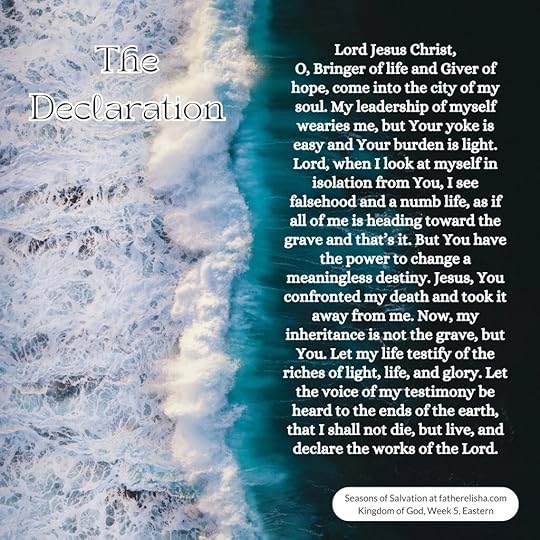
Photo by Ivan Bandura on Unsplash
The post October 6–12, 2024 (Eastern): The Declaration first appeared on Father Elisha: Let me take you on an intriguing journey..