Washington Irving Is My Hero, and Not Just for Adding to Two of My Lists with a Single Passage
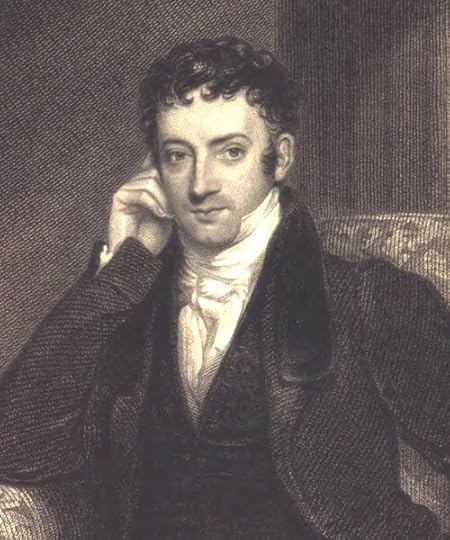 Washington Irving (1783-1859)I have amused myself, during a snowy day in the country, by rendering ["The Grand Prior of Minorca: A Veritable Ghost Story"] roughly into English, for the entertainment of a youthful circle round the Christmas fire. It was well-received by my auditors, who, however, are rather easily pleased. One proof of its merits is, that it sent some of the youngest of them quaking to their beds, and gave them very fearful dreams. Hoping that it may have the same effect on your ghost-hunting readers, I offer it, Mr. Editor, for insertion in your Magazine.-- Washington Irving (writing as Geoffrey Crayon), 1840
This week, with this a single passage, Washington Irving lengthened two of my TARDIS pages. (On this site, TARDIS stands for Trusted Archival Research Documents in Sequence. I’ve heard tell that, elsewhere, the same acronym indicates a not entirely dissimilar mode of time-travel.)
Mr. Irving’s Second Contribution to the First OneThe first page is the Fireside Storytelling Descriptions & Depictions TARDIS. This page features written and visual “snapshots” of the centuries-old tradition of telling spooky stories by the hearth on a stormy evening. Irving was already in this gallery, under 1819, with a passage taken from “The Legend of Sleepy Hollow.” I’ve now added this one, too.
On a side note, several people are engaged in reigniting this custom, and my own Tales Told When the Windows Rattle series of readings is part of that. Come to think of it, our widespread effort is something I should blog about more often. If I don’t, poke me in the shoulder, cross your arms, and give me a disappointed look. Clear your throat and tap your foot, too, if it comes to that.
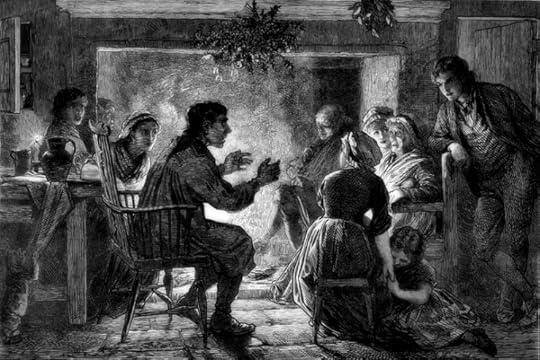 “A Ghost Story,” by George Thomas, from Illustrated London News 45 (Dec., 1864) pp. 44-45. Please spot the cat about to give everyone there a terrible fright. Mr. Irving’s First Contribution to the Other One
I added part of the very same passage to The Rise of the Term “Ghost Hunt” TARDIS. This list covers roughly a half-century of, well, pretty much anything that shows how people used “ghost hunt,” “ghost hunter(s),” and “ghost hunting” long before it became a familiar part of the paranormal investigation lingo we know today. In fact, I traced things back to the late 1700s/early 1800s. I didn’t know quite when to end this list, though, and Irving’s contribution strikes me as an excellent place to do just that. By 1840, the term “ghost hunt” had risen — even Washington Irving was using it!
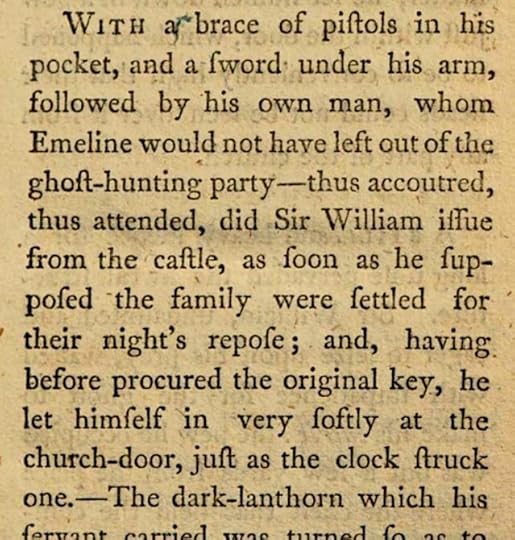 The second use of the term “ghost-hunting” in Elizabeth Gunning’s 1794 novel, The Packet.What If There’s More?
I can’t help but wonder what else Irving wrote that could go on, say, my Chronological Bibliography of Early Occult Detectives. In Tim Burton’s 1999 Sleepy Hollow, Ichabod Crane acts as an occult detective — but the “same” character decidedly does not in Irving’s 1820 work. I suspect many folks who have never read the original would be stunned by the differences between it and almost all of the film or television adaptations. Irving’s Ichabod is not a very likeable guy.
Or might the great author qualify for The Ghost Hunter Hall of Fame? If anyone knows if Irving did indeed go on something like a ghost hunt, please let me know! His fictional character Dolph Heyliger investigates a house said to be haunted in a twist-filled tale of the same name. But this ain’t the same fish as Charles Dickens wandering the streets of Cheshunt to find a house said to be haunted or Arthur Conan Doyle reinventing what happened during his investigation of a Charmouth poltergeist. Dickens and Conan Doyle are inducted into the Hall of Fame. But I have a hunch that, if Irving ever had gone on a ghost hunt, I’d have stumbled across it by now.
That said, I only very recently stumbled across the passage on the far end of this post. Who knows? Until something happens, feel free to visit
The Fireside Storytelling Descriptions & Depictions TARDIS,The Rise of the Term “Ghost Hunt” TARDIS,The Chronological Bibliography of Early Occult Detectives, orThe Ghost Hunter Hall of Fame.— Tim