A Quick Guide to Slasher Movies
While a sizable chunk of the horror genre features crazed murderers stalking and killing victims, the term ‘slasher movie’ has evolved to encapsulate a group of movies that conform to a specific set of rules. Emerging in the late-seventies and reaching a boom period in the eighties, slashers usually feature a group of teenagers being stalked and slain by a masked killer in an isolated location where help is unavailable. The ‘final girl’ motif is often mentioned (although possibly overstated) in reference to a wholesome female protagonist who outwits the killer and survives while her more promiscuous friends meet grisly ends.
Alfred Hitchcock’s Psycho (1960) is an early influence on the genre but isn’t really a slasher for a couple of reasons. It doesn’t involve a group of teenagers and, aside from Janet Leigh being butchered in the notorious shower scene, the movie is more of a psychological thriller with only one other character being killed onscreen. Other crime-mystery movies like The Bat (1959) and Peeping Tom (1960) contain slasher elements and the Italian giallo movement (named in reference to the yellow covers of crime fiction books popular in Italy) is a definite precursor to the slasher. Gialli like The Bird with the Crystal Plumage (1970) and A Bay of Blood (1971) are essentially stylish whodunnits which often include shots from the killer’s point of view and grisly murder set pieces which became staples of the slasher genre.
 Dario Argento’s giallo classic The Bird with the Crystal Plumage (1970) is considered a strong influence on the slasher genre.
Two movies in 1974 are often quoted as ‘proto-slashers’ or even slashers in the truest sense. The Texas Chainsaw Massacre and Black Christmas both deal with groups of teenagers being terrorized by a killer in an isolated location but it would be John Carpenter’s Halloween (1978) which truly established the genre. Featuring the masked maniac Michael Myers who escapes from a psychiatric hospital and returns to his hometown to terrorize babysitter Laurie Strode (Jaime Lee Curtis, the daughter of Psycho star Janet Leigh), Halloween shifted horror into the suburban backyards of the middle class and countless imitators followed.
By utilizing a specific date, Halloween started a trend with many copycats keen to cash in on the calendar gimmick. Friday the 13th, New Year’s Evil, Mother’s Day and Christmas Evil all emerged in 1980, followed by Bloody Birthday (1981) and My Bloody Valentine (1982). 1984 saw a further two Christmas themed slashers; Don’t Open till Christmas and Silent Night, Deadly Night, the latter igniting protests by incensed parents at the depiction of Santa as a bloodthirsty killer.
 John Carpenter’s Halloween (1978) introduced the world to Michael Myers and set the slasher movie in America’s backyard, igniting a slew of imitators.
 Another popular motif of slasher movies to the point of almost being another subgenre altogether is the ‘camp slasher’. Largely inspired by Friday the 13th (one of Halloween’s more high-profile imitators), summer camps became the stalking ground for many forest dwelling maniacs who butchered their way through groups of not-so-happy campers in Madman and The Burning (both 1981) as well as Sleepaway Camp (1983) and its sequels.
While many killers were simply psychos lacking much in the way of motive, some killed due to tragic backstories or the pursuit of material gain. A prank gone wrong motivates the killers in The Burning and Terror Train (1980) while strong competition between female performers lies at the heart of Curtains (1983). Many of the killers were surprisingly nondescript. The killer in Prom Night (1980) merely wore a ski mask and looked little different from your average bank robber while some killers didn’t bother with a mask at all. The demented drill-wielding fiend in Slumber Party Massacre (1982) does nothing to conceal his identity and the villain in Final Exam (1981) really is just ‘some guy’ with no backstory, mask or anything particularly noteworthy about him. Perhaps these movies were onto something in the way of presenting a more realistic killer who could be anybody in a crowd, but it was the masked killers like Michael Myers who really left an impression on the genre, and one mask in particular was about to become the most famous of them all.
 Jason Voorhees appeared in Friday the 13th Part 2 (1981) and donned his distinctive hockey mask a year later to become a slasher icon to rival Michael Myers.
Jason Voorhees may not have made his first appearance in the Friday the 13th franchise until the second movie (and even then, he wore a pillowcase over his head, not picking up his iconic hockey mask until Part III) but he would quickly become the focus of the series and an icon of the genre which had exploded in the early ‘80s.
Cheap and formulaic, slasher movies were easy to make and over 100 examples were released between 1978 and 1984, earning much controversy and critical derision. That was of no concern to their target audiences however, namely teenagers out for thrills, chills and high body counts. Paramount, a respectable studio, had expressed a certain embarrassment at the popularity of their Friday the 13th franchise and tried to kill Jason Voorhees off in Friday the 13th: The Final Chapter (1984) but didn’t count on that movie being one of the most popular in the series, igniting a second wave of sequels.
1984 marked a change in the straight-forward slasher formula which had saturated the first half of the decade. The release of Wes Craven’s A Nightmare on Elm Street with its star, Freddy Krueger; a knife-fingered bogeymen who murders teenagers in their dreams, revitalized the flagging genre and placed more emphasis on the supernatural and the use of special effects.
More talkative and wisecracking killers with supernatural backstories followed suit like Chucky in Child’s Play (1988), a talking doll possessed by the spirit of a serial killer. It was no longer enough to have a masked maniac as the antagonist. Now, the supernatural was more often then not behind the plunge of the knife. Maniac Cop (1988) featured a murdered cop come back from the dead for revenge and, despite Paramount’s attempts to bury the franchise, Jason Voorhees was brought back as a zombie in Friday the 13th Part VI: Jason Lives (1986) a movie so tongue-in-cheek it was almost a parody of itself. That same year, The Texas Chainsaw Massacre 2 also poked fun at the genre, a clear sign that slashers were starting to draw laughs rather than screams.
Despite a slew of Elm Street sequels, Freddy Krueger’s reign of terror was short-lived as he gradually morphed into a figure of fun than of fear and the series found itself on life support by the end of the decade. The Friday the 13th series was also struggling, despite efforts to mix telekinesis and a trip to Manhattan into the formula and the slasher genre limped into the nineties with an uncertain future.
 Wes Craven’s ‘A Nightmare on Elm Street’ (1984) gave the slasher formula an overhaul and introduced one of the genre’s biggest bogeymen, Freddie Krueger.
Occasional highlights aside (such as 1992’s Candyman), the early ‘90s was something of a dead zone for the slasher as audiences suffered genre fatigue and the juggernaut franchises dried to a trickle with ever diminishing box office returns. New Line Cinema (which owned the Nightmare on Elm Street franchise) had bought the character rights to Jason Voorhees from Paramount (but not the Friday the 13th title) and toyed with the idea of a Freddy-versus-Jason movie. Audiences would have to wait until 2003 for that, and in the interim endured the baffling Jason Goes to Hell: The Final Friday (1993). Meanwhile, Wes Craven returned to Elm Street with Wes Craven’s New Nightmare (1994); a self-referential slasher in which actors played themselves while Freddie Krueger, a fictional movie monster, seeps into the real world.
Strangely, Halloween, the movie which really got the genre up on its feet, never enjoyed as much success as a franchise as its rivals. After a lackluster Halloween II (1981), the series attempted to go in a different direction with Halloween III: Season of the Witch (1982) as it didn’t feature Michael Myers, wasn’t even a slasher and went largely ignored by audiences. Michael Myers remained in the shadows until the tenth anniversary of the original movie in which he made a comeback in Halloween 4: The Return of Michael Myers (1988) but its sequel the following year was less well-received. 1995 saw Myers return again in Halloween: The Curse of Michael Myers, a late attempt to provide a supernatural explanation for the killer’s apparent immortality involving a rune curse and a secret cult.
Wes Craven can be credited with revitalizing the slasher genre not once, but twice. As well as revolutionizing it in 1984 with A Nightmare on Elm Street, he gave it another shot of adrenaline in 1996 with Scream, a self-referential slasher focusing on a group of horror-obsessed teens and the ghost-faced killer who starts knocking them off. Smart and sexy, Scream was a massive success, bringing the slasher back from the grave but in a new guise. The slashers of the 1980s were notable for their low budgets and no-name casts, but the post-Scream slashers of the late ‘90s like I Know What You Did Last Summer (1997) and Urban Legend (1998) were a lot glossier, boasting bigger budgets and actors who were at least recognizable from popular teen TV shows of the time. Even the Halloween franchise got in on the action by bringing back Jaime Lee Curtis as Laurie Strode for a showdown with Michael Myers in Halloween H20: 20 Years Later (1998) that adopted the glossy Scream formula.
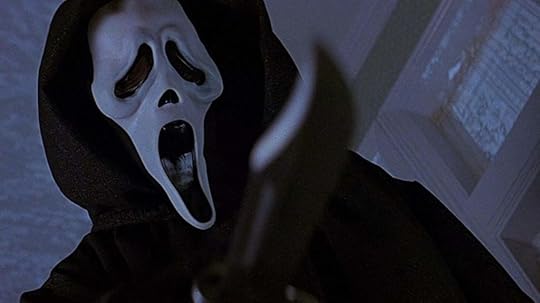 In 1996, Wes Craven revitalized the slasher genre yet again with Scream.
The slasher renaissance was short-lived, and, by the mid-2000s, it had deviated from the formula as the ‘torture porn’ subgenre emerged, typified by the Saw and Hostel franchises. In the late 2000s, remakes were the name of the game and pretty much every big horror movie of decades past got the reboot treatment, though were met with little approval by horror fans.
The slasher genre is far less prolific than it once was. A few gems stand out in the past ten to fifteen years like You’re Next (2011) and The Terrifier series which gave us our most recent masked manic in the form of Art the Clown. The Scream franchise chugs along with a new cast and now has six entries to its name and the Halloween series brought Jamie Lee Curtis back once again in yet another sequel confusingly called Halloween (2018) which was popular enough to earn a couple of follow-ups.
Nostalgia for the 1980s exemplified by the success of the Netflix series Stranger Things and a new adaptation of Stephen King’s It (2017) fueled several slashers which reveled in the genre’s halcyon days like Summer of 84 (2018) and X (2022), the latter of which spawned a prequel and a sequel to much acclaim. In a more comedic vein, The Final Girls (2015) and Totally Killer (2023) literally revisited the ‘80s via time travel plot devices.
Perhaps the most interesting slashers of the modern period are the ones that bend the rules of the genre or reinterpret the formula. Freaky (2020) has a final girl swap bodies with the killer and Don’t Breathe (2016) introduces its teenaged protagonists as housebreaking delinquents who get more than they bargain for when they try to rob an old blind man. It Follows (2014) doesn’t feature a killer with a knife but still presents a group of teens being stalked and slain by a supernatural something while playing with an interesting reversal of the chastity ‘rule’ of earlier slashers.
 A new kind of slasher? 2014’s ‘It Follows’ bends genre definitions but is considered by many to be one of the best slashers in recent years.
But where does the slasher genre go from now? As the original generation of fans grow increasingly older, nostalgia for the ‘80s can only carry it so far and, as movies like It Follows prove, the formula can be twisted so out of shape that genre definitions begin to seem redundant. But, with ‘legacy sequels’ like Scream (2022) riffing on the ‘90s slasher renaissance (just as the original Scream did on the ‘80s slasher boom), we can confidently say that the slasher is going nowhere. It might not be as common as it was, but if done right, it will always find an audience who eagerly await a mixture of old school scares and new takes.
If you love ’80s slashers, be sure to pick up my own humble entry in the genre – Twilight of Evil – available in print and for Kindle from Amazon, Godless, and a whole host of other places. You can also grab the prequel novella – Mountain Bike Massacre – for free here!