
Dormosedan, a sedative, for first shoeing
By Patty Wilber
I recently got two new colt starts, Ciroc and Rascal. They both got their first set of shoes over the past two weeks, and I used the sedative Dormosedan (detomidine hydrochloride) gel for both of them.
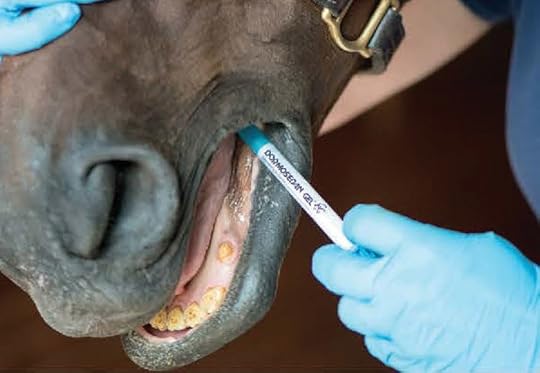
Photo from; https://www.americanfarriers.com/arti...
Dermosedan is a safe prescription sedative that can be given to a horse without veterinary supervision. The gel is squirted under the tongue about 45 minutes before shoeing and the effects last 90 to 180 minutes.
According to the package insert, “Dormosedan (detomidine hydrochloride) is a synthetic alpha2-adrenoreceptor agonist with sedative properties.” I used the AI tools Perplexity and Google Gemini to help understand what that means (because Chat GPT 4o would not give me references today).
“Synthetic” means the drug was artificially produced in a lab as opposed to being made from an organic source.“alpha2-adrenoreceptor agonist” indicates that Dorm binds to the alpha2-adrenoreceptors in the central nervous system instead of noradrenaline. When noradrenaline binds, the result is an increase in alertness, but when Dorm binds, there is a decrease in the nerve impulses normally triggered by noradrenaline, and the horse is sedated. Plus, any noradrenaline released after Dorm is given is prevented from binding because the Dorm is in the receptor.If a horse is already excited and keyed-up, Dorm does not work as well. That is because a keyed-up horse has a gob of noradrenaline coursing through its system, taking up a lot of the alpha2-adrenoreceptors. You can go ahead and give the Dormosedan, but it has less effect because it cannot bind to the receptors since the noradrenaline got there first.
The effects of the Dorm last 90 to 180 minutes because that is how long it takes most horses to metabolize the drug and flush it from their systems, freeing up the receptors for their normal molecule, noradrenaline.
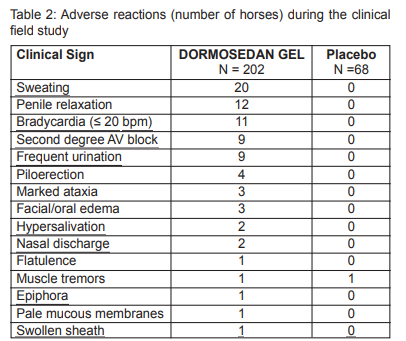
This sedative has minimal side effects. Over 200 horses were tested and “minimal adverse reactions, such as sweating, urination, salivation, flatulence, slow heart rate, and sheath dropping” were observed in less than 2% of the horses tested according to the Blue Ridge Equine Clinic.
In reading the drug package insert, I found a more precise breakdown.
So, why did I use Dermosedan on these two young horses? Mainly I did it for the farriers. The first set of shoes on a young horse can sometimes be a chore and I suspected that Rascal in particular was going to have trouble with his hind feet because he has just learned to be comfortable picking them up and letting me clean them. I basically used the Dorm to bribe the farriers. They were both (different farriers for each horse) grateful because the Dorm worked and both horses were really easy and safe to work with.
Three farriers I have talked to feel, based on their experiences, that Dormosedan does not inhibit learning. That would be nice because using Dorm definitely keeps a horse calmer, and thus the memories a horse would have of the shoeing would be calm and drama-free.
Research on memories made by Dormified horses, however, is scant. When horses are sedated, it is thought that memory formation is indeed impaired, though it depends on the degree of sedation and the individual horse. It would be a bummer if Ciroc and Rascal got through their first set of shoes with no recollection of anything because then the second farrier visit would just be ground zero. Let’s hope that both horses do remember a thing or two from their first shoeings because eight weeks from now, (with more hoof-handling by me in the interim), we are going Dorm-free.


