W.E. Ord: An Early Proponent of the “Ghosts as Detectable Energy” Theory
I’m far from an expert on how ghosts are understood in our present age. However, the array of equipment used by paranormal investigators, from EMF meters to EVP recorders, seems to suggest that the goal is to detect is some form of energy, from electromagnetic to psychic. In addition, I have noticed in my brief encounters with paranormal investigators that the word “energy” is often spoken. I sense it’s important an important part of ghost-hunting vocabulary these days.
However, in my research into the long history of ghost-hunting, I haven’t run into many sources that use that term. That’s why I was very interested to find an 1897 essay titled “A Scientific View of Ghosts,” in which W.E. Ord mentions energy by name while indirectly endorsing the use of “ghost-hunting tools.” After noting how our unassisted senses allow for only fleeting and possibly illusory glimpses of spectral phenomena, Ord explains that special equipment, from photographic cameras to magnetic compasses, might be tapping into the ghostly realm. He writes:
Recent science has shown that there is probably a world of energy and matter hidden from our ordinary senses, of which we can only conjecture from the suggestions obtained when the photographic plate records more than the human eye is ever capable of seeing or the magnetic needle responds to an influence quite unfelt by our dull senses. Now it may be that it is in such a hidden world that ghosts have their existence — spirits finding a dwelling-place in forms as much material as those of ordinary human beings but of an essentially different, and perhaps more ethereal, character. Into their hidden world of peculiar and unknown energy, mankind cannot usually enter, but at critical times in a man's life, corresponding to the fitful and occasional appearances of ghosts, his senses may be abnormally developed, so that — as with the photographic camera — he sees more than his eye is ordinarily capable of seeing, and may become conscious by sight, or hearing, or touch, of that hidden world in which ghosts live, and move and have their being.On the one hand, there’s not a lot in Ord’s essay that is remarkably new, even in 1897. Essentially, Ord seems to be saying that, at times, almost anyone can temporarily become a “ghost-seer” (or a medium or a psychic or a sensitive, etc.). He illustrates this by referring to “crisis apparitions,” which involve someone perceiving the spirit a loved one at the moment of that person’s death, and these experiences had been discussed at least since 1859.
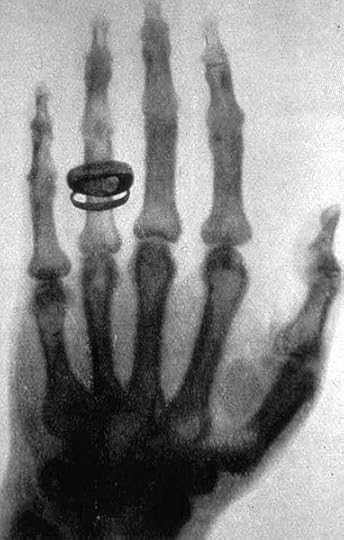 Albert von Kölliker’s hand, an X-ray taken in 1896 by Röntgen
On the other hand, what I find interesting is Ord’s implication that cameras and even compasses extend our perception into the “hidden world of peculiar and unknown energy,” possibly wherein spirits dwell. (Crisis apparitions, he posits, grant a peek into that world.) When he refers to cameras, by the way, I doubt he’s suggesting spirit photography. It was too controversial, too fraught with fakery, and not exactly the “[r]ecent science” Ord mentions because it had been around for over three decades when the essay appeared. Instead, he probably means X-rays, which had been detected only a couple of years earlier.
It might be interesting to chart how the use of perception-extending equipment — or what I probably shouldn’t belittle as “ghost gizmos” — came to overtake the sit-and-wait nocturnal surveillance method that ghost hunters had relied upon for centuries. Ord’s essay seems to have a place in the roots of that development. (And if you’re interested, so does the “ululometer,” which I discuss here.)
— Tim