“Did he or didn’t he? This excellent book suggests not!” Review of Philippa Langley’s “The Princes in the Tower”
It’s been another busy few weeks, or indeed months, for me. I can’t believe that it’s already March and spring is tentatively rearing its head here in the Yorkshire Pennines. Snowdrops are going over, and miniature daffs (and even the full-sized ones) are sun-shining in our garden (which is just as well, because the real sun has been mostly absent this past week).
Last week I visited an old friend in Belgium, who has over recent years driven me to various locations for book research, and very kindly did again. This time the destination was Binche castle, at one time owned by Margaret of York, Dowager Duchess of Burgundy. The reason for visiting? That it may have been somewhere Richard of England stayed during his time with his aunt Margaret.
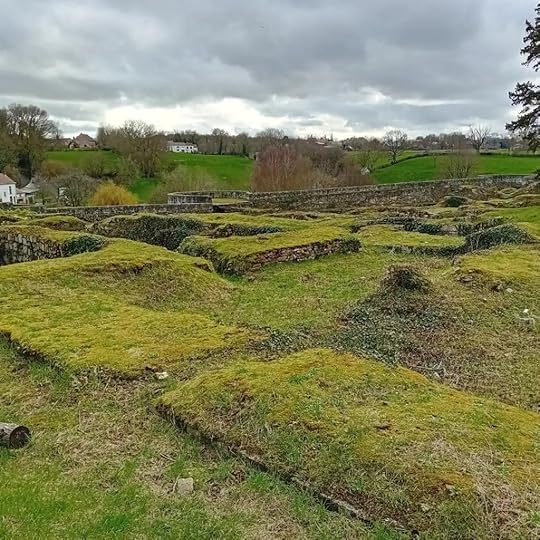 The remains of Binche castle
And the reason I’ve been so busy over the past few weeks/months? First, I’ve been working towards publication of my work-in-progress (working title ‘The Mystery of Coultry Tower’ – see my previous post), hopefully this summer. And, second, I’ve been wrestling with the challenge of deciding what book to write next.
I’ve enjoyed writing a contemporary-set book with historical elements, but without the constraints imposed by writing historical fiction based on real events. But with so many readers of my ‘White Boar‘ books asking me in person or in reviews to tackle the thorny issue of so-called ‘Perkin Warbeck’ aka Richard of York/England, and/or tell the future lives of Matthew and his friends, I’ve had a lot to consider. And I have to admit, though the idea of telling such a story is pretty daunting, it’s also very enticing. Wouldn’t it be nice to ‘complete the set’ – to tell, for younger readers, the stories of both pretenders/both sons of Edward IV, so important to the overall legacy of King Richard III – the task I set myself all those years ago?
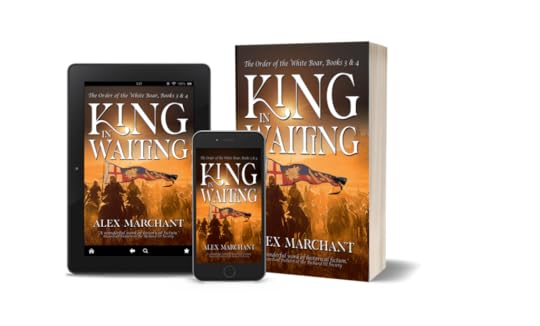
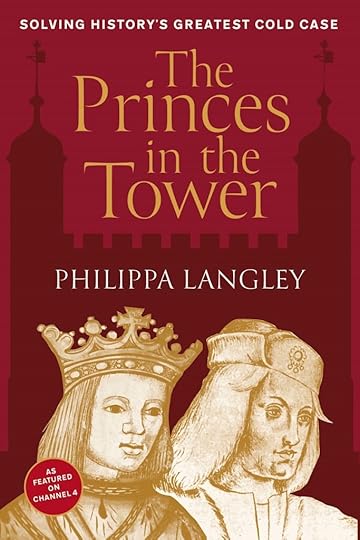
Vital to my decision-making has been publication of Philippa Langley’s new book, The Princes in the Tower: Solving History’s Greatest Cold Case. I’ll make no secret of the fact that I delayed making my decision on whether to embark on a new ‘White Boar’ book until after I read it – and found out about the new material that has come to light about whether the ‘princes’ survived. Throughout the writing of King in Waiting and Sons of York I was well aware that the Missing Princes Project was underway and might discover information that could turn my premises upside down. If you’ve read the books, you’ll know that I take the view that both sons of Edward IV survived, and the elder (Edward V) returned as the Dublin King (who has gone down in Tudor-led history as the imposter ‘Lambert Simnel’).
Imagine my relief when, not only was my basic premise not overturned, but at least one document had been found that supported the theory about Edward V being the Dublin King!
So – should I write the story of the younger boy, Richard of York, or not?
This isn’t the time to let you know where my deliberations are going (though you may have a clue already from recent posts on Facebook and Instagram). Rather I thought I would share with you the review I’ve written on Philippa’s book for posting on Amazon. If you’re in any doubt about reading this book, maybe this will help you decide. It’s certainly been helping me in making what could be a very important decision!
The review can also be found on Amazon
Did he or didn’t he? This excellent book suggests not!
“History’s greatest cold case” – did King Richard III murder the so-called “Princes in the Tower”? After this incredibly researched book, it seems increasingly unlikely that he did.
For centuries English law has insisted on the principle that a person should be deemed innocent until proved guilty, but strangely it’s taken more than 500 years for this to apply properly to Richard III. A number of mock trials in recent decades have found him “not guilty” of the worst charges levelled at him by Tudor chroniclers and later historians – the murders of his two young nephews, usually known as “the Princes in the Tower” – but still many historians stick to the line that he must have done it. But surely no more, following this landmark publication.
“The Princes in the Tower: Solving History’s Greatest Cold Case” presents the interim findings of the Missing Princes Project – eight years (so far) of reconsidering every piece of “evidence” known that could be used for the prosecution of the crime or for the defence – plus investigation of as many archives as possible containing documents from the relevant time period. Established by Philippa Langley, who was the driving force in the quest to find King Richard’s grave in Leicester, the multilingual Project team followed every relevant line of investigation that they could, and new discoveries from those archives, on the continent in particular, include four remarkable documents new to English-language researchers.
These documents are remarkable as they appear strongly to support the possibility that the two boys survived after Richard’s death at the battle of Bosworth in 1485 – contrary to the “official” Tudor story – and that they returned as the improbably named pretenders, Lambert Simnel and Perkin Warbeck. At the very least, the documents, together with mounting other evidence of the boys’ survival, undermine the prosecution “case” for their murder by King Richard.
Philippa Langley’s clear, dispassionate dissection and discussion of both old and new evidence – comprehensively referenced throughout – presents both cases, for and against, at length, beginning with the evidence for the prosecution. This is shown to be primarily rumour and hearsay, mostly recorded years or decades after the events in question, and often by individuals who had their own particular agendas, usually political. The latter charge could be levelled at much of the evidence for the “defence” too – supporters of both pretenders may well have had an interest in stirring trouble for the new king of England, Henry Tudor, especially Margaret of Burgundy, the boys’ aunt and stalwart supporter of the rival House of York. Yet when seemingly insignificant records such as receipts and household accounts – including those of Henry Tudor himself, records not conceivably aimed at propaganda or persuasion – name the boys as Edward son of Edward IV or Richard, Duke of York, and when the huge sums of money spent by various European rulers on backing their claims are taken into account, it does seem that such support may have had a firmer foundation than simply a desire to cause problems for a king with a sometimes shaky hold on his crown.
For me the weight of evidence has now shifted firmly to the defence. It may not yet be “beyond reasonable doubt” that the boys survived King Richard’s reign, although I personally think the evidence taken all together and laid out clearly in this book is very compelling. Does the book actually do what it says in its bold subtitle and solve “history’s greatest cold case”? Not 100 per cent perhaps. But with more investigations by the Project underway and more revelations likely, it may well not be too long before this 500-year-old mystery is finally solved. And it will all be due to the incredible efforts of Ms Langley and her team, and the other open-minded historians on whose work they’ve built over many years.
If you enjoyed and were intrigued by the recent Channel 4/PBS documentary based on the findings, do take a look at this book. There’s so much more to explain why the findings are so significant, and so much more background to the controversial story outlined. It’s a sizable volume, but don’t let that put you off. The prose is straightforward and very readable, whether or not you know a great deal already about King Richard and the enduring mystery of what happened to his nephews.
Philippa’s book can be bought at all good bookshops or via Amazon: https://www.amazon.co.uk/Princes-Tower-Solving-Historys-Greatest-ebook/dp/B0CHBL4HS3/
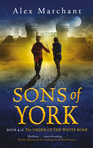
Alex Marchant is author of two books telling the story of the real King Richard III for children aged 10+, The Order of the White Boar and The King’s Man, and a third in the sequence, King in Waiting, which continues the adventures of the young members of the Order in the following years. A fourth book, Sons of York, was published in June 2022 and offers a ‘plausible theory’ for the fate of the ‘Princes in the Tower’.
Alex is also editor of Grant Me the Carving of My Name and Right Trusty and Well Beloved…, two anthologies of short fiction inspired by King Richard, sold in support of Scoliosis Association UK (SAUK).
Alex has also published a standalone timeslip novel for readers aged 10+, Time out of Time, relating the adventures of Allie Turner through a doorway into history found under layers of old wallpaper at ancient Priory Farm.
Alex’s books can be found on Amazon at: author.to/AlexMarchant
My Twitter handle and Matthew Wansford’s
Instagram: AlexMarchantAuthor
GoodReads: https://www.goodreads.com/author/show/17175168.Alex_Marchant
Linktree: https://linktr.ee/alexmarchantauthor