The Sword of Kaigen is the best standalone fantasy novel of all time
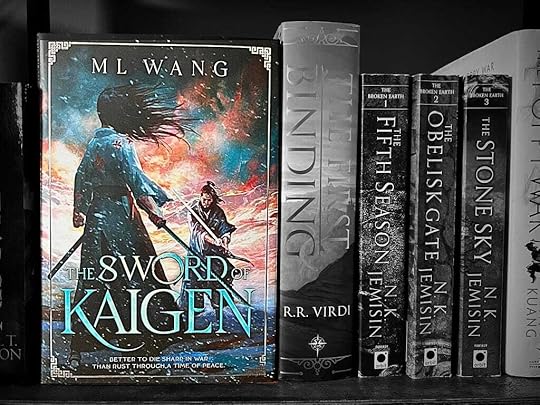 My special edition copy of The Sword of Kaigen by M.L. Wang
I know saying a book is the greatest of a particular genre is a big claim, especially because “best” is subjective. But give me a chance to make my case.
I read a lot of fantasy books every year. I love a chunky epic with multiple nations, big battles, and interesting magic. More than anything, I like character-driven stories. I think fantasy and science fiction gives us a chance to explore themes and situations in ways that literary fiction cannot.
However, after reading 100+ fantasy books, I’ve noticed that it is rare to get a book that can have a huge, epic world with amazing action and well-developed, complex characters without it being a long series.
Before you throw “Game of Thrones” at me, let me cut you off there. I love A Song of Ice and Fire (for the characters), but it doesn’t have what I would call “epic” battles. It has… battles. Sure, they are fun, but they aren’t magic-sword, world-shaking, dragon battles (at least not in the books that have been released so far).
For the series that do have those things like Wheel of Time, Stormlight Archive, and The Faithful and the Fallen you have to dedicate thousands of pages of world-building, character development, and context to hit the mark.
Simply put: I didn’t think it was possible to have amazing character work and epic, fun magic in a standalone novel.
Until I read The Sword of Kaigen by M.L. Wang.
So, give me a chance to convince you that this book is worth reading.
M.L. WangM.L. Wang is a martial artist and self-published author who started with her Young Adult series “Theonite.” She describes it as heavily influenced by Avatar: The Last Airbender but inspired by Harry Potter. The Sword of Kaigen is an adult fantasy novel set in the same world (although you don’t need to know anything about Theonite to enjoy SoK).
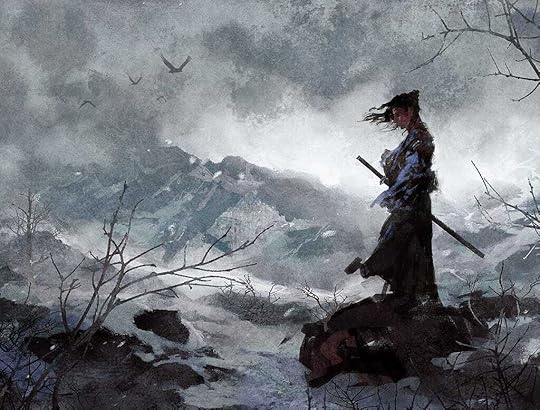 Interior art in The Sword of Kaigen // Félix Ortiz
In an interview with The Fantasy Book Critic, Wang talks about her inspirations for the series and what surprised me the most was that she doesn’t read much fantasy herself.
“Here’s the part where I have to admit that I don’t read much fantasy, or indeed much at all. I know that everyone and their mom insists that you need to read in your genre constantly in order to be a good writer, but that had better not be true because reading has never been part of my writing process. I very occasionally listen to fantasy audiobooks… but when I read with my eyeballs, it’s almost always history books.
The world is full of fantasy based on other fantasy, meanwhile, there are whole real-world cultures that go unexplored in modern SFF. I have a tragically limited attention span for reading — just ask any of my grade school teachers, I was the worst — so when I am able to read, I prefer to put that energy into the neglected histories of our own world. If these count as literature, I would cite the Kojiki, the Nihon Shoki, and The Tale of the Heike as influences for The Sword of Kaigen.”
M.L. Wang majored in history, so it’s no surprise that she draws a lot of influence from historical events. What’s more interesting is how she uses history to create her fantasy world.
Kaigen is an imperial nation in the world of Duna. The “Sword” of Kaigen refers to a peninsula that serves as the first line of defense against the Ranganese, the technologically more advanced nation at war with Kaigen.
From the beginning, you’ll see Kaigen is very heavily influenced by Japanese and Korean cultures. From the attire to the architecture to the honorifics used. This is certainly not the first book to do that, but what I found the most refreshing is the use of technology and traditions.
This is a modern fantasy novel filled with cell towers, airplanes, and more. The peninsula that serves as the “Sword” of Kaigen though is anything but a “modern” nation (I put in “modern” in quotes since that term is subjective).
Students train with swords and martial fighting techniques even though guns and air bombers exist. There is no internet or connection to the outside world other than antenna TV and radio. No major roads and one of the first conflicts of the book is whether or not they should construct a cell tower in the region.
I read some reviews where people called this out as odd. “Why would a prosperous nation let itself fall behind on purpose?”
In that above interview, Wang touches on this a bit:
“…to me, one of the most interesting things about the modern world is the interplay between traditional lifestyles and new technology. Some of the Japanese officers who shot at my relatives during World War II carried katanas. I’ve been to mountain villages in central Africa where men headed out to hunt with spears in their hands and iPhones in their back pockets. The mutual exclusivity some people imagine between swords and cell phone towers is a product of genre, not reality.”
The result is a refreshing setting for a fantay novel that feels completely plausible.
History shaping stories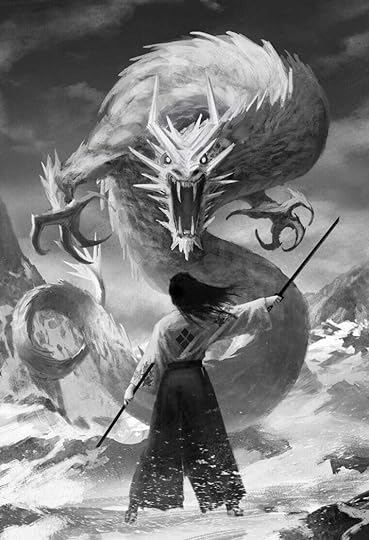 Misaki (The Sword of Kaigen Wraithmarked Special Edition) // Félix Ortiz
If you’re wondering what piece of history shaped the plot of The Sword of Kaigen, you’d have to research the “Nanjing Massacre” during the Second Sino-Japanese War. The same event inspired parts of The Poppy War by R.F. Kuang (another one of my favorite series).
The difference here is that the power structures in The Sword of Kaigen are flipped.
“The underlying premise of Planet Duna is that it takes the racial hierarchies of our own history and flips them, giving the reader a chance to walk a mile in someone else’s shoes. In Theonite, ‘Europeans’ (Hadeans) have been colonized by ‘West Africans’ (Yammankalu). In The Sword of Kaigen, the ‘Chinese’ (Ranganese) do some genocide in a ‘Japan’ (Shirojima, Kaigen) ruled by an Imperial ‘Korea’ (Jungsan, Kaigen)”
We follow a Japanese-inspired nation that is the victim of one of the biggest tragedies in modern warfare, rather than the perpetrators. You might be quick to think this is some sort of wish fulfillment or revision of history, but the appreciation of modern Japanese culture and the complex history of Japan and China is something M.L. Wang struggles with.
“My mom is American and my dad is from Jiangsu, China. For those unfamiliar with Eastern World War II history, Jiangsu is the province where the Nanjing Massacre happened. Growing up, I had a weird relationship with Japan — basically trying to reconcile my fondness for modern Japanese culture and people with the genocide that affected the previous generation of my family and left a scar on the collective Chinese psyche.
… fiction is the way I process reality. This was all a coping mechanism of my teenage brain.”
We see the characters in The Sword of Kaigen struggle with similar conflicting feelings. Matsuda Mamoru feels betrayed by his country and has a strong resolve to protect and preserve it. His father, Matsuda Takeru, wrestles with his own complicity, blind faith, and nationalism in the face of mass tragedy.
Then there is Misaki…
Matsuda Misaki is one of the best fantasy characters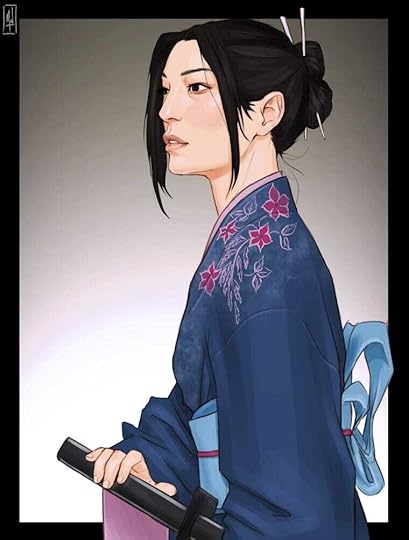 Misaki (The Sword of Kaigen) // Merwild
Although the story starts by focusing on Mamoru (the teenage son of Misaki and Takeru), the character that sees the most growth is absolutely Misaki. She is one of the few characters that kept popping into my mind months after finishing this book and it would be impossible to talk about everything that makes her so memorable without completely spoiling this novel.
She is in her thirties, her life of action and fighting is behind her, she’s in an estranged, emotionless marriage, and she has no clear goals when the story sets out. By all definitions, she shouldn’t be an interesting protagonist. Even M.L. Wang says “She is, from a utilitarian perspective, the worst-designed protagonist for an action story.”
So, why am I even talking about her? Wang discusses this in a blog post:
“…when I first outlined The Sword of Kaigen, I thought that I was embarking on a simple novella-length story about a simple mother and her oldest son. However, when I started writing Misaki in her restrictive kimono, in the cold halls of her husband’s house, I realized that there was a more complex character in that little housewife. That complexity sprang from the sheer contrast between a reckless teenager sprinting across rooftops and a poised mother of four. My now-adult writer’s brain recognized that there must have been a period of transition between the spirited teenager and the housewife of infinite patience — and that that transition could not possibly have been painless. …Misaki loved her old life, loved fighting, yet she left it behind at the age of nineteen to marry a man she didn’t love at all. Logically, that decision had to be a source of regret. And the Matsuda family, with their cold aura and repressed emotions, is a place where that kind of regret could only fester and grow in silence.”
Unlike the other people in Kaigen, Misaki has traveled the world and does not have the same reverence for the empire as the rest of her community. She spent the first decade and a half of her arranged marriage resentful, which led to a distance not only with her husband but her children.
When her son begins to question the history he’s been taught, she defaults to the complacent, emotionless respect she’s been living with for years.
As the story progresses (I won’t spoil it too much), we see Misaki not only step into her role as a mother, but begin to take pride in her own history and what she can teach her children. As the stakes get higher and higher, we see a woman who is strong not just because she spent years training, but because she begins to fight for something she believes in.
“Wholeness, she had learned, was not the absence of pain but the ability to hold it.” — The Sword of Kaigen
There is a grueling action scene where she is the last line of defense against soldiers invading her home to get her children as her husband (one of the most powerful men in the world) is fighting off an entire army.
And when I say “grueling” I mean it. It’s not the typical action scene you’d expect from an epic fantasy novel — it literally takes place in a kitchen. It is the closest thing to a John Wick scene in a novel I can think of.
Misaki goes through a lot and I would say that a major theme of this story is righting your own wrongs and learning to live with a new reality. The characters — from naive Mamoru to stubborn Takeru — each recognize hard truths in themselves and the world around them.
But this is also a story about parenthood and I think this story hits differently if you have children or someone dependent on you. Because it’s not just about hard truths, but swallowing your pride in the face of those truths to create a better world for the ones you care about.
The Action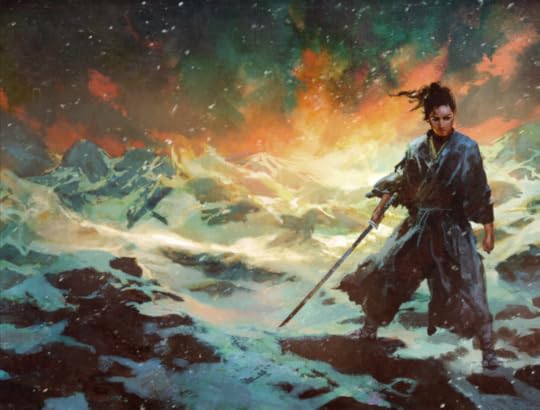 Mamoru from The Sword of Kaigen, art by Félix Ortiz
One thing I see pop up a lot in reviews on Goodreads and YouTube is people saying that “the climax is in the middle of the book!”
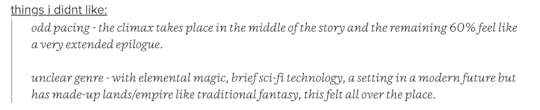 Review screenshot from a prominent book review with 42k followers on Goodreads
What they’re referring to is the epic, magic-filled, bare-knuckled, martial-arts-inspired, brutal battle when the Ranganese army invades Kaigen.
But that is not the climax because that’s not what the story is about.
This is a story of grief and of a community dealing with tragedy in the aftermath of an invading army. So although that epic battle is a lot of fun to read and the type of thing you’d expect to close out an adult fantasy novel, it is not the climax.
The climax is Misaki finally facing her husband, standing up for what she believes in, and repairing her family. The ice dragons are just cool set pieces.
Should you read this?There are definite trigger warnings: sexual assault and violence against children. Although they aren’t egregious as parts of The Poppy War (which references the same historical event), it can be very hard to read.
But if you like fantasy novels and character-drive stories, I would say yes. This is one of the few books I’ve purchased multiple times (first on my Kindle, then again with the special edition). It’s the rare standalone fantasy gem and it is worth every page.
Plus, it’s always good to support an indie author!
[image error]