
It’s a Mod, Mod, Mod World
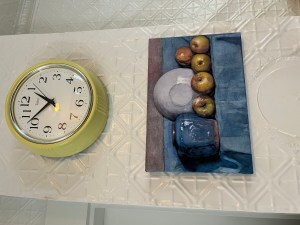
 A couple of months ago, I was scrolling through my Facebook feed (always a mistake, but better than that hellscape which is now the ominous X), when I came across this painting. It engaged me immediately: the sheen on the jar and dish, the imperfect apples grown long before they got sprayed to waxy and bug-free oblivion. I looked at the caption and was stunned to see Mondrian was the artist.
Now, we all think of Mondrian as the line and primary color guy whose grid paintings sell for millions, even though any kid with a ruler and poster paint could replicate the same thing in about 15 minutes. (The painting below was sold for $51 million in 2022!!!) But he wasn’t always a “modern” artist. It made me wonder about his artistic journey, so I fell down the usual rabbit hole of research.
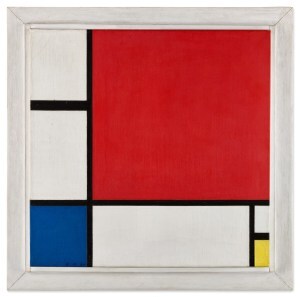
Mondrian eventually distilled everything down to what he considered the very basics, thinking his Neoplasticism created “universal beauty,” and that figurative reality wouldn’t lead to the true spiritual nature of art. His utopian philosophy is somewhat lost on me, since I much prefer his apples.
Times change. Rock, jazz, and rap are a far departure from classical music, and how did that happen? Architecture has swung from the magnificence of cathedrals to brutal glass and concrete blocks. Evolution (some would say devolution) of the visual and auditory arts is a fascinating thing if you think about it, but the written word stays relatively immutable. Stories have a beginning, a middle, and an end. We all learned that at bedtime many years ago. Words have meaning and weight, and most writers struggle to choose the right ones, even in a blog post. (For example, I just changed “correct” to “right.”) We need to be truthful, though 1984 territory seems perilously close in the wider world.
Yes, James Joyce messed around with structure (confession: I have never read Ulysses and am unlikely to at this stage of my life), and Kate Atkinson did something groundbreaking in Life After Life. Poetry is more elastic yet. Writers can use flashbacks, multiple points of view, creative punctuation, and tenses all they want, but most readers want something they can make sense of. (Fun fact: according to an art historian, one of Mondrian’s paintings has been hanging upside-down for over 75 years.)
I’ve evolved only to the extent that I started off writing romances, though my first love was mysteries (Judy Bolton, anyone?). Because I am not much of a plotter, I thought mysteries were beyond my capabilities. Maybe they are, LOL. But I’m working on my seventh anyhow, leaving 20+ historical romances behind me.
I’ve usually alternated points of view with the main characters. This time, however, I’m writing first-person, and finding it challenging yet fun. I’m really in the head of my turn-of-the-20th-century heroine. She is very much younger than I am, so I’ve got to be careful I don’t make her too mature/contemporary/jaded. Although it seems to me people were “old-headed” and more responsible at young ages in the past. Do you know the average age of a World War II RAF pilot was 20? Of those killed in action, the average age was 22. The world was saved by college kids. Let’s hope they don’t have to do it again. “We have come a long, long way, but we have a long, long way to go.” ~Martin Luther King, Jr.
Do you care who’s “talking” in a book? Read or seen anything lately that made you say “Wow?” What’s hanging on your kitchen wall?


Lea Wait's Blog

- Lea Wait's profile
- 509 followers

