Why you should read Hyperion
Hyperion by Dan Simmons is one of the greatest SciFi stories ever written and achieved that accolade by pulling from 14th century poetry.
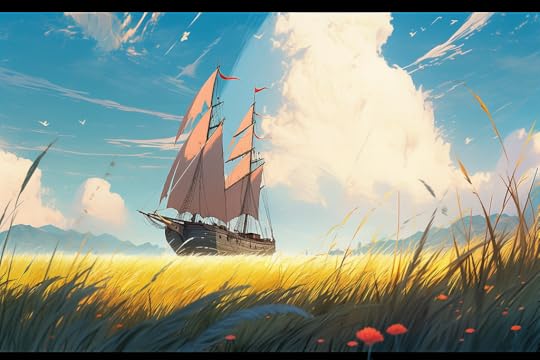 A sailboat saling across a seas of grass
“In the beginning was the Word. Then came the f****** word processor. Then came the thought processor. Then came the death of literature. And so it goes.”
What if I told you one of the best SciFi stories ever told was based on 14th century poem, didn’t have an ending, and had a villain named after a bird that could fit in the palm of my hand? There are a lot of reasons why Hyperion by Dan Simmons shouldn’t work but people are still discovering and talking about this book almost 35 years after it’s publication.
I’m not the biggest SciFi fan in general, doubly so for “classic SciFi.” So although I had heard great things about Dan Simmons’s “Hyperion” I was hesitant to read it. A lot of classic SciFi gets mired in over explaining, politics, technologies, etc. I crave character-first stories and a lot of times, I don’t get as much of that as in want with Frank Herbert or Isaac Asimov or Phillip K. Dick.
If you’re a literature nerd, you’ll probably love all the references throughout this book. Firstly, it’s named after the unfinished epic poem by John Keats (Hyperion) about the fall of Gods from Olympus. Keats is referenced throughout this book in both subtle and knock-you-over-the-head-with-a-hammer ways. Without getting too much into spoilers, a very topical part of this book talks about the use of AI to recreate personas from the past based on feeding it information. And so, an AI version of John Keats is created based on analysis of his works.
This part of the story feels more relevant today than it probably did in 1989 (I was 3 when this book came out, so I didn’t quite have my finger on the pulse of the AI debate back then). Humankind creates AI so advanced that the AIs secede from humanity and create their own government/organization known as the TechnoCore. Much like the AI we see today, most people don’t know how it works, what industries are influenced by it or what the repercussions are in the long term.
So what does that have to do with John Keats? Well, the AIs create “Cybrids” which are AI consciousnesses inside a human body. As a result, we get John Keats — an AI created from John Keats’s writing and journals inside a human body.
However, the poem that is much more prevalent in Simmons’s Hyperion is Chaucer’s 14th-century poem “The Canterbury Tales” — an epic poem (also unfinished) about a group of people from different walks of life going on a pilgrimage to the titular city of Canterbury. In fact, the ominous creature that haunts the world of Hyperion is named the “Shrike” — a bird that appears in Chaucer’s work as “wariangle” that roughly translates to “destroying angel” in Old English.
Much like Chaucer’s work, Hyperion is a story of seven people (and a baby) going on a pilgrimage to meet the mystical creature “The Shrike” that lives on the uncolonized planet Hyperion.
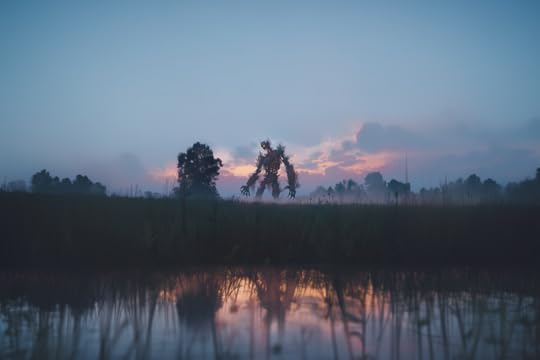
Shrikes (the bird) are often referred to as “Murder Birds” as they use spikes of thorn bushes and trees to impale insects, lizards and small mammals to consume later… That’s a real thing that actually exists in our world. A fitting name for mystical monster made of metal.
And like Chaucer’s Canterbury Tales, this pilgrimage is more of a vehicle to present multiple short stories that are loosely connected. This is where Simmons’s writing really shines. Each story is engrossing and uniquely told, even shifting between first and third person at times to emulate different authors of the genre.
The cast has to spend hours on ships sailing across grass seas and space elevators, with nothing to do but talk about how they ended up there. Pilgrims for this trip have to volunteer and only a small number are selected. Worst of all, they all know that only one person ever returns. So what type of person would volunteer for such a thing?
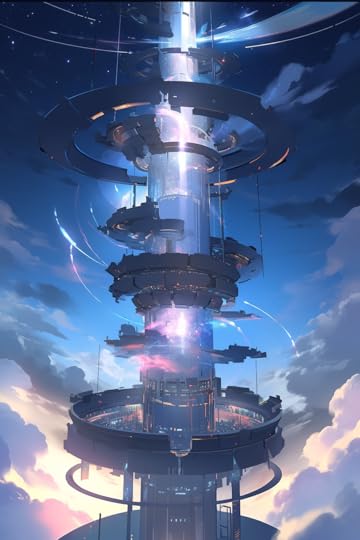 Space elevator
The most notable story was Brawne Lamia (her name coming from John Keats’s love Fanny Brawne and the eponymous creature his “Lamia and Other Poems”). Simmons tries to channel Cyberpunk author William Gibson, who was very influenced by the hard-boiled detective novels made famous by Raymond Chandler. In fact, Simmons even names Brawne’s section “The Long Good-Bye” in honor of Chandler’s award-winning novel.
This is the section where we meet Cybrid John Keats and how the influence of AI has shaped the galactic, political landscape. It’s also where Simmons poses some philosophical questions around what makes something truly “alive” that feels very relevant today.
Each story told here could stand on its own. Simmons does a wonderful job of laying the foundation of the world through the narrative voice of his characters and not through the prose sections between each story. It would have been easy to have a bunch of info dumping up front before jumping into each character’s story, but that would have felt forced.
There’s a lot more to unpack here but overall, knowing the background of this story can give you a better appreciation for the story as a whole. I gave this 5 stars — it really is that good as far as fantasy books go. It blends together multiple stories with clever worldbuilding, difficult philosophical questions, and memorable characters.
If you haven’t read it but enjoy SciFi, I highly recommend.
[image error]