Polynesia and Tahiti
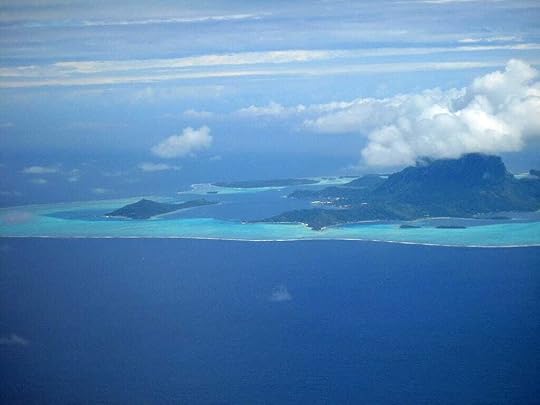 Bora Bora, French Polynesia.
The Pacific Ocean, more significant than all the Earth’s land masses, comprises more than 7,500 islands. The central regions are Melanesia to the west (New Guinea, New Caledonia, & Fiji) and Micronesia (Palau, Guam, and Marianas) in the middle. The third region is Polynesia, meaning “many islands,” and is the easternmost. These islands include Hawaii to the north, Tahiti, Samoa, and New Zealand to the south, with the Easter Islands the easternmost. The people of Polynesia are believed to have immigrated from China and Taiwan. They were thought to have island-hopped over centuries to Indonesia, Solomon Islands, Papua New Guinea, Australia, New Zealand, Society Islands, and finally around 500 A.D. to Hawaii.
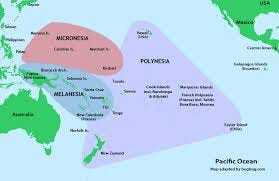 Human migration pattern from Melanesia, Micronesia, to Polynesia.
Stretching from New Zealand in the southwest and Easter Island in the southeast to Hawaii in the north, the Polynesian (“many islands”) Triangle spreads across a large swath of the central and southern Pacific Ocean and includes over 1,000 islands. Legendary sailors adept at navigating by the stars, Polynesians left their ancestral home of Taiwan sometime between 3,000 and 1,000 BCE. They began to explore and inhabit some of the most remote slivers of land on Earth.
French Polynesia is renowned for its beauty and friendly people, but relatively little is known about its history. A marae is a Polynesian temple enclosure used for worship or sacrifice, the most important being Taputapuatea marae on the island of Raiatea. It dates to 1000 AD and is located at the heart of Polynesia. It is used for worship and as a community gathering for ceremonies and rituals. It was believed to be an area where the gods lived, and humans and the gods could interact. The marae was dedicated to the war god, Oro. The worship of this god was linked to human sacrifice, their skulls crushed with clubs.
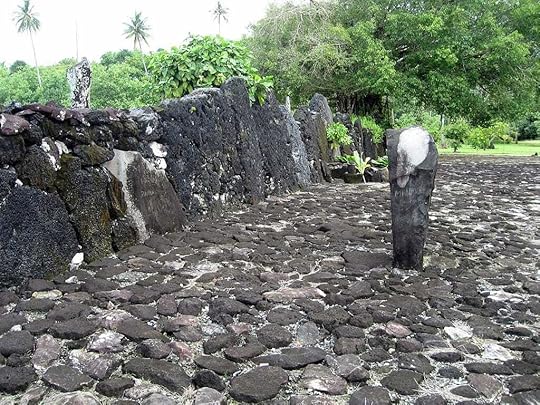 Taputapuatea marae on the island of Raiatea, French Polynesia.
Western explorers only recognized the cultures and beauty of these peoples living in their paradise in the late 18th century when explorers started bringing back reports of gorgeous beaches, tranquil blue lagoons, and loosely clad women. No Pacific locale is better at defining the beauty of Polynesia and its people than the islands of Tahiti.
Tahiti is a group of Islands that make up French Polynesia, also called the Society Islands. The first Polynesians arrived about 300 A.D. and settled in the Society Islands. It would be over 1400 years before European explorers arrived in the South Pacific, accompanied by their botanists and artists to detail their discoveries for their sponsoring countries. Commencing in 1767, these initial explorations to the Pacific and Tahiti generated many wonderful new and different interpretations of the world. These artists begot authors, who delivered more artists, and later photographers, to reveal the islands’ animals, plants, and peoples of these South Seas. Understanding the magnetism that was Tahiti is different than any other island chain in the Pacific; an aura, an allure, attracted the artist’s souls from the Western world to this paradise.
[image error]