Editing: a fine art.
This is the ‘uncorrected proof’ of Rook, sent out a month or so ago by the team at Bloomsbury. Now I’m walking a knife-edge – there’s the hope people will love Rook and maybe respond with a word or two, and then there’s the fear no one will. Book cover ‘blurb’ from a well-known author will give a huge boost to a beginner like me. But imagine Rook on the bedside table of an author whose work I’ve read and admired for years? No. Best not to. Pretend it’s not happening. As Claire King has recently blogged, you can only hope people will be kind.
So far, I have found they are.
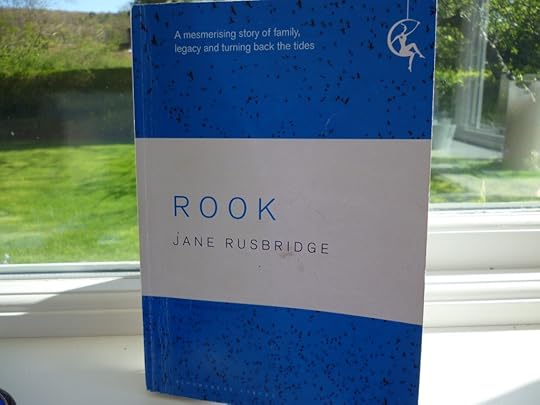
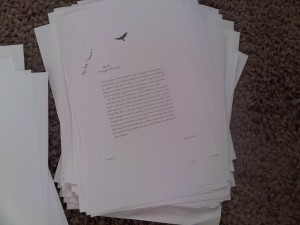
Page edits and last minute typos are still to be done before Rook is published in August; much ‘correcting’ – major and minor editing work, countless redrafts of scenes and sentences – has already been done, way too much to recount in detail here.
However, to follow on from Gerald Hornsby’s insightful post on editing a self-published novel , I’m going to outline the way the editing process proceeded for me, as an author published with Bloomsbury.
The beginning:
Late 2008: I’m a ‘myopic’ editor of my own work, changing a sentence as it emerges, fiddling endlessly with detail. As I wrote the first random scenes, I felt my way, word by word. In January 2009, I joined Kathy Page’s Workout for the Novel , an online course which gave me a kick-start, and more idea where the novel might be going. The course involved valuable input sessions as well as weekly online workshops. Feedback from Kathy and other writers raised questions and led to changes. And more editing.
Throughout 2009 there were monthly meetings, with an exchange of feedback with my long-term writing group of four, plus emails flying, in moments of crisis, to other writing friends, like Jackie Buxton. The novel progressed haphazardly. I’d imagined the final scene, but not how the characters would get there. In March 2010, I joined Vicky Grut’s Novelists’ Club , travelling up to London once a month for productive day-long workshops on various aspects of novel writing such as dialogue, plot and structure. With Vicky’s editorial help I worked on a chapter outline. Joined up a few dots. Finally, in August 2010, the very first draft of Rook was sent to my editor at Bloomsbury.
The middle:
I had no confidence in that first draft. It was all over the place. There’d been no ‘perfect storm’ moment which Aminatta Forna so accurately describes. I’d done plenty of line-by-line work, but there’s another aspect to editing a novel – a different skill – which involves being able to take an overview of the sprawling mass of words, to see how best to shape them. An experienced professional editor brings this invaluable skill into the mix. Having previously worked with Helen Garnons Williams on The Devil’s Music, I knew already how much creative energy can spark through the insight gained from a talented editor.
That first wobbly, raw-egg draft of Rook was in fact read by two editors, Helen and her assistant, Erica Jarnes. It was clear from the 7 pages of notes they put together that they saw straight through my chaos of stray plotlines right to the story’s pulse. It’s such a relief to find that your editor ‘gets it’. Helen and Erica ‘got’ Rook before I did, or so it seemed at the time. After a week or two to mull things over, I had some suggestions of my own, and Helen and I met to bounce ideas around. Afterwards, throughout the autumn of 2010, I wrote with clearer vision and renewed energy. Some peripheral drama was cut; one central character had to go. (I’d never liked him, which should have told me something.) This wasn’t tweaking but a major rewrite, one which revealed to me the core of the emotional journey I wanted the reader to travel.

During the spring of 2011, insomnia plagued me as I wrestled with interwoven narratives, secrets and memories, three feisty women characters, warriors and battle scenes from 1066. I was, more often than not, at my desk by 4.30 a.m., prodded awake my ‘wild mind’, as Natalie Goldberg calls it. The narrative came together with the exhilarating synchronicity many writers speak of as essential to the creative process – it’s certainly part of the magic. I was buzzing with excitement when I sent off the second full draft, in June 2011.
Editorial feedback was very positive. All that was needed in terms of structure was some adjustment to the penultimate chapter where fresh preoccupations of mine had crowded in at the last moment – actually the beginnings of novel 3 stirring in the compost of my mind. Out that came!
The final stages happen quite quickly:
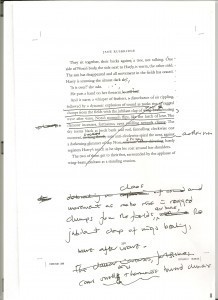
October 2011: The draft of Rook was sent to one of Bloomsbury’s copy editors, Audrey, whose meticulous mind helped sort out stray inaccuracies in TDM. Emails flurried to and fro between us for a few days, ranging over a variety of issues such as tying historical dates in with characters’ ages, whether to use ‘Cnut’ or ‘Canute’, and whether rooks eat carrion. In November 2011, a fat envelope arrived containing Audrey’s copyedit manuscript for my approval, with fortnight deadline for any changes to be marked on the pages or listed by email. Just before Christmas, page proofs landed on my doorstep, with another deadline the middle of January 2012. While I read these page edits, another editor at Bloomsbury was checking them too. Whoever it was found an error I’d never have noticed: I’d used ‘Robinson’s’ instead of ‘Robertson’s’ when talking about jam!
Fiction editors are important. They play a central creative role in the growth of a novel, or so I have found. At Bloomsbury, over a period of 18 months, my novel-in-progress passed through the hands of four different editors, all of whom helped shape the novel that will be Rook when it hits the shelves in August.
The View From Here literary magazine has interviewed Helen Garnons Williams, fiction editorial director at Bloomsbury
Part one: Introduction
Part two: Insights into working with authors and Helen’s advice and top three tips for debut authors.
Part Three: Helen discusses the ever changing publishing industry, working at Bloomsbury, and hopes for the future.
Share this on Bebo
Blog this on Blogger
Share this on del.icio.us
Share this on Facebook
Post this to MySpace
Tweet This!