The Real Story Behind The Exorcist Movie: The Exorcism of Roland Doe
One of the greatest horror movies of all time is based on true events. That thought should give everyone a moment's pause.
The Exorcist, both William Peter Blatty's 1971 novel and William Friedkin's 1973 movie, came a time in our history when people had stopped believing in the existence of the devil. A great time for the devil, a scary time for us.
Have you ever wondered how much is Hollywood and how much is real?
Spoiler ... It's a lot more reality than Hollywood.
 Here's the true story behind The Exorcist, taken from the notes of the exorcists priests, the eyewitnesses, the neighbors, friends, classmates, and the newspapers.
 You will find that truth is much stranger than fiction ...
This is a chapter in a larger book I wrote on the subject: True Catholic Exorcisms. Now, also an audiobook, narrated by BBC-veteran Alan Turton.
[image error] [image error] [image error] [image error]First off, it wasn't a little girl -- no Linda Blair. It was a little boy that was possessed.
Also, before diving into this, it's a good idea to pray the St. Michael prayer for protection:

Not Regan ...
Meet Ronald. Ronald Edwin Hunkeler was given the pseudonym, Roland Doe, by the original Washington, DC newspaper accounts of the possession in 1949. His real name wouldn't be revealed until his recent death in 2020, may he rest in peace.
Stay tuned until the end of the article for a yearbook picture of Roland.
Roland Doe,[1] 1949
The exorcism which re-captured the nation’s imagination – this is the exorcism which inspired William Peter Blatty’s 1971 horror novel turned movie, The Exorcist. Blatty, himself, heard rumors of the exorcism from the Jesuits priests of Georgetown University, while a student there as a member of the class of 1950.
Between1950 and 1971, many priests had begun dismissing the reality of the demonic,including many Jesuits. Merely metaphorical or social evil was preached fromthe pulpit. The Devil was just a personification of the evil within us. Demonsdid not exist. Psychologists and academics, even to this day, dismissed allsupernatural phenomena as superstitious nonsense.
Thisis why The Exorcist re-captured the nation’s imagination. TheDevil had succeeded, for a time, in convincing the world he did not exist.
MichaelCuneo discusses The Exorcist case atlength in the opening chapter of his book AmericanExorcism. Cuneo points out that the case was sensationalized. Some of thestory’s most basic details were changed. For example, the possessed child was aboy who lived in Mount Rainier, not a girl living in an upscale Georgetown neighborhood.
TheGeorgetown setting was due to the author’s personal encounter with the storywhile attending Georgetown University. Blatty’s time at Georgetown clearly madea lifelong impact: “Those years at Georgetown were probably the best years ofmy life,” Blatty said in a 2015 interview. “Until then, I’d never had a home.”
Projectilepea soup vomit and spinning heads were just literary embellishments. Once youhear the true story, however, you will wonder why any embellishment was neededin the first place.
Note:Unfortunately, the ridiculous quantities of green, projectile vomit were notmerely embellishments. Check out the chapter in True Catholic Exorcisms detailing the exorcism ofEmma Schmidt.

The Exorcist case is important not onlybecause of the extreme supernatural phenomenon on display. It’s important forthe impact it had on the American psyche. It is the single most familiar exorcismto the wider American public, whether or not people realize it was based on atrue story.
The Exorcist left an indelibleimpression on the world’s imagination more so than any other case of possessionever has. This is because it was thrust upon the world after several decades ofmounting disbelief in the existence of Satan.
AlthoughThe Exeter Report showed that fear ofSatan was already on the rise in England, exorcisms in America had declinedprecipitously. The United States had fallen into a deep sleep after its victoryover evil during World War II. Even the Pentecostals had tried to dampen theirmore charismatic deliverances.
Thelaunch of The Exorcist in movietheaters all over America released a flood of repressed fears. It had beensimple enough for the Devil to recede into the background of a world faced withnuclear annihilation and extinction. Then came the The Exorcist, and an ancient history of satanic awareness surged tothe foreground. Many people found themselves unable to cope with the sudden joltof religious revival, or at least the reminder of supernatural realities.
Thisresurgence in satanic awareness resulted in thousands of people suddenly fearingthat they or a loved one was possessed. Father Tom Bermingham, one of the film’sminor actors and a researcher for Blatty’s book, suddenly found himself swarmedby hundreds of requests from individuals seeking an exorcism.Exorcism and possession suddenly became mainstream, and the devil who hadbenefitted from being ignored and forgotten, now was suddenly benefitting frombeing a celebrity.
Forone thirteen-year-old boy,Satan had been a reality, long before the sale of the movie rights.
Firstoff, let’s get the location right.
RolandDoe, the pseudonym used for the possessed boy, is commonly described as being aresident of Mount Rainier, Maryland. At the time of the first exorcisms in 1949,Mount Rainier was a small, working-class community of nearly 8,000 residentsquietly tucked away in Victorian homes and bungalows on the outskirts ofWashington, D.C.
Eversince the early 1980s and the release of (the first) Exorcist movie, local teens have been flocking to a then-vacant lotat the corner of Bunker Hill Road and 33rd Street in the residential heart ofMount Rainier. Anurban legend, spawned by local newspapers, holds that this was the former siteof the house of Roland Doe.Prince George’s County teens have long delighted in roaming the lot at allhours of the night, drinking beer, conducting initiations, erecting woodencrosses on the property, and yelling and screaming until local police areforced to come and chase them away.
Alongwith several other sources, Dean Landolt, a lifelong Mount Rainier resident ofover seventy years, informed researchers that, “I was very good friends withFather Hughes, the priest involved in that case, as was my brother Herbert. FatherHughes told me two things: one was that the boy lived in Cottage City, and theother is that he went on to graduate from Gonzaga High and turned out fine.”
It’seasy to understand the confusion. Cottage City is an even smaller,semi-isolated community just a short distance from Mount Rainier. Cottage Cityis nestled between the towns of Colmar Manor and Brentwood.

DO NOT use Ouija Boards. Terrible idea.
Ina 1979 article for Fate magazine,Steve Erdmann includes the following description of events taken from a diarymaintained by one of the priest-exorcists, Father Bishop:
January 15, 1949—A drippingnoise was heard in his grandmother’s bedroom by the boy and his grandmother. Apicture of Christ on the wall shook and scratching noises were heard under thefloor boards. From that night on scratching was heard every night from 7 p.m.until midnight. This continued for ten consecutive days. After three days ofsilence, the boy heard nighttime “squeaking shoes” on his bed that continuedfor six consecutive nights.
Andin another description:
For some time prior to theexorcism [...] the unidentified boy had been tormented by a battery of bizarrephenomena: There were scratchings and rappings on his bedroom walls, pieces offruit and other objects were sent flying in his presence, and his bedmysteriously gyrated across the floor while he tried to sleep.
Whywere these things happening to the pseudonymously named Roland Doe? Was it justrandom? No, it appears the child’s aunt introduced him to the demonic.
RolandDoe was born into a German Lutheran family and was his parent’s only child. Sincethere were no other children in the family, Roland looked to his parents andother adults in his household for playmates. The boy spent much of his timewith his Aunt Tillie.Tillie was reportedly a “spiritualist”, which seems to indicate that she dabbledin witchcraft and other occult interests. She introduced Roland to the Ouijaboard.This is when the trouble began.
Avery detailed diary was kept by one of the priests that would later exorciseRoland. Under the heading January 26, 1949, the diary records the followingconcerning Aunt Tillie:
“Aunt Tillie,” who had a deepinterest in spiritualism and had introduced Roland to the Ouija Board, died ofmultiple sclerosis at the age of 54. Mrs. Doe suspected there may have beensome connection between her death and the seemingly strange events thatcontinued to take place. At one point during the manifestations Mrs. Doe asked,“If you are Tillie, knock three times.” Waves of air began striking thegrandmother, Mrs. Doe, and Roland and three knocks were heard on the floor.Mrs. Doe again queried, “If you are Tillie, tell me positively by knocking fourtimes.” Four knocks were heard, followed by claw scratchings on Roland’smattress.
Mrs. Doe also recounted using blessed candles whena comb flew across the room and extinguished them.Other observations include fruit flying across the room, a kitchen tableturning over, milk and food moving off a table, a coat and hanger flying acrossthe room, a Bible landing at Roland’s feet, and a rocker spinning around while Rolandwas sitting in it. Roland was also removed from school after his desk movedaround the classroom floor on its own.
The desk event left an indelible impression on oneeyewitness. Roland’s best childhood friend also recounted this event in detailin a 1998 interview with Mark Opsasnick:
One thing happened regarding all of this and I have a hardtime clearing it in my mind. We were in eighth grade, it was the ’48-’49 schoolyear and we were in a class together at Bladensburg Junior High. He was sittingin a chair and it was one of those deals with one arm attached and it lookedlike he was shaking the desk—the desk was shaking and vibrating extremely fastand I remember the teacher yelling at him to stop it and I remember he kind ofyelled “I’m not doing it” and they took him out of class and that was the lastI ever saw of him in school. The desk certainly did not move around the roomlike that book [Possessed] said, itwas just shaking. I don’t know if he was doing it or what was doing it becauseI just can’t clear it in my mind.
The diary also describes Mrs. Doe taking a bottleof holy water and sprinkling its contents throughout the house. When she returnedthe bottle to its shelf, it flew across the room on its own but did not break.
Another night, while holding a lit blessed candle atRoland’s bedside, Mrs. Doe experienced the whole bed rocking back and forth.
 The Tools of the Catholic Exorcist: Holy Water, Blessed Salt, and the Rosary
The Need for a Priest Accordingto American Exorcism by Michael Cuneo,the boy’s family initially requested the help of a Protestant minister, LutherMiles Schulze, but this only worsened the situation.
PastorSchulze had long been interested in parapsychology, and arranged for the boy tospend the night of February 17, 1949 in his home for observation.Schulze witnessed several disturbing phenomenon during this and subsequentencounters, including household objects and furniture moving by themselves.
BillBrinkley interviewed Pastor Schulz for an article for The Washington Post entitled “Pastor Tells Eerie Tale of ‘Haunted’Boy”.Schulz describes the as boy sleeping nearby in a twin bed. In the dark, theminister reported hearing vibrating sounds from the bed and scratching soundson the wall. Schulz also observed the boy sitting in a heavy armchair, which tiltedon its own and tipped over. While the boy was laying on them, a pallet ofblankets also inexplicably moved around the room.
Schulzesoon advised the boy’s parents to “see a Catholic priest.”The family then sought help from the local Jesuit community. Despite theirtheological disagreements with the Catholic Church, Protestants generallyacknowledge that priests are needed for the most difficult possessions.
Anyordained priest, with the blessing and permission of the local bishop, canperform an exorcism. Exorcisms, for that matter, are not all that rare.Elements of exorcisms are (or were once) incorporated into many Catholicliturgies, including the Mass and the Rite of Baptism, for example.
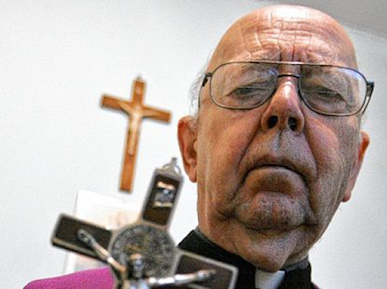 Father Gabriele Amorth, the foremost Catholic exorcist priest (now deceased)
 Nevertheless,the Church provides training for priests who are asked to specialize in exorcisms.This process is described by Father Gabriele Amorth, the designated exorcistfor the Diocese of Rome, in his book, AnExorcist Tells His Story. Father Amorth describes the benefit of specialtraining:
We cannot improvise anexorcism. To assign such a task to any priest is like demanding that someoneperform surgery after reading a textbook on the subject. Many, too many, thingsare not written in a text but are learned only through experience.
FatherAmorth also laments the decline of “the school” for training exorcists:
I am convinced that allowingthe ministry of exorcism to die is an unforgiveable deficiency to be laidsquarely at the door of bishops… Today the exorcist is seen as a rarity, almostimpossible to find… The Catholic hierarchy must say a forceful mea culpa. As a result of thisnegligence, we now have lost what once was the school; in the past, apracticing exorcist would instruct a novice.
Father Edward Albert Hughes(1918-1980) was a Catholic priest who served as an assistant pastor from June16, 1948 to June 18, 1960 at St. James Church in Mt. Rainier, Maryland. FatherHughes performed the first round of exorcisms on Roland Doe.
Just as Mrs. Doe had before him, Father Hughes isdescribed as experiencing supernatural events concerning blessed objects:
Hughes reported giving a bottle of holy water and candles toRoland’s parents to give to Roland before he went to sleep. The parents saidthe telephone table on which the holy water sat smashed into hundreds of pieceswhile the candle flamed up, torching the ceiling.
Shortly thereafter, it is recorded that FatherHughes received permission to exorcise the boy and the ritual was undertakenfirst and unsuccessfully at Georgetown University Hospital.
As discussed before, it is imperative that thelocal Bishop grant permission and authority to the presiding priest. It is notcertain whether Father Hughes received such permission. This may be the reasonFather Hughes was ultimately unsuccessful in exorcising Roland Doe. FatherHughes also only had a short time with the boy, and may have only attempted anabbreviated or informal exorcism.
The next attempt at exorcism would occur when theDoe family left Maryland for Missouri.
Dr.J. B. Rhine, director of the Parapsychology Laboratory at Duke University, reportedlydescribed the phenomena associated with the possession, the “most impressivemanifestation he has heard of in the poltergeist field.”
Despitethe best help of medical professionals, the situation continued to deteriorate:
When a natural cure wasn’tfound for his affliction, [...] and the bizarre symptoms threatened to ragecompletely out of control, it was decided to pursue a more drastic course ofaction. A Jesuit priest in his fifties was assigned to the case, and over thenext several weeks [...] he performed more than twenty exorcisms on the boy. Inall but the last of these, [according to an article in the Post] the boy broke into a violent tantrum of screaming, cursingand voicing of Latin phrases—a language he had never studied—whenever thepriest reached those climactic points of the 27-page [exorcism] ritual in whichcommanded the demon to depart. It was the last of the exorcisms, after two nerve-janglingmonths, that finally did the trick. Following its completion, the strangesymptoms disappeared entirely, and the boy was restored to full health.
One of the attending priests kept a meticulous diary during the boy’s exorcism. This diary was obtained by Blatty while he was researching The Exorcist and served as a major inspiration for the novel. The diary details many of the supernatural phenomena that occurred during the exorcisms.
Manyof the phenomena associated with demonic possessions can be attributed tomental illness, even some of the amazing displays of seemingly superhuman strength.
Thefollowing, however, cannot be attributed to merely natural causes.
Theexorcist’s diary described mysterious brandings and inflammations that spontaneously materialized on the thirteen-year-oldboy’s skin at various points during the ordeal. The brandings were not justrandom shapes. The brandings sometimes formed entire words, such as the word “SPITE”.There were times when images, even portraits, formed on the boy’s skin, includinga hideous satanic visage.
Thediary also described furniture shaking and crashing in the boy’s presence.There was also one particularly memorable incident in which a hospitalnightstand flung itself from floor to ceiling.
Perhapssome might dismiss such witness testimony out of hand, since it is coming fromreligious men. Men of faith are prone to delusions, right? Ignore the fact thatJesuit priests are among the most educated people in the world, and have beenfor the last five centuries.
However,these incidents were not just witnessed by the exorcist priests. Cuneo notesthat these incidents were also witnessed by a physics professor from WashingtonUniversity. The professor later remarked that there is much we have yet todiscover concerning the nature of electromagnetism.Truly.

Figure 8:The Exorcist movie still, "...an old priest and a young priest", as potrayed by Max Von Sydow and JasonMiller, respectively
FatherRaymond J. Bishop, S.J. was a Jesuit priest who assigned to teach at St. LouisUniversity. In case you are wondering, no – Father Bishop never became BishopBishop. He spent the last 20 years of his life teaching at another Jesuitinstitution, Creighton University in Nebraska.
Sometimein March 1949, Father Bishop was approached by one of his female students. Sheasked for the priest’s help with her thirteen-year-old cousin, Roland Doe (atthis point, sometimes also referred to by a second pseudonym, Robbie Manheim).After contacting his close friend, Father William Sporing Bowdern, the twopriests decided to perform the boy’s exorcism together.
FatherBowdern was the pastor of St. Francis Xavier Church, the church located on thegrounds of St. Louis University. In addition to the permission of the localbishop, the assistance of the priest with authority over the local geographicalarea would be crucial to the success of the exorcism.
Theage difference between the two Jesuit priests, Father Bishop and FatherBowdern, was not as well defined as TheExorcist movie portrayed it. Bowdern was 52 and Bishop, his assistant, was 43.
Accordingto the diary, Father Bishop met the boy for the first time on March 9, 1949,and witnessed the scratches on the boy’s body and the unexplained movements of hismattress.
Threedays later, on March 11,Father Bowdern arrived on the scene. After Roland fell asleep around 11pm, Bowdernand Bishop began praying a Novena for the intercession of St. Francis Xavier.Bowdern also blessed the boy with a first class relic of St. Francis Xavier,and fixed a relic-encrusted crucifix under the boy’s pillow. Shortlythereafter, both priests departed and the boy’s relatives left his room.


Father William Bowdern
Afteronly a short time had passed, a loud noise was heard in Roland’s room and the fiverelatives present rushed back to the boy’s bedroom. They discovered that alarge book case had moved, a bench had been turned over, and the crucifix hadbeen moved to the edge of the bed. The shaking of Roland’s mattress had alsoresumed and only came to a halt after family members yelled, “Aunt Tillie,stop!”
Theexorcism began on March 16 after Father Bowdern received the permission of thelocal bishop, Archbishop Joseph E. Ritter, to begin the formal rite ofexorcism.
Thatnight Father Bowdern was again accompanied by Father Bishop, as well as aJesuit scholastic,Walter Halloran. A series of exorcisms would occur over the next months andinto April. During this time, the ritual was performed at various locationsincluding the boy’s aunt’s house in Normandy, Missouri,the nearby rectory (likely of St. Francis Xavier parish), and the AlexianBrothers Hospital in the southern section of St. Louis.

Father Walter Halloran, then just a Jesuit Scholastic and not yet a priest
Latein the night, Father Bowdern succeeded in forcing Roland to wear a chain of holymedals and to hold a crucifix in his hands. Roland’s demeanor visibly softened,and he calmly asked questions about the meanings of certain Latin prayers.
Bowderncontinued the ritual and demanded to know the name of the demon that was possessingRoland and when he would leave the boy. Roland erupted into a tantrum, butnevertheless admitted that he was one of the fallen angels.
Bowdernpersisted with the ritual until 11:00 p.m., at which point Roland interruptedthe priest. There was a new voice coming from the boy. The voice announcedhimself as St. Michael. St. Michael roared through Roland the followingcommand:
Satan! Satan! I am St.Michael! I command you, Satan, and the other evil spirits to leave this body,in the name of Dominus, immediately! Now! Now! Now!
Roland’sbody shook with one last spasm before falling quiet. “He is gone,” Roland announced.
Rolandwould later tell Father Bowdern that he had experienced a vision of St. Michaelholding a flaming sword. Twelve days later Roland and his family left Missouriand returned to Maryland.
[Remember that prayer to St. Michael! Pray it with your Wheaties in the morning]
Byall accounts, Roland Doe, or Ronald Edwin Hunkeler, his real name, lived therest of his life in peace, in the most ordinary of ways. Doe/Hunkeler graduatedfrom Gonzaga High School in 1954 and, it seems, played a lot of canasta withfriends and family.
Familyfriends had little else of note to say about the boy or his family, except onenotable change occurred following the boy’s successful exorcism by FathersBowdern and Bishop.
Theyconverted to Catholicism.
Happily Ever After: Roland Doe's Yearbook Picture
 Ronald Edwin Hunkeler, the real Roland Doe,yearbook page,
 graduating senior class 1954, Gonzaga High School
Footnotes: The True Story Behind The Exorcist Movie: The Exorcism of Roland Doe
RonaldEdwin Hunkeler was given the pseudonym, Roland Doe, by the original Washington,DC newspaper accounts of the possession in 1949. In December 2021, The Skeptical Inquirer (JD Sword. "Demoniac: Who Is Roland Doe, the Boy Who Inspired The Exorcist?" Skeptical Inquirer, November/December 2021. Vol. 45, no. 6) and The Guardian (Maya Yang, 2021-12-20, "Boy whose case inspired The Exorcist is named by US magazine," The Guardian) reported the purported true identity of Roland Doe/Robbie Mannheim as Ronald Edwin Hunkeler (June 1, 1935 - May 10, 2020).
“WilliamPeter Blatty, Author of ‘The Exorcist’, Dies at 89,” The Washington Post, January 13, 2017.
JamieH. Parsons, The Manifest Darkness:Exorcism and Possession in the Christian Tradition, 2012, 64-68.
W.Scott Poole, Satan in America, 112.
MichaelCuneo, American Exorcism: ExpellingDemons in the Land of Plenty, 12.
Roland Doe is often described as being fourteen; however, his birthdate hasbeen confirmed as June 1, 1935 making him thirteen at the time of the firstexorcism. Also, it is interesting that both Roland Doe and Emma Schmidt firstsuffered possession at approximately the same age.
Though 3210 Bunker Hill Road is commonly listed as the home of the Doe family,research conducted by Mark Opsasnick of StrangeMagazine concluded that the family’s actual address was 3807 40th Avenue,Cottage City, Maryland. Opsasnick found that the yearbook entries for thegraduating seniors of Gonzaga High School listed their home addresses. Based onthe convergence of other clues including the boy’s birthdate, Opsasnickbelieves he found the correct entry for Roland Doe. A copy of the yearbook pageis provided at the end of this chapter.
Mark Opsasnick, “The Haunted Boy of Cottage City: The Cold Hard Facts Behindthe Story That Inspired ‘The Exorcist’”, StrangeMagazine, Issue 20 (1999).
Opsasnick, ibid.
Steve Erdmann, “The Truth Behind The Exorcist,” Fate Magazine, January 1975; “Aunt Tillie” referred to elsewhere as“Aunt Harriet”.
Thediary was entitled “Case Study by Jesuit Priests.” Erdmann describes the originand chain of title for this diary: duringthe fall of 1949 an unnamed Georgetown University student, whose father was apsychiatrist at St. Elizabeth’s Hospital in Washington, D.C. and may have beeninvolved in the case, told Georgetown faculty member Father Eugene B.Gallagher, S.J., of the existence of the mysterious diary. Father Gallagherobtained from the psychiatrist a 16-page diary-like document written as a guidefor future exorcisms. Mark Opsasnick states in his piece for Strange Magazine, referenced many timesherein, that the diary was kept and written by Father Bishop.
MichaelCuneo, American Exorcism: ExpellingDemons in the Land of Plenty (New York: Doubleday, 2001), 5.
Steve Erdmann, “The Truth Behind The Exorcist,” Fate Magazine, January 1975; “Aunt Tillie” referred to elsewhere as“Aunt Harriet”.
ThomasB. Allen, Possessed: The True Story of anExorcism, Book Country, 11 November 2013.
Erdmann, ibid.
Erdmann, ibid.
Erdmann, ibid.
Erdmann, ibid.
Allen, ibid.
The WashingtonPost, August 10, 1949.
The Evening Star, another Washington,D.C. paper, wrote a story of its own on the incident, which was published onthe same date, August 10, 1949. This article originally named the boy’s parents“Mr. and Mrs. John Doe” and the boy, “Roland”.
Allen, ibid.
Gabriele Amorth, An Exorcist Tell HisStory, Ignatius Press, 1999, 68.
Amorth, 55.
Allen, ibid.
“MinisterTells Parapsychologists Noisy ‘Ghost’ Plagued Family,” The Evening Star, August 10, 1949.
Cuneo,6.
Cuneo, 7.
Ibid.
TroyTaylor, The Devil Came to St. Louis: TheTrue Story of the 1949 Exorcism, Whitechapel Productions Press: 2006.
Steven A. LaChance, Confrontation withEvil: An In-Depth Review of the 1949 Possession that Inspired The Exorcist, Llewellyn Worldwide: 2017.
Opsasnick, ibid.
This particular relic was a piece of bone from the forearm of St. Francis Xavier.
Ascholastic is the stage in a Jesuit’s career after novice, i.e. after they havegraduated from the novitiate. Scholastics are not yet ordained priests. AJesuit seminarian typically attends university as a scholastic, and this occursin the third through fifth or sixth year of being a Jesuit.
This is a different aunt from Roland Doe’s Aunt Harriet or “Tillie”.
Erdmann describes that on one occasion Roland got his hand on a bedspring,broke it off, and jabbed it into a priest’s arm. It is uncertain whether
Opsasnick, ibid.
Opsasnick uncovered this detail in his interviews of the Does’ neighbors inCottage City. Alvin Kagey, a childhood friend of Roland and now a dentist inSouthern Virginia, provided this detail.