9th Annual Midwest KM Symposium: Part 5: Rajesh Dhillon
This is the fifth in a series of posts about the Midwest Knowledge Management Symposium held June 16, 2023 at Kent State University. This post is about the third presentation in Track 3 (Governance, Organization Development, and KM as a Profession) delivered by Rajesh Dhillon, who traveled all the way from Singapore to give his talk.
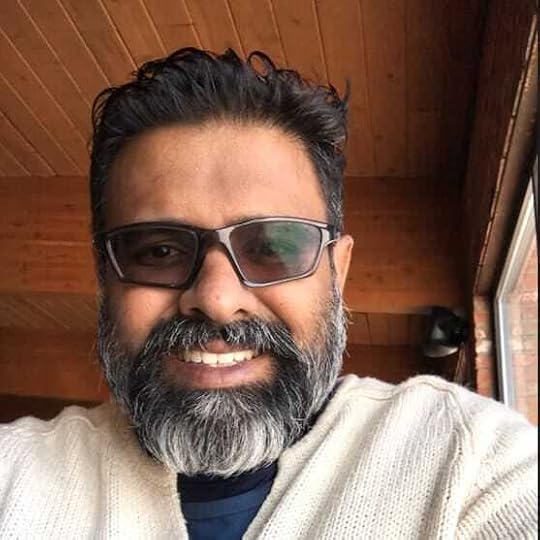
Rajesh Singh Dhillon started his KM journey with the Singapore Navy, retiring after 23 years as a naval commander. In Singapore he is an Associate Faculty at Nanyang Technological University and Singapore University of Social Science, where he teaches KM Strategy and Information Management at the Master’s and Bachelor’s level, respectively.
Rajesh is also the Knowledge Architect at Acies Innovations in Singapore, where he provides consulting services in the areas of leadership development, knowledge and performance management, employee engagement, and organizational learning.
As the President of Knowledge Management Society, Singapore and one of the founding members of Knowledge Management Global Network, Rajesh is a well-known figure in the professional KM community in Singapore and Asia.
His roles have included ISO 30401 KM consultant, lead evaluator of the Knowledge Ready Organization (KRO) awards, and member of the international judging panel for the Most Innovative Knowledge Enterprise (MIKE) awards.
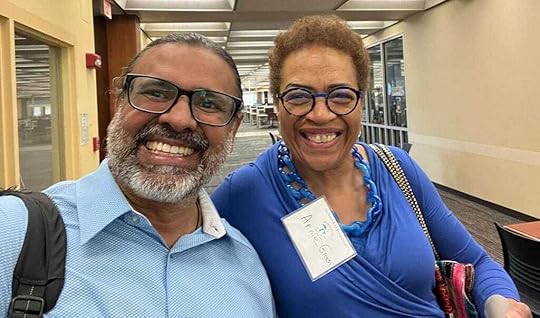 Rajesh Dhillon with
Annie Green
at the Midwest KM Symposium
Rajesh Dhillon with
Annie Green
at the Midwest KM SymposiumSustainable Knowledge: Lessons from My Plumber by Rajesh Dhillon
Rajesh began by listing the similarities in the professions of plumbing and knowledge management. He noted that while there is complexity in both jobs, they both involve fixing leaks.
He shared terms from plumbing that are also used to describe knowledge challenges:
Knowledge SeepageKnowledge LossKnowledge LeakBrain DrainRajesh asserted that an organization’s competitive advantage can be lost if knowledge and/or experience is lost or leaked. He then showed how leaks occurred, both pre- and post-COVID:
Pre-COVID Knowledge Leak
Outsourcing: does not facilitate a complete transfer of knowledge and know-how, especially when workers face redundancyReorganization and mergers: cutting employees without consideration of differing levels of worthSubject Matter Experts: if dependent on the skills of key employees, what happens when they leave?Post-COVID Knowledge Leak
Retirement: Millions of Baby Boomers retire annually, and there was a COVID-19 recessionResignation: workers have their pick of offers, and many cite uncaring employers and a lack of scheduling flexibilityHe defined a Sustainable Development Goal (SDG) with one aim with four focus areas:
Leadership: Strong emphasis on leaders’ capabilities and knowledgeTransformation: Making it work betterWork Practices: Ensure meaningful work by understanding employee trendsCareer Development: Growth and development within the sectorRajesh showed three charts that outlined Knowledge Management SWOT (Strengths, Weaknesses, Opportunities, Threats):
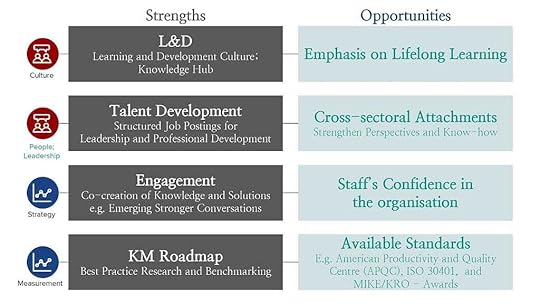
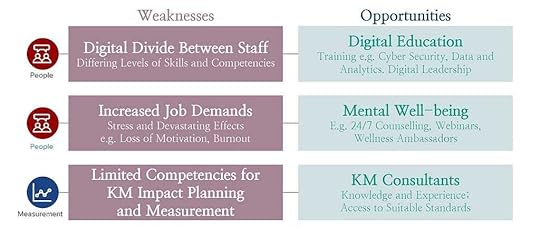
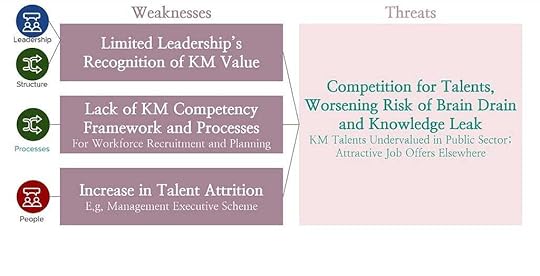
Returning to his comparison of KM and plumbing, Rajesh said that both require a systematic approach and resources to be effective. Both knowledge management systems and plumbing systems require ongoing maintenance and quality control. Knowledge needs to be regularly reviewed and updated to ensure its relevance and accuracy. Plumbing systems require regular inspection, maintenance, and repairs to prevent leaks, ensure safety, and comply with regulations. Without proper maintenance and quality control, both knowledge and plumbing systems can become inefficient and ineffective.
Rajesh provided four recommendations, each three underlying points:
Recommendation #1: Leveraging technologies to harness KM capabilities further, while balancing the need for human intervention and protection against cyber attacks
Technologies can be wrongNeed for human touch when technologies failIncreased number of data breaches could affect client confidenceRecommendation #2: Embedding KM strategies into business strategies and developing a KM roadmap
Need to sell KM benefits to senior management given hefty resourcesKM strategies to be aligned with business strategiesKM roadmap to allow clarity for staff and seek greater buy-inRecommendation #3: Highlighting the importance of continuous learning and embracing future work
Learning and sharing should not be tedious, thus acting as a deterrenceInnovation will open possibilities for new work areasNurture a culture of continuous learning to strengthen staff capabilitiesRecommendation #4: Recognizing KM contributions as a criterion for job promotions, supplemented with people management skills
Motivate staff for KM contributions through job promotions, bonus and special titlesFamiliarize new hires with tech toolsRegular training for existing staffHe offered a list of 16 critical core skills for the future of work:
Cluster #1: Thinking critically
Creative thinkingDecision makingProblem-solvingSensemakingTransdisciplinary thinkingCluster #2: Interacting with others
Building inclusivityCollaborationCommunicationCustomer orientationDeveloping peopleInfluenceCluster #3: Staying relevant
AdaptabilityDigital fluencyGlobal perspectiveLearning agilitySelf-managementRajesh concluded his presentation by supplying a leak toolkit in two parts:
Leak Toolkit, Part 1 — Preventive measures for learning before, during, and after projects:
Connect people to information and knowledge
Case Study — share experience from project progress and outcomesKnowledge bank — repositories so that we have accumulated knowledge at handRapid Evidence review — build a new baseline so new projects spiral up and not start from zeroConnect people to people
Community of Practice — learning from shared experiences and best practicesPeer Assist — first-hand knowledge transferKnowledge Café — informal learning through dialogueKnowledge Marketplace — push required knowledge to people and allow people to pull knowledgeOrganizational Learning
After Action Review — tacit knowledge captureRetrospect — capture lessons learned and publish for all to learnKnowledge Exchange — exit interviews, mentoring, coachingLeak Toolkit, Part 2: — Guide to capturing and storing knowledge:
Establish KM program objectives (strategy)Build a KM implementation roadmapBuild a taxonomyConduct handover and exit interviewsCreate a how-to guideCreate staff profile pages (expert directories)Establish shared networks, blogs, and discussion forumsRajesh’s presentation was both light-hearted and thoughtful. Those who attended it appreciated both his humor and his insights.
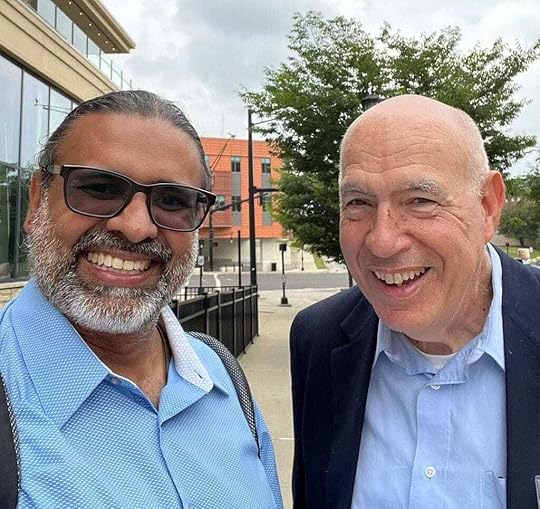 Rajesh with me during our walk following the symposium
Part 6 of this series will feature Rachel Teague. Part 4 featured Dan Ranta.
[image error]