Character Driven #1 — An Analysis of Captain George Osborne from Vanity Fair (1848).
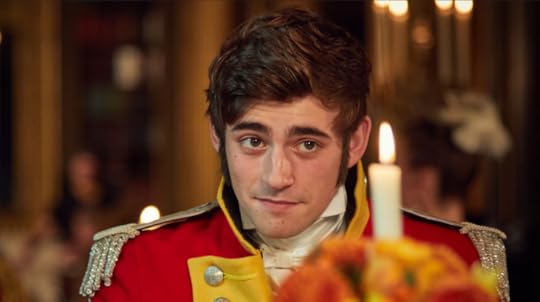 Captain George Osborne in ITV’s adaptation of Vanity Fair.
Welcome to my blog series, ‘Character Driven’ in which I will unpack my thoughts on various literary characters from the canon of classics. Today, I’ll be turning my thoughts back to the novel, Vanity Fair, published in 1848 by William Makepeace Thackeray; a favourite of my own, and beloved by many fans of classic literature. Spoilers included below.
Views on Vanity Fair’s resident bad boy, Captain George Osborne, vary in the extreme. From Team ‘I CAN CHANGE HIM’ — of which I am a longstanding member — to those more sensible among us who find his wandering eye and excessive sense of self-worth render him perfectly unamiable.
To my knowledge, Captain Osborne’s character was largely based on that of Captain William Booth from Henry Fielding’s novel, Amelia, published a century earlier in 1751. In both Captains we have a propensity for all the usual vices; smoking, hard-liquor drinking, gambling, infidelity, gambling, general financial imprudence and more gambling. Did I mention gambling? Good job they were both handsome, I suppose…
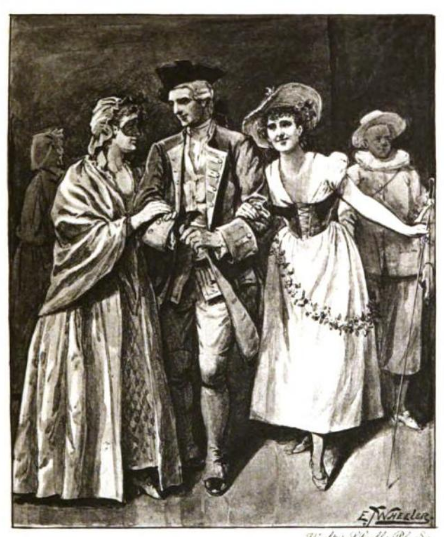 Captain William Booth with two young ladies hanging upon his arms.
The difference, I think, between the two bad boys is in the ends of their respective personal tales. Captain Booth’s character arc ends in his being revealed to be rather sad and pathetic; his poor family only saved from ruin by his long-suffering and quite perfect Amelia. Captain Osborne, however, is killed, the vision of bravery, before he can ruin his Amelia’s life entirely.
George Osborne is a much better sketched character than Booth; there are simply more layers to his story. Perhaps that’s why interpretations of his character vary so greatly.
That’s enough about the two captains. Now, I shall break down George’s character into the good and the bad. A good ‘bad-boy’ character must have a strong foundation (even if hidden) of at least some strong morals.
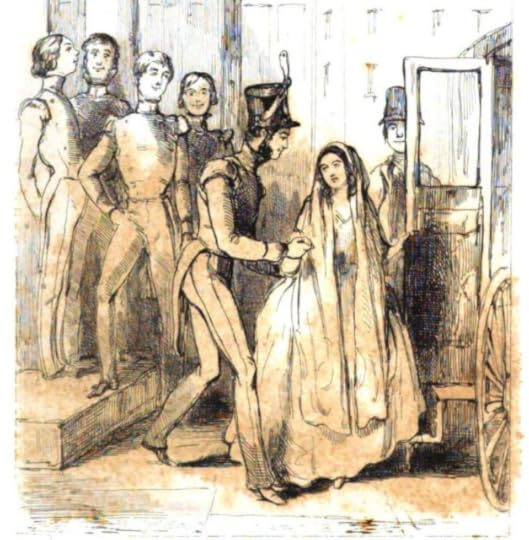 Captain Osborne and Amelia get married.
George is self-obsessed. He is extremely vain and nobody loves George like George loves George. It’s hardly the worst thing a man can be, but it’s also not a good quality in a person, therefore, we shall add it to our list of bad characteristics.
George is supercilious. He doesn’t come from some ancient or honourable family, his father is an extremely wealthy stockbroker but his grandparents were very ordinary lowly people. Now the family has money, George wants to be part of the higher ranks of society and he doesn’t want to associate with anybody who is not of those ranks. This is, I think we will agree, a bad quality.
George had a sad and lonely childhood, one worthy of at least some pity. Details about George’s childhood are woven throughout the novel; we know that George went to boarding school where he was beaten and abused by the older boys. His father beat him too, which wouldn’t have been unusual for the time period but to a modern reader adds a level of personal trauma to his character. While these are not good things, they do make some of his flaws more understandable, so we shall put this in the ‘good’ pile.
His parents. We don’t know when George’s mother died but it was before the novel begins. Mrs Osborne enters the novel only in recollections of her tenderness towards George; the antidote to his father’s tyranny. His father materially provides everything for George yet appears emotionally abusive and pretty awful to his son. Again, all this makes George’s flaws more understandable, so it goes on the ‘good’ pile.
George is a loyal friend. He’s definitely not the best example of a fictional friend, but to his best friend he is loyal and open. Dobbin often calls George out on his terrible behaviour, and George does often listen, take heed and take the advice of his well-meaning friend. This is undoubtedly a good quality.
George can be icy cold. Amelia and George were betrothed from childhood and for much of their engagement he would have been either an adolescent or an adult and she would have been a child. It doesn’t seem strange to me that he is (at best) indifferent to a girl he never chose to marry. It doesn’t surprise me and I don’t think it makes him a bad person.
But he does take this one step further. He’s emotionally cold, not very nice to Amelia and he’s rather embarrassed by his relationship with her; he doesn’t want to be seen out with this girl and he certainly doesn’t want his friends to know that he’s engaged to Amelia. She is very sweet and adores him and he hardly thinks of her. A bad mark of his character.
George is a wannabe Casanova. It’s unclear how successful he is with the ladies, but he tells his friend of his plans for having scandalous affairs with different women before he marries Amelia. Even once he is married, he is still chasing after other women, buying them gifts, lavishing them with praise and admiration and completely ignoring his darling, sweet wife. Thumbs down, George.
George loves all of the vices. It’s very difficult to have a good bad-boy character without some vices in there, and he’s got them all. Smoking, drinking and gambling; the perfect trio for any bad boy. I don’t think these things are inherently bad qualities, but they do all feed into his bad-boy character.
He’s respectful (in some ways). You have to read between the lines to pick this out, but George does not push boundaries with Amelia before they are married. They don’t tie the knot until he’s 28 years old and Amelia has been an adult (and pretty) young lady for several years. Despite being presented as a licentious Casanova, and having frequent opportunities of Amelia’s private company, there is no hint that he attempts to coerce, manipulate or pressure her into premarital shenanigans. Perhaps this is a reflection of social conditioning, or that the consequences of doing so would be too severe. Still, he’s no Mr Wickham, I shall count it towards the good in him.
Brussels. You know what I’m talking about. George is called off to war and he takes Amelia with him only a few weeks after they are married. The whole time they are there, he ignores his patient wife and instead chases after Amelia’s best friend, Rebecca. He tells Becky how beautiful she is, buying her flowers, buying her gifts, all while wasting away what little money he has. The night before he marches off, Amelia spends her evening crying at a ball because of how horribly George is treating her. Bad show, George!
George is heroic. His first act of heroism is in defying his father to honour his commitment in marrying Amelia; an act that was romantic and gutsy. When called to battle, George has no fear, we know that he behaves bravely while fighting. Courage, I shall place among his good qualities.
George is very remorseful. Just before his exit from the book, George has a Shakespearean moment of realisation; Amelia is perfect and he’s treated her horribly. George runs home to his wife and they share many tender hours before he leaves for battle. Later in the novel, we learn that, just before he was shot, George’s last thoughts are of Amelia and regret for the foolish note he gave Becky. He asks his best friend to care for Amelia should George be unable to return to her.
George is dead. This is, I think, George’s most redeeming quality because he’s unable to undo the good qualities he develops just before his death. Unlike Captain Booth, George dies at the high point of his character and when Amelia seems most in love with him. A true tragic hero must die after he’s realised his own flaws and follies. This was very clever of Thackeray. In dying, George gives Amelia and their son the freedom to have a life that had a truly happy ending. Being dead is George’s best quality.
That’s all on my deep dive into Captain George Osborne for now. What are your thoughts on this character?
[image error]