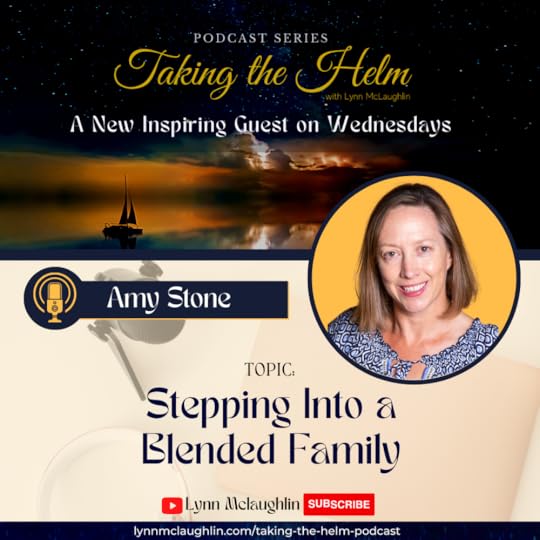
TRANSCRIPT OF AMY STONE | STEPPING INTO A BLENDED FAMILY
Listen Link
[00:00:00]
Hello, everyone, and welcome to our first episode of 2023. If you feel like your life in a blended family is hard, I hope you'll listen. Our guest today is Amy Stone.
Music Intro
Are you facing a crisis in your life or business? It's time to steer yourself in the right direction through the real experiences, passion, and courage of our guests. Where taking the helm with your host, Lynn McLaughlin .
[00:00:31]
And it's my pleasure to introduce our first guest of 2023, Amy Stone. If you are about to make a tough decision, do you want to be a step-parent? You've fallen in love with someone who has children or you're in a blended family? Amy is a life coach who's had the experience herself, and she's going to take us through some tough decisions that have to be made. How she got through it and what she's doing today to help people in this situation. All right, Amy, first guest of 2023. We're so happy that you're with us. How were your holidays? Relaxing, invigorating really a lot of fun.
[00:01:09]
Thanks for asking. I'm thrilled to be here. Thank you for having me, Lynn. Excellent. Okay, well, when we take the helm, we always go back to what took us to the place that we are now.
[00:01:19]
And why are you doing the work with parents that you are today, Amy? That's such a wonderful question. And there's so much that how much time do I have?
[00:01:32]
So why do I do the work that I'm doing? I do the work that I'm doing because I know that and this is something I sort of fell into. I work with step parents and adults and blended families. And when I started my stepparent journey many years ago, I was young, and I did not know then that this is what I would be doing. Fast forward 25 years down the line.
But like many people during the pandemic, I was picking up some extra education and really doing a lot of soul-searching about what were the things that I was doing in my life and what's the place that I could make the biggest impact. And I hit on this. I was talking to a coach one day and I said, what if I helped stepparents? And I sort of said it out loud in a very soft whisper and not realizing that the person on the other end of the conversation was a stepparent and said, oh, wow, I think that might be really helpful. And then as I leaned into it more, I realized how important it was to me to be able to help people who are in a spot similar to what I had been and how valuable it can be to really help people when they're in that spot and they need it.
[00:02:45]
So you've been doing this now for how long? About 18 months. That is fantastic. It's interesting how, despite the tragedy and the horrific things that we experienced through COVID that there has been some good that's come of it. Right.
[00:03:00]
I think we were all sick of that word pivot in about a couple of eight to ten months into it. Right. We're all really tired of that, but so many of us did it, and I think we're actually, in a lot of ways, seeing a reverse pivot now sort of slowly, like, as we go back, because everything was online. Then we got very burnt out of online stuff, and now we're looking for where's the mix? Where's the mix of what we do in our lives.
[00:03:29]
Okay, so I look at this from the opposite end. I am a child of parents who divorced with two step parents. I think we from different perspectives. Right. So what kinds of things do you do right now, Amy, to support blended families and stepparents?
[00:03:45]
So it's interesting. I did not realize that you had stepparents. My parents were divorced, but they didn't remarry, and so I didn't have stepparents. So I have part of that experience as a child, and so that definitely impacts the way I handle things because I've experienced some of the challenge of being that kid. So my focus is on my life coach. So I'm not a lawyer, and I'm not a counselor, and I'm not a doctor. I'm not diagnosing problems or assessing labels. And my goal is really I work with individuals, not the entire family and not couples. My goal is really in contentment and happiness. If you're about to make this decision to join a blended family or if you're in a blended family and your expectation is not matching your reality, right.
[00:04:44]
What are some things we can do? What are some action steps? What are some decisions you might want to make? What are some things you might want to do that are going to lead towards contentment and happiness? Like, we only get this one life, right?
[00:04:56]
We only get this one life, and we do want it to be happy, not just for us, but also for the whole family. The dream is you come home and you set down your bag, whether it's a grocery bag or a work bag or a workout bag, and you feel secure and safe and loved, and you can do things that make you happy. And it's not rainbows and unicorns, don't get me wrong, but that's the dream, right? It's not pie in the sky. It is the dream that we all want just to have happiness and contentment sorry. And joy in our lives, for sure. So to make that decision, I mean, I think about I've got a very, very good friend who's the stepmom, actually, the mom. She's raised four children, stepchildren, whatever you want to phrase it is. And that's got to be a huge decision before entering a relationship. I mean, it's enormous when you think about not having biological children of your own and then very quickly becoming a mom of four children.
[00:05:58]
Yes, there's a million ways these families come together, right? And I was a child-free stepmom, so I was young and didn't have any kids, joined a family that had two kids, and then we added two more kids. So that's my story. Other people come in when they already have kids. And then there's the Brady Bunch method, where people bring two groups of kids together, right.
[00:06:23]
And there's a lot of different combinations therein. That's a broad stroke simplification. But definitely what you talked about just then is really true. I do believe that one of the things that makes it challenging is it is a rapid change. You go from living alone, perhaps and being single to being full instant family. And that is very different than the timeline. If you are creating a family from scratch, taste like a first family where you have the pregnancy and then the little phase where the baby is like just a little worm and doesn't do very much, and you've got a pretty long time before you have this full influx family with all the people. And when you're blending a family, it is rapid. It is a really intense, rapid change. And your friend that went into I call it the instant Family with four kids, she's outnumbered because that's a huge change.
[00:07:23]
When we went to two to four, that was a gigantic change in how much work there was around the house. And it's a level of responsibility. We just go back to the example you gave of someone living alone, and now they're in a home with a partner and four children. And the level of responsibility must be like, I can't unfathomable because they're not. Used they may not be used to it.
[00:07:48]
Living with other people is a lot more complicated than we want to admit, is just an observation I have of life. When we're by ourselves, you think to yourself, what do I want for lunch? And then you just kind of do whatever that is, and you change your mind or whatever. And when you have an active family of two or four or six or eight people, every single stage of that just becomes exponentially more complicated. Not that it can't be enjoyable, but it is more complicated.
[00:08:24]
I got to throw this in my mom's second relationship, there were two children. And the ages of the children that you're bringing into your life makes a difference too. Makes a huge difference to an angry. 15 year old or those kinds of things. But my mom had a relationship. She really loved the man. I really felt she did. And she decided not to carry on with it because she'd already raised four of us almost single-handedly by herself as a single mom for many years and just said, I just can't do it again. So there's that. Yes, 100%.
[00:08:52]
And that is a completely valid, valid decision. Right. Your mom had done all of the work of raising a full batch of children and she knew exactly what was involved in it. And then to think about whether or not to do it again and to have the self empowerment to make that decision is really strong of her because a lot of times women will feel like they need to take that on for somebody else, and you may not want to once you've been through it. I'm almost at the end of the I've got two and a half more years before I'm an empty nester.
[00:09:33]
Oh, you think so? I'm just going to say you think so? Maybe not, but I'm well past diapers and everybody drives. I can see the light at the end of the tunnel and I describe it. Young children, and we talked about it is a difference between little kids, teenagers, if you're remarrying and you have adult children, completely different situations.
[00:09:57]
But young children are like a black hole of resources. They will absorb all available time, all available love. You can literally have a giant village of adults and family loving on small children. They just soak it all up. There's no limit to how much we can invest in them. There is, however, an impact on how much else we can do. It's an investment in the lives of our children and there's different levels of what everybody is able to do. But nobody goes through this journey of raising children as a step parent or a parent without investing time and energy. And once you've done that, when you look back, you think to yourself, oh, do I want to do it again? It's a decision.
[00:10:38]
It's a very empowering thing to be able to say, I have this decision. And I've worked with clients who've made the same decision that your mom did, where they said, do I want to go back and reset now and take on another twelve or 15 years of parenting small children? Or do I want to make a different decision and commit to my independent life as an adult? Some of my dreams? When you're helping individuals, I'm sure you're helping individuals through different phases of, first of all deciding, is this something I want for myself?
[00:11:07]
And then the transition. So what kinds of supports do you offer? Amy? So, yeah, people usually come to me in one of two times. One, they come before they've made the commitment, which I think is very interesting.
[00:11:17]
It was unexpected when I started that people would search me. I think that's a very tuned in and enlightened place to be because I did not do that. I charged forward, assuming I knew what I was doing. Completely wrong about that, by the way, but just barreled right through. And I really love that people will reach out and say, hey, before I do this, what are some things that I would like to know and I love to work with people on that.
[00:11:39]
And the other group of people I tend to work with are people who are they're committed in their relationship. They're either married or they've made a significant committed. They're living together and there's a mismatch between what they thought their life would be like and what it's actually like. And I describe it as a little bit of chaos, a little bit of unhappiness, a little bit of discontent, throwing a smidgen of fear that you may have made the wrong decision or taken on more than you understood you were taking on. And you're trying to find your way through into whatever you might want it to be.
[00:12:14]
So the support that I offer is as a life coach, right? So it's in helping you get clear on what's going on in your life and what are the decisions you want to make and how do you want to get there. I happily share with people the things I did, including as many mistakes as anybody wants to hear about. And I've been through it for a long time. So I can look back and say, these are some things I did that I didn't know I was doing wrong, but I really didn't know I didn't have kids when I became a stepmom.
[00:12:44]
And I openly admit that I made myself fairly miserable for a while simply because I wasn't aware of what small children were like. I really thought they should be quieter than they are. I really thought they should be a little more independent. I would have loved if they slept in a little bit all of the things that they don't do. This was normal child development stages and I didn't understand that.
[00:13:09]
And so I created some frustration for myself and I always tell people that and so I always share the things that I do, but we unpack it, figure out what's going on and figure out the things that you want to do. So I come in as support. I stand beside you in the situation that you're in, non judgmentally and supportively. Right? That's a crazy hard thing to find in a blended family. There's a lot of stigma, there's a lot of judgment. The first line of resources for stepparents and people who've gone through divorce are really often people will suggest therapists and lawyers and you don't always need a legal solution or a diagnosis, right. Sometimes you need somebody who has been there, done that can help you figure out what you want to do. And in my case, I wanted to be happy. I wanted to create a happy family.
[00:14:09]
And so the process I went through was really figuring out how to be happy in my family. What were the things that I did? We all have our own journey, but being able to be in the driver's seat of how I'm going to experience my family was very empowering to me. Yeah, I want to go back to what you said just a little while ago about things you did wrong. I'm going to throw a little bit of compassion out there.
[00:14:33]
Self-compassion. I don't think it's mistakes that we learn from right and right and wrong are different in every family based on culture, tradition, background, beliefs. Absolutely. I've got to give you credit, Amy, for what you just said about being able to walk people through side by side when people are coming from so many different places and perspectives. That's got to be tough.
[00:14:54]
It can be. I think I thought I knew a lot more about parenting before I was a parent. Right. If you had asked me about my opinions before I was a parent, I would have probably had a lot of very rigid ideas. And one of the shifts that's happened to me over the last 25 years is, as you said, there's a million ways to skin this cat and people come from different positions. And I'm so much more accepting of the fact that here's how I did this, but there are other ways to do this.
[00:15:24]
And so I honor that. I am very much more open about the fact that what I think is should the way it will be often was not the way it worked out. And that was okay. The process worked itself out and it was all right. But also that when people come to me with their situation, I just see it. I just see it and I say, all right. So it just is what it is. Right. This is the construct of your family, and these are the things that are happening right now. What are the tools that we have and what are the tools that we need to have a good day and have a good week and to love ourselves and to love the other people in the family and feel loved.
[00:16:07]
Right. Feel loved. And I'm thinking, in addition to the complexities of bringing children into your life, when you have two people from two different religious backgrounds and then navigating, what does the future look like for that blended family now with maybe two very different backgrounds and religious beliefs? My goodness. Wow.
[00:16:27]
Yeah. No, absolutely. Yes, we do have that in my family. My husband is Jewish and I was raised in a Catholic house, and so we've had lots of adventures like that, and we chose to celebrate all of the traditions, which every once in a while provides for a very busy couple of years. I forget how long ago it was.
[00:16:44]
They overlapped. We had Christmas and Hanukkah all at the same time. My kids were little, and so I had to make a rule. We did it once, and then I had to make a rule. I was like, listen, I can't do Santa Claus and Latkas all in the same day. We have to parse this out. That is exactly the situation of the friend that I was speaking about earlier, who is now the mom of four children.
[00:17:11]
Same thing, Jewish and Catholic between the two of them. Yeah. And people do it different ways because some people will pick one and move forward, and other people will do both. And sometimes we had a book when my kids were little, we had a book where the people in the book, each parent sort of took over their own traditions. So there are lots of ways to do it, and it just depends on what's the important part to your family.
[00:17:38]
And making those conscious choices and decisions moving forward, as opposed to grappling, just to, what are we going to do? What are we going to do? No, you make those decisions yes. Along the way. And that can be harder.
[00:17:48]
Right. Like, it can feel very pressuring to make the choices, and it can also take a little while before the choices feel empowering, if that makes any sense. Right. Because our beliefs are so dear, and we were raised with these beliefs. Some of us have changed our beliefs over time, and that's okay.
[00:18:05]
But being put into a situation where you love someone and want to carry on a life with them, you got to figure it out. Amy, you have something called seven action steps? Yes. All right. So as a part of this process, over the last I mentioned that I did not know I was going to do this when I started this family.
[00:18:26]
So the first thing we did, let me tell you, if you want to do something fun, tell your family that you're going to start a business about your family. That's like an underwrite number. So the first thing we did, my husband I wrote down a list of things that I thought were the lessons that we had learned over the years, and my husband signed off on those, and he thought those were good, and those were very helpful for people, but then those were not action steps. So after I talked about those for a while, I realized I was like, oh, these were just the lessons. But then what did I do?
[00:18:54]
What did I do that made the difference? And so I have seven steps, which are the things that, looking back, these are the changes that I think I made. These are the things that I did that really made a difference in our family. So that we were I was happier. We were all happier. There's truth in that phrase that if the mom is happy, the family is happy. Right. So when I was unhappy, a lot of people were unhappy. But yes, I have seven steps. Seven action steps for creating happiness in your family.
[00:19:23]
And I put that on my it's free, and I put that on my website, which is Amy says. So can you give us an example of one of the action steps? So one of the action steps is taking personal responsibility for how I'm going to feel. And that's a broad stroke thing that I break down into different things. And this is not exclusive to blended families, right?
[00:19:50]
This is a human thing, but it's harder when we're dealing with small people and the people that we love, as long as we are giving the people around us the responsibility of if you're unhappy, then I'm going to be sad. If your behavior is the way I don't like, then I'm going to feel sad. That's a limit. And by learning to take responsibility for can I be happy even if this is not exactly the way I wanted to go? If you have a tantrum, can I still be happy?
[00:20:22]
If you're late to school, can I still be happy? If the transfer between houses doesn't go the way I thought it would be, can I still be happy? If I don't feel totally comfortable in a mixed blended event, can I still be happy taking responsibility for how I feel? Fantastic. Well, that's available for free on your website.
[00:20:39]
Amy, do you have any closing comments or advice for our listeners and our viewers today? Sure. My closing piece of advice is that happiness is a totally worthwhile goal. It sounds sort of woozy and like it's like marshmallows and sunshine, but shifting to saying, you know what, what does happiness feel like? What is contentment?
[00:21:04]
What does it mean to me? And what are the things in my life that will get me? There is a totally worthwhile goal, in my opinion. And if you don't have people on your team surrounding you who agree with that, then find other people who are working with you towards happiness because it makes a big difference. Well, you know, considering this is the first podcast interview on Taking the Helm of 2023, if you haven't set a New Year's resolution yet, there's one happiness, right, conscious and positive choices to get there.
[00:21:35]
I think that's fantastic. And I thank you very much for joining us today. Amy, thank you for having me. It's been a pleasure. What a way to start by setting intentions, as you know, Taking the Helm.
[00:21:45]
We join you every two weeks with a new and inspiring guest, someone who suffered some type of crisis and has taken that to open new doors and possibilities for themselves and for other people. If you're interested in transcription, all of the notes are now on my blog for every single podcast interview for likely the last three months when we started doing the transcribed notes. Stay healthy and safe for everyone and we'll see you in two weeks.
Music Outro
Thanks for tuning in and posting your review of Taking the Helm on your favorite platform. We'll give you a shout-out in a future episode. To be inspired by people who are steering us in the right direction. Go to Lynn McLaughlin .com where you can search previous guests by the topic of your choice. And while you're there, download Lynn's gift. There’s more than one way to face a crisis!