
Miniature Portraits: Another Alternative
A while back I posted a blog on the history of silhouettes, or shadow portraits. As I noted in that post, while some silhouettes were proportional or close to the actual size of the person whose profile was being traced, as an artistic form with affordability a major contributing factor, most silhouettes were small. Many were so tiny they could be placed into jewelry.
Silhouettes: A Portrait Alternative with a Dark History (pun intended)
In contrast, painted portraits were almost exclusively life-size or gigantic (as seen in the “painting of paintings” down below). Understandably, this meant portraits were extremely expensive due to the cost of materials and the commission for the artist. With these facts in mind, it would be logical to deduce miniature portraits appeared as a unique cost-cutting art form. Not in the least, as it turns out.
 1660s “Picture Gallery of the Archduke Leopold Wilhelm in Brussels” painted by David Teniers the Younger.
The first tiny paintings arose from the medieval illustrations in hand-written books. The colorful decorations known as illuminated manuscripts became fancier and increasingly more colorful during the 1460s in order to compete with the new printed books (thanks to Johannes Gutenberg). Interestingly, the term “miniature” originally didn’t refer to being small. The word derives from the Latin miniare, meaning “to color with red lead” and minium for “red lead paint” as this was the preferred color used for capital letters and highlighted text in ancient manuscripts.
 From the Missale Cisterciense (Wolfgang Missale) in the Rein Abbey Library from Austria, 1493 (Wikipedia)
Wikipedia has a great article: Miniature (illuminated manuscript) and this one on Europeana is, well, illuminating: Lighting the Way
As printed books gained in popularity, certain artists adapted the techniques they used in illuminated manuscripts to produce small portraits using watercolor or enamel painted on vellum, copper, plumbago, card paper, or ivory. The technique was called limning, or “painting in little” and the term held until the 18th century when miniature entered the vernacular.
Early artists of note, known as a limner, included:
Jean Fouquet (1420-1481)Lucas Horenbout (1490-1544)Hans Holbein the Younger (1497-1543)Jean Clouet (1480-1541) and his son Francois Clouet (1510-1572)Simon Bening (1483-1561)These small paintings first gained prominence in the French and English courts by Jean Clouet for Francis I, and Lucas Horenbout for Henry VIII. Monarchs and the aristocracy adored the tiny paintings which could be bestowed as gifts to those whom they favored. They were seen as tokens of affection, the unframed likeness placed in a locket and carried wherever one went. They could be kept secret as a symbol of a private love or worn against the skin to feel close to one who was far away.
Miniature portraits were also used as a declaration of one’s political loyalty. During the reign of Oliver Cromwell, for instance, those loyal to Charles I carried mourning portraits to show their solidarity with the Crown. Previously, during the tumultuous reign of Elizabeth I (who was a passionate fan of miniatures), wearing her image was a sign of support against threats by Catholic Spain.
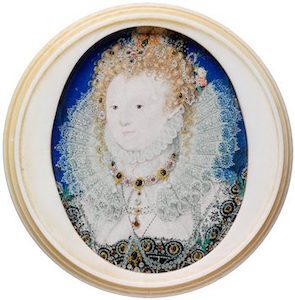 Elizabeth I miniatures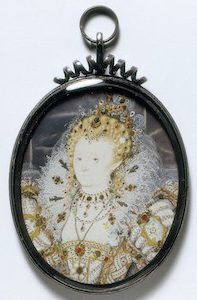
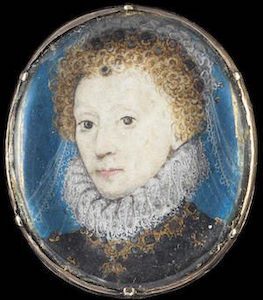
James I, who inherited the English throne in 1603, continued the trend of his illustrious predecessors, using the power of miniatures as a royal gift. Nicholas Hilliard (1547-1619) and Isaac Oliver (1565-1617), two of the greatest limners of that period in England, produced many miniature portraits of the King and his family, just as they had for Queen Elizabeth. Hilliard contributed to the understanding of the methods and materials used in 16th to 17th century miniatures with his c.1600 publication Treatise on the Arte of Limning. The six examples shared above and below are Hilliard’s work for the English royals.
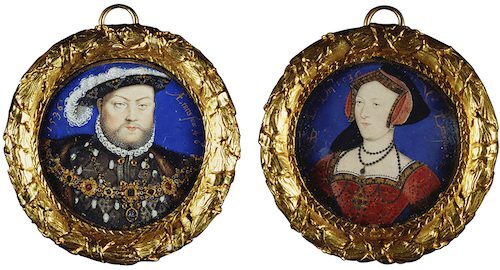 Henry VIII and third wife Queen Jane Seymour
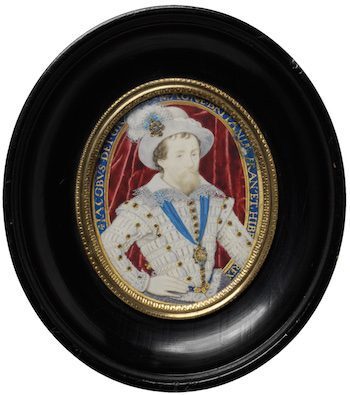 James I miniature by Nicholas Hilliard
By the late Georgian Era, miniature painting had evolved into an established profession with true masters in the art apprenticing talented young artists. In 1754, drawing master William Shipley founded an arts society in London. His desire for a serious school for artists began as a modest drawing school in The Strand called “Shipley’s Academy” and would later be known as “Ackermann’s Repository of Arts” (A name we who love the Regency are very familiar with!) and then later it became the Royal Academy of Arts. Amongst Shipley’s classes was the drawing of miniatures, and three young boys who were students during the 1760s became the famed miniaturists Richard Cosway, John Smart, and Richard Crosse.
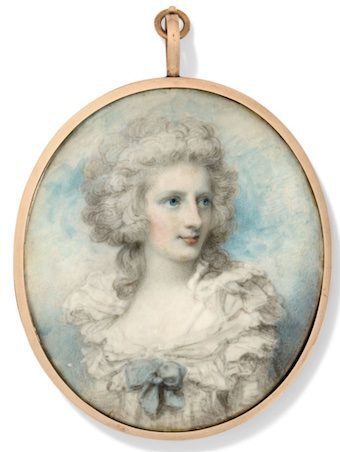
Elizabeth, Countess of Derby by Richard Cosway
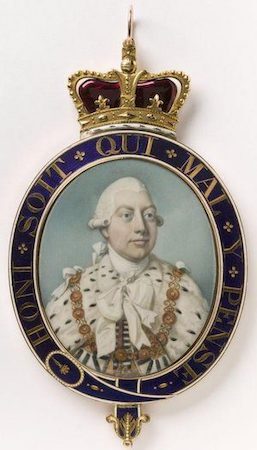 King George III by Richard Crosse, 1793
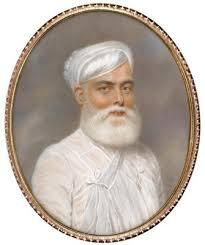 Muhammad “Ali Khan, Nawab of Arcot and Prince of the Carnatic” by John Smart, 1791
As a specialized art, miniature painting would continue well into the late 1800s, aided to a degree by the establishment of the Royal Society of Miniature Painters in 1896. However, the last great miniaturists of note are Alfred Edward Chalon and Sir William Charles Ross (Queen Victoria’s miniaturist).
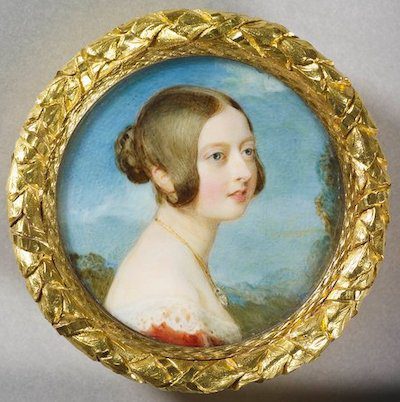 Queen Victoria, by Sir William Charles Ross, 1840
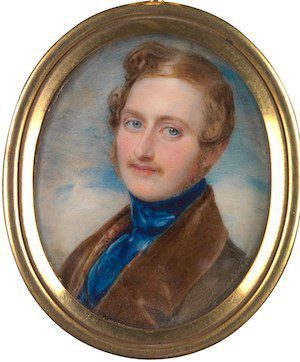 Prince Albert, by Sir William Charles Ross, 1840
The 18th and especially the 19th centuries saw advanced techniques and improved materials for creating miniature paintings far superior to anything done in previous centuries. As with silhouettes, portraits of all sizes would remain a popular method of immortalizing one’s likeness well into the 19th century. Sadly, also as with silhouettes, the improvements in artistry and lowered costs of supplies could not contend with the glory of photography, which was invented in the mid-1800s. By the 20th century, the flame of miniature portraits, a four hundred year tradition, was essentially extinguished.
The links below are to articles exploring the history of miniatures in greater depth and the great artists who created them over the centuries.
LinksA History of the Portrait Miniature on the Victoria and Albert Museum website
Windows Onto Lost Worlds, a History of Portrait Miniature Painting on Sotheby’s
Collecting Guide: Portrait Miniatures at Christies
Best Miniature Portrait Painters (c.1300-1850)
The post Miniature Portraits: Another Alternative appeared first on Sharon Lathan, Novelist.


