PAIR vs PARE vs PEAR: simple spelling tips to remember the difference
The words PAIR, PARE and PEAR are easy to confuse because they’re homophones – words that sound the same but have different meanings.
Here are my simple tips to remember the difference between the words PAIR, PARE and PEAR.
When to use PAIRPAIR can be a noun or verb. As a noun, PAIR describes a group of two things.
As a noun, you can use PAIR in a sentence like this:
“I swear my washing machine eats socks… There’s always one sock missing from the PAIR!”
As a verb, PAIR describes the act of grouping two things.
As a verb, you can use PAIR in a sentence like this:
“I like to sit in the sunshine and PAIR my socks.”
When to use PAREPARE is a verb, meaning to trim or reduce in size. It’s often used with the word ‘down’.
Use PARE in a sentence like this:
“Let’s PARE down this budget. We’re spending way too much!”
When to use PEARPEAR is a noun, referring to the juicy green fruit.
Use PEAR in a sentence like this:
“I’m a bit bored of apples, but I wouldn’t say no to a PEAR.”
Remember, if you PARE down a PAIR of PEARS, you’ll only be left with one!
Now you know the difference between PAIR, PARE and PEAR! I hope my tips help you remember the difference between these commonly confused words in the future.
Get more tips in The Little Book of Confusables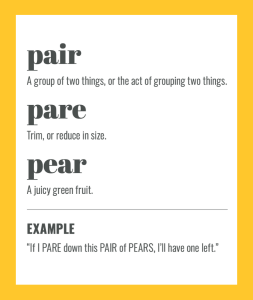
PAIR vs PARE vs PEAR. Excerpt from The Little Book of Confusables by Sarah Townsend. Get simple spelling tips for 500+ commonly confused words.
The post PAIR vs PARE vs PEAR: simple spelling tips to remember the difference appeared first on Sarah Townsend Editorial.