
CMP#113 Treading the Boards with Ann Ryley

Fanny took "up the volume which had been left on the table, and begin to acquaint herself with the play of which she had heard so much... she ran through it with an eagerness which was suspended only by intervals of astonishment... that it could be proposed and accepted in a private theatre! Agatha and Amelia appeared to her in their different ways so totally improper for home representation—the situation of one, and the language of the other, so unfit to be expressed by any woman of modesty, that she could hardly suppose her cousins [Maria and Julia] could be aware of what they were engaging in... -- Fanny Price reading Lover's Vows in Mansfield Park CMP#113 Fanny Fitz-York, part 5: Unexceptionable as to morals
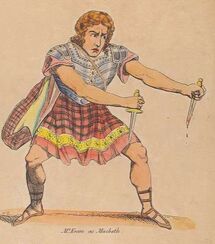 Edmund Kean as Macbeth In previous posts, I've looked at the forgotten novel Fanny Fitz York (1818) in terms of its plot, its female characters. and the moral and political opinions the characters express. In this post, we're going to the theatre and dealing with some other bits and pieces.
Lady Ann, the mother of the heroine, carefully safeguards her daughter's morals. When they are invited to take in a play, Lady Ann asks if the actors are any good, then asks: "And the piece-- is it a moral one?” When she is assured it is “Unexceptionable,” she decides to take a box. “The young folks no doubt will be highly gratified, and if, as you say, the play is unexceptionable, improved. The drama, under proper restrictions, would not merely be an innocent amusement, but a very high source of edification…”
It's not surprising that Anne Ryley has opinions about the theatre. Her husband, S.W. Ryley, was an itinerant actor and comedian, and she herself trod the boards as a young wife. No doubt the scenes described in Fanny Fitz-York are based on Ann Ryley's real experiences playing in front of rowdy Georgian audiences.
On this first trip to the theatre, young Fanny is enthralled by everything. She pays “close attention to the performance,” which draws the sarcastic attention of other theatre-goers, because “any attention to Shakespeare, or those whose acting is his brightest illustration, is an offence so barbarous, vulgar, and unfashionable, that it is universally rated a bore…”
Fanny and her friends go to the theatre and the opera frequently in Fanny Fitz-York, and some little incident always occurs. Author Ann Ryley has thoughts about noisy, inattentive theatre patrons...
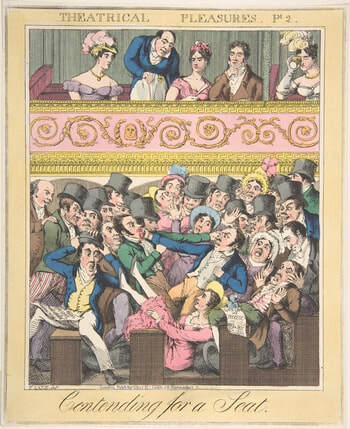 Hijinks at the theatre
In an early scene the vulgar young lieutenant Matty Gaskell is hissed and hooted out of the theatre for being drunk, loud, and obnoxious.
In another foray to the theatre, Matty's vulgar sisters are sharing a box together when some strange men burst in on them and start molesting them. The rest of the audience stands up on behalf of the girls: “the pit had warmly taken up the female cause, and insisted so strenuously upon the offending party being turned, that their companions, more reasonable, because less inebriated, forced them from the box, and once more restored the house to order.”
Mrs. Bloomfield, an opinionated dowager we met in previous posts , turns this into a teachable moment for the Gaskell girls, (though today this would be called “slut shaming”). “When females forget the delicacy of their sex, and appear in public almost in a state of nudity, they cannot wonder that men should forget it also, and treat them with the disrespect appearances too well justify…” she goes on to say that anybody might mistakenly assume “the profession” of girls dressed in such scanty clothing.
On another occasion, Mrs. Bloomfield sarcastically tells a raucous group in another box that if the rest of the audience had known in advance that by coming to the theatre they would disturb a private party they would all have stayed home, “but as this information was withheld, I move, that you leave the place and no longer interrupt the amusement of rational creatures.” The rest of the audience applauds.
There is also this exchange between Lady Anne and her friend Mr. Strictland, where she opines that actors and actresses who play heroic and virtuous characters on the stage, ought to be influenced for the better as a result: “I fear many of the sons and daughters of the stage, exhibit a beautiful theory of virtue, without reducing it to practice.”
“My dear Lady Ann,” [her friend responds] “do you expect players to be better than other people?”
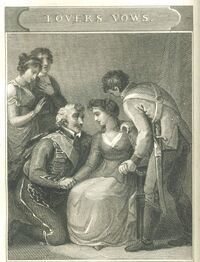 The Baron kneels to Agatha as Amelia, Anhalt, and Frederick look on in Lover's Vows. Austen opines on an improper play
This week I've been comparing Ann Ryley's unvarnished views as a counterpoint to the widely-held belief that Jane Austen had to share her beliefs "warily and subtly," because of social and political repression. Fanny Fitz-York came out the same time as Northanger Abbey/Persuasion and I've been comparing author Anne Ryley's outspoken views with Jane Austen's avoidance of political controversy.
It occurs to me that I can point to one tiny thing that Jane Austen actually opined about, and I quoted the relevant passage at the top of this post. In Mansfield Park, Fanny Price thinks that the play Lover’s Vows is unfit for home representation, and we can presume that Jane Austen thought so as well. The “situation” of Agatha, an unwed mother, and the “language” of Amelia, a forward flirt, in a play well known to Austens first readers, made the play unsuitable for chaste young ladies to portray in private theatricals.
Critics in the increasingly genteel Regency age--leaving behind the rowdy, bawdy Georgian age and looking forward to the Victorian age--considered the play Lover's Vows to be improper. One critic complained of the “radical defects and absurdities of the piece” and opined, “the Play of Lovers’ Vows, drawn from the polluted sources of the German School, however it may occasionally strike upon our feelings, has no moral influence upon the heart, and leaves no permanent impression behind it. That it should have maintained a place among our acting plays, is a serious impeachment of the taste and judgment of the public..."
Whether or not Austen saw Lover's Vows performed, she was aware of the criticisms against it, and the first readers of Mansfield Park would have known of the controversy around the play as well. See Claudia Johnson for a discussion of this play and its significance in Jane Austen: Women, Politics, and the Novel. United Kingdom, University of Chicago Press, 1990.
 And-- oh yeah, some spoilers--the end of the novel
If you've been reading along this week, you'll know that Fanny Fitz-York has a lot going on in its pages and has a large cast of characters. I gave an outline of the beginning of the novel here. If anyone would like to know the conclusion of the novel, here it is.
I mentioned the mystery of the missing natural son of Fanny's late uncle Frederick. This son does show up, Out of financial desperation brought on by bad luck, he turns highwayman, and through an amazing coincidence, robs a noble relation of Lady Anne, then he robs a carriage containing his own mother (whom he does not recognize), and and is rescued from an angry mob when Lady Anne also rolls by in her carriage. (Our older novels depend upon death, coincidence, and misunderstanding for their plots, and much of the misunderstanding has to do with the inability to communicate with people in the days before mobile phones and the internet.) Anyway, Lady Anne refuses to turn the highwayman over to the law, preferring to urge him to repent. She discovers he is her nephew and she helps him regain a respectable footing in society (though of course much lower on the social scale, given his illegitimacy). She sets him up as a small-town merchant.
The highwayman's mother makes for an exciting villainess. She had abandoned her son as a child when she went abroad. Returning to England, she learns of the death of Frederick, and she hires an imposter son to try and shake down the rich and noble family for some support money. There are some lively court-room scenes where we have the Big Reveal when her true son shows up and announces himself (Not a big surprise, but still fun).
Rosette's sister Julia, whose fall from virtue is forgiven by her brother the curate, marries the man who seduced her but he is a horrible villain and his shenanigans add interest to the final volume.
Mrs. Bloomfield the outspoken widow carries on being Mrs. Bloomfield. Lord Moseley, who fell in love with Fanny in volume one, finds happiness elsewhere. A random rich uncle shows up from the West Indies to bestow his inheritance on Fanny, and promptly dies. Lady Anne, Fanny's mother, receives a marriage proposal but turns it down, preferring to maintain her widowed state. One of Fanny's early suitors, the amiable Henry Tudor, dies of consumption. I guess he served as a love-interest decoy in volume one, and wasn't needed after that. Both Fanny and her friend/governess Rosette make happy marriages--Rosette to a baronet, Fanny to a titled and wealthy young lord whose parents really like her, unlike her snobby relatives.
More on Ann Ryley's life and theatrical career in the final post in this series.


No comments have been added yet.


