Download our database of retrieval practice research in real classrooms
We are thrilled to share our literature review and a comprehensive database of retrieval practice research conducted in real schools and classrooms.
Punchline: Yes, retrieval practice consistently benefits learning in real classrooms, from K-12 to medical school, across 50 experiments and more than 5,000 students.
Get involved and share this research on Twitter. Thank you for unleashing the science of learning.
Access Our Research Database
Photo by Jesse Orrico on Unsplash
Want a quick way to access classroom research on retrieval practice? We have a database of 50 experiments from the literature review, sorted by grade level, content area, type of retrieval practice, and more.
This is much more than a literature review or database. In order to advance both research and practice, we:
Share and provide access to valuable research in cognitive science
Compare apples to apples by carefully defining classroom research
Identify trends and research-based recommendations for teachers
Highlight future directions for applied research on retrieval practice
Access the Database Read the Publication Learn More About the Literature Review
Click here to read the literature review
Published in Educational Psychology Review, authored by:
Pooja K. Agarwal, Ph.D., Founder of RetrievalPractice.org and Assistant Professor, Berklee College of Music
Ludmila D. Nunes, Ph.D., Researcher and Science Writer, Association for Psychological Science
Janell R. Blunt, Ph.D., Assistant Professor, Anderson University
Given the growing interest in retrieval practice among educators, it is valuable to know when retrieval practice does and does not improve student learning—particularly for educators who have limited classroom time and resources.
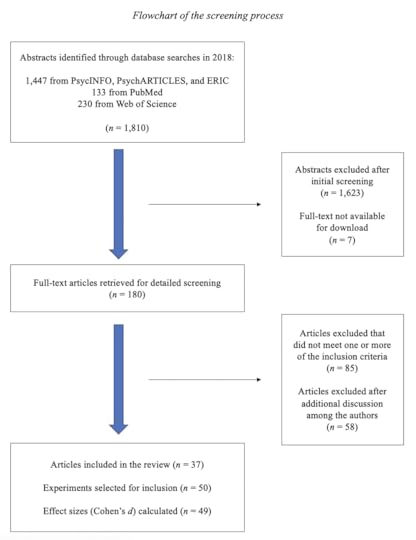
In this literature review, we developed a narrow operational definition for “classroom research” compared to previous reviews of the literature. We screened nearly 2,000 abstracts and systematically coded 50 experiments to establish a clearer picture of benefits from retrieval practice in real world educational settings.
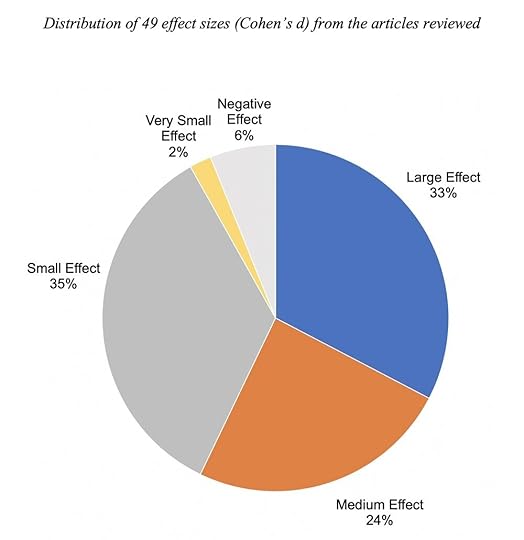
The literature review yielded 49 effect sizes and a total sample population of more than 5,000 students. The majority of effect sizes (57%) revealed medium or large benefits from retrieval practice (see pie chart below). We found that retrieval practice improved learning for a variety of education levels, content areas, experimental designs, final test delays, retrieval and final test formats, and timing of retrieval practice and feedback.
The vast majority of experiments reviewed (94%) were conducted in the United States and Western Europe, consistent with prior findings that the majority of published studies in psychology are conducted in WEIRD countries (western, educated, industrialized, rich, democratic countries). Only 3 out of 50 experiments (6%) drew samples from schools located outside the United States and Western Europe.
Based on this review of the literature, we make eight recommendations for future research and provide educators with a better understanding of the robust benefits of retrieval practice across a range of school and classroom settings.
Read the publication for more details and access the database to view all effect sizes.
Key Figures from the Literature ReviewClick here to read the literature review
Recommended citation:
Agarwal, P. K., Nunes, L. D., & Blunt, J. R. (2021). Retrieval practice consistently benefits student learning: A systematic review of applied research in schools and classrooms. Educational Psychology Review. doi.org/10.1007/s10648-021-09595-9
This project is registered on the Open Science Framework (OSF) at http://osf.io/mz2ks. This post was updated on August 5, 2021, based on a previous version that was published in October 2019.