The validity of the writer who doesn’t write
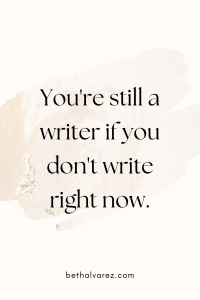
I’ve seen a graphic floating around recently. Maybe you’ve seen it, too. It talks about how it’s okay to take a step back from creating to do other things; you’re still valid as a creator if you take a break.
That’s probably something we should discuss more: the validity of the writer who doesn’t write, or the artist who doesn’t make art. I’m sure there are lots of things to be said about society and the expectation to be productive, but that’s not really where my thoughts went, so it’s not what I’m going to discuss today. Instead, I’d like to focus on a part that’s often overlooked: the need to not create.
My friend Megan shared a blog post last week about when you should write every day and when you should not. It was interesting to see her talk about it, because it was already on my mind when the post went up. ‘Cause you see, writing is hard, but sometimes not writing is harder… especially when you’ve already established the habit of writing daily.
The more I write, the faster I write, but it also means my high word counts are followed by deep crashes where I feel like I have no words in me at all. It’s like putting a kink in a garden hose. The water–the words–come out high-pressured when it’s unkinked, and there’s a deluge for a moment. Then the flow returns to normal, and then, sometimes, it ends up kinked again and the flow stops.
One of the hardest things I’ve had to start adjusting to is that it’s okay to work in spurts. Slow and steady is fine, but so is stopping to refill the well. Except my words aren’t always like a well. A well refills slowly, a trickle of water that seeps in through the ground until the level is back to where it was. Often, my productivity is more like a bird feeder. I’ll have a few days where the birds show up and peck a bit, maybe flutter and frolic a little, then go on their way. These are normal writing sessions. Standard production days. Then we have the days where a squirrel gets into the feeder, knocks the lid off, and sends the feeder swinging like crazy, spraying birdseed out in every direction. Often, this results in weird sprouts in the yard. But it also results in a feeder that’s empty after a moment of wild productivity, and it stays that way until I go out there to make a conscious, deliberate effort to refill it.
But what happens when I’m out there, tidying up and refilling the feeder? Not writing, that’s for sure. I can’t write until the feeder’s full again, because there are no words until I’m done.
Changing to block scheduling has helped this a lot. It gives me spells where I don’t need words, where I can take my time getting out there to refill my feeder and wait for my birds to come back. But it also means long gaps between writing sessions, and sometimes I feel bad for not making steady progress.
Does it matter? Not really, as long as the work gets done. We don’t always have what we need to refill our mental bird feeders with words. Maybe the store was out. Maybe we couldn’t afford it at the time. Maybe we just forgot, or the weather has been too bad to get it done.
The important takeaway here isn’t that the feeder is empty, though. It’s that it’s there. And whether or not it’s got seeds in it, its purpose is never changed. It never stops being a bird feeder, just like the writer who’s out of words doesn’t stop being a writer. Still there. Still valid. Still existing in just exactly the way it was meant to exist. It’s just empty for a bit, that’s all.
Refill when you’re ready. You’re still a bird feeder when you do.