Aimless Thoughts on “Purposeless” Ghosts
I’m in the editing phase of Certain Nocturnal Disturbances: Ghost Hunting Before the Victorians, and I’ve been thinking about types of ghosts. There are headless ghosts, for instance, who sometimes ride headless ghost-horses and are sometimes attended by headless ghost-postillions. That comes up in the book. But one of my chapters is devoted to a baffling case from the late 1700s, a haunting in which the manifestations don’t point to a particular type of ghost exactly. No, those manifestations appeared unconnected to any history at the house. Whispery voices were heard, but so was a sort of music. Was there more than one ghost? Disembodied footsteps came and went. Doors slammed on their own. A pretty good ghost hunt was conducted, but the only “solution” was to recommend the residents move away. And they did!
I present this case as an early example of a “purposeless” ghost before such ghosts were officially recognized by those who dealt with such things. Let me explain. For centuries, ghosts seemed to have had a mission or some unfinished business. The purpose might be to reveal one’s murderer. To rectify an unceremonious burial. To ensure that the proper party inherit the family loot. There’s a whole list, and upon achieving the goal, the ghost typically found peace and “moved on.” Some nasty phantoms came back from the grave simply to raise a ruckus, and their stories usually end with being forced to move on via exorcism.
 Eleanor Mildred Sidgwick (1845-1936)
In 1885, though, Eleanor Sidgwick found things had changed. After an exhaustive study of ghost reports submitted to the Society for Psychical Research — after winnowing down these hundreds of reports to the most reliable twenty-five — she found that ghosts don’t give a wooden nickel for tradition. They don’t have any particular fondness for old houses or for materializing on particular anniversaries. A history of crime or tragedy doesn’t appear to matter all that much. Indeed, Sidgwick reported:
[T]here is a total absence of any apparent object or intelligent action on the part of the ghost. If its visits have an object, it entirely fails to explain it. It does not communicate important facts. It does not point out lost wills or hidden treasure. It does not even speak. . . .
The purposeless ghost was netted and put on display.
A few years later, in a book titled Cock Lane and Common-sense, Andrew Lang differentiated what he called the “old-fashioned” ghost to “the modern ghost,” a.k.a. “the ghost of the nineteenth-century,” a.k.a. the purposeless ghost. Apparently paraphrasing Sidgwick’s report, he explained that this modern specter is much more shy:
He appears nobody knows why; he has no message to deliver, no secret crime to reveal, no appointment to keep, no treasure to disclose, no commissions to be executed, and, as an almost invariable rule, he does not speak, even if you speak to him.
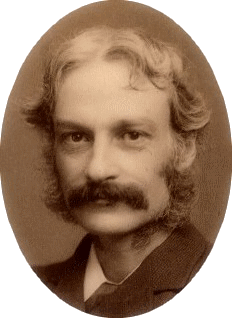 Andrew Lang (1844-1912)
Lang knew that ghosts hadn’t changed overnight. In an article published about the same time as the book, he clarifies that there wasn’t a sudden loss of spectral purpose:
The more probable theory is, that the old believers in the old-fashioned ghost chiefly collected and recorded the more striking and interesting cases — those in which the ghost showed a purpose (as a few modern ghosts still do) — while these anecdotes were, doubtless, improved upon and embellished.
In other words, the shift probably says more about ghostologists than ghosts. (Owen Davies dives a bit further into this point on pages 8-9 in The Haunted: A Social History of Ghosts.)
The upshot? What’s my purpose for this post? Hmmm, guess what… Well, maybe it’s just to report that Certain Nocturnal Disturbances is progressing nicely.
— Tim



 newest »
 Lovely article and I look forward to your book. Seems a bit odd that one expects a purpose for a ghost, though it does seem to be a regular theme--back for revenge or to protect the buried treasure...but let's think about life for a second. We don't always have a purpose-- say, a rainy Saturday afternoon, it could be a nap or a jigsaw puzzle. What if one died during the nap but was hesitant to move on to the next level? Perhaps that ghost would wander the house, maybe a cup of tea, maybe putter about in the bathroom, contemplate a book... I for one, don't have a purpose every moment of the day. I owned a pleasantly haunted house for 15 years. Lived in it for 5, rented it out for 10. Vera (I know!) was like a friendly aunt who really loved the house, her pantry, and order. She interacted with people, but just to let them know she was there. Flickering lights, turning on faucets, playing with laundry. What was her purpose? I think she was stuck. She stayed with the familiar house afraid to move on. Maybe she feared hell? Maybe she didn't know about the white light? No idea. She seemed content enough to putter about the house ,