Wednesday Wonder: Finding meaning
Welcome to Wednesday Wonder. For the next few weeks, we're continuing our LIVE collaboration experiment. Read more below!
Last week I admitted to losing my mojo at work. In a fun new experiment, I crowd-sourced your wisdom on meaning at work and WOW, you delivered! We received 469 incredibly helpful and insightful ideas about meaning and purpose at work.
Take a look...
Here's all your responses in a cloud!
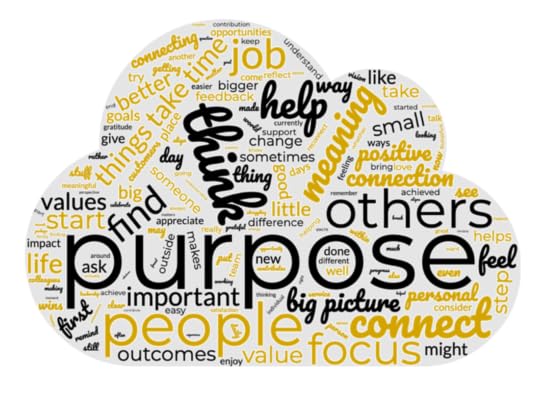 We asked how important a sense of meaning was in your work, and the results were an average rating of 9.0/10. Woh.
Then I asked how to rediscover meaning, when it's lost. There were heaps of incredible answers and suggestions - and most of them centred around three key areas:
1. Shifting perspective
"Look at the big picture. Your work will be helping somebody indirectly which is so cool!"
"I think zooming out and zooming back in. Checking out the big picture of how your work fits into the grand scheme of things, and then maybe digging around in nooks and crannies to consider the tiny little ways you contribute and make a difference."
"Shift your focus - go big or go small. It's easy to get stuck on aspects of our work such as endless emails, meetings, same routine day after day. "Meaning can be found by focusing at a different level, for example the one on one interactions you have with others that can make a difference in their lives (going small) or the ultimate good that results from your contribution to a bigger whole (going big). Play around with different perspectives until you find even a glimmer of meaning or purpose and focus on that. What you focus on will expand."
2. Focusing on how you help others
"Remembering how their work impacts the lives of others, no matter how small."
"Talk to others you work with or provide a service/product to. They may appreciate your work more than you do!"
"Flip that question on its head, a realisation that your contribution, no matter how small makes other wheels go around. Also it’s about humility and a strong belief in ‘service to others’. Believe in your team or community and strive to serve. Don’t look to be recognised, it will come when the people say, “we did it ourselves”
3. Connecting with your personal vision and values
"In my experience when this has happened it is generally because I have gotten caught up in stress or too much mental activity and am operating from my head rather than my heart - I have lost my connection with myself. So in the first instance I recommend taking steps to reconnect with yourself first."
"Undertake a values exercise, it forces you to consider aspects of yourself you don't often notice, pay attention to, or are aware needs nourishment. This helps you focus when it really matters for you."
"Find a cause you can PERSONALLY support by your work. Create a personal vision and mission bigger than the company, bigger than the self."
You can read all 469 responses by clicking here.
CHANGE SIGNALSThis week, I've been thinking about the warning signals that something needs to change. It stems from some work I'm doing around change and ambiguity.
It's a work in progress, but here's an early model that sums it up. It's similar to a Cynefin framework, providing a guide about the criteria we should use to make decisions, based on what's going on around us, and how important our decision is.
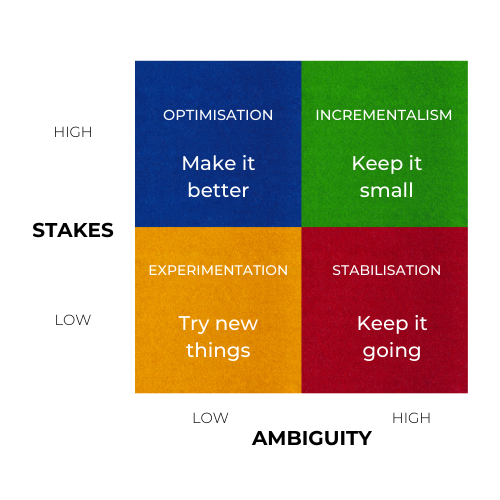
When there's low ambiguity and low stakes, we should try new things while it's safe. This is great for hobbies, outfits and activities!
When there's low ambiguity, but high stakes, we should look for the best solution, rather tham innovating. Here, we should do what's smartest for our wallet, time and big goals. This is usually true for large purchases, career and relationship choices.
When ambiguity is high, but decision stakes are low, we should keep things on an even keel. There's enough going on. If you're mid restructure and wondering whether to switch gyms or get a dog - don't. Wait.
When ambiguity is high, and the stakes are high, we should make decisions as small as possible, so we can shift as things change. So, if you're mid restructure and wondering whether to end your marriage... don't blow it up - but don't just let it sit, either. Small steps.
My initial work suggests this framework holds up whether we're looking at policy making, lifestyle choices or organisational change, but in the spirit of Wednesday Wonder, I'm open to your thoughts, ideas or examples!
Now, onto this week's Wonder! I'd love to know about your early warning system - how do you know it's time to change something? What advice do you give others?