Trailing bastons
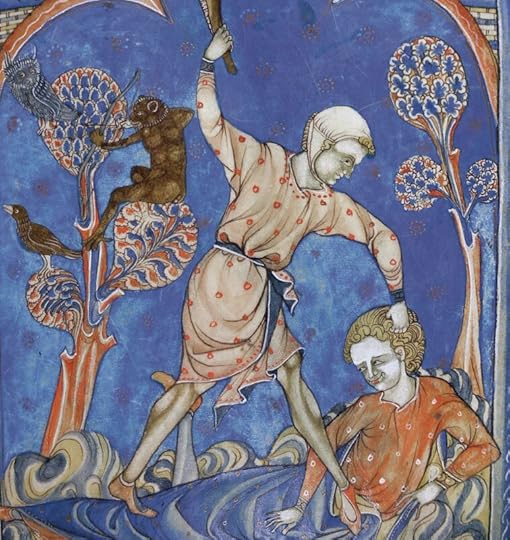 Trailing bastons.
The 'trailbaston' commissions were set up in the troubled last decade of Edward I's reign, ostensibly to deal with a crime wave in England. This was the result, supposedly, of the wars in France and Scotland that had destabilised law and order in England.
Some modern historians have argued that trailbaston was really a device to make money, rather than a reaction to increased crime. This interpretation is based on the notion that Edward needed to refill his depleted coffers, and so exaggerated the crime rate in order to introduce heavy financial penalties for offenders.
In her recent works, Caroline Burt has argued persuasively that the king was right to be worried. Edward himself described the state of disorder in England as being like the start of 'civil war', and the steep rise in business in King's Bench from every county in England speaks for itself.
What really happened was this. After the end of the Scottish war in 1304, Edward was once again able to focus on domestic government. He and his legists turned to the problem of gangs of malefactors – most of them ex-soldiers – who were wandering from place to place in England, killing and robbing at will. For instance, a commission issued at Newcastle in August 1303 speaks of 'vagabonds in league' committing 'depredations at night' and 'refusing to submit to justice'. The 'trailbaston' commissions themselves were named after the heavy clubs or 'bastons' that the robbers carried with them, literally trailing on the ground.
These new commissions had the power to investigate all felonies and trespasses committed in England since 1297. The most radical innovation was to prosecute offenders even if no private accuser could be found: this was unprecedented, and intended to prevent the intimidation of plaintiffs. As Burt said:
“It was clearly intended that there would now be no hiding place for those who had, as the king himself wrote angrily, flouted his lordship and whose outrages were like the beginning of civil war'.
In the short term at least, trailbaston was effective. In the last years of Edward's reign the crime rate plunged in most of the counties, although in some places it went up again soon after the succession of the new king, Edward II. The key problem was that too much depended on the person of the king: if he was distracted by external wars, or disputes at court, he could not give sufficient personal attention to law and order. This, however, was a fundamental issue of medieval kingship that no clever legal systems could fix.


No comments have been added yet.