
Gen. Slim Gets it Together, Part Two
We left General Slim last week contemplating the string of catastrophic defeats his Allied forces had suffered at the hands of their enemy in Burma and India.
The strength of the Japanese lay … in the spirit of the individual Japanese soldier. He fought and marched till he died. If five hundred Japanese were ordered to hold a position, we had to kill four hundred and ninety-five before it was ours—and then the last five killed themselves. It was this combination of obedience and ferocity that made the Japanese Army, whatever its condition, so formidable.
Worse, Slim’s own troops were reeling emotionally.
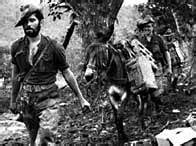 Jungle fighting was not like the movies
Nothing is easier in jungle fighting than for a man to shirk. If he has no stomach for advancing, all he has to do is flop into the undergrowth; in retreat, he can slink out of the rearguard, join up later, and swear he was the last to leave. A patrol leader can take his men a mile into the jungle, hide there, and return with any report he fancies. Only discipline—not punishment—can stop that sort of thing; the real discipline that a man holds to because it is a refusal to betray his comrades.
You and I as writers and artists also face an implacable enemy—the force of fear, self-doubt, and self-sabotage inside our own heads. How do we produce a countervailing force?
Morale is a state of mind. It is that intangible force which will move men to give their last ounce to achieve something, without counting the cost to themselves; that makes them feel they are part of something greater than themselves … I remember sitting in my office and tabulating these foundations of morale something like this:
1. There must be a great and noble object.
2. Its achievement must be vital.
3. The method of achievement must be active, aggressive.
4. The [individual soldier] must feel that what he is and what he does matters directly toward the attainment of the objective.
General Slim started with small-unit patrolling and ambushes. He sought successes for his troops to build their self-confidence.
We had now to extend this confidence to [larger] units and formations. [More ambitious attacks] were carefully staged, ably led, and, as I was always careful to ensure, in greatly preponderating strength. We attacked Japanese company positions with brigades fully supported by artillery and aircraft … [we assaulted] platoon posts by battalions. Once when I was studying the plan for an operation … a visiting staff officer of high rank said, “Isn’t that using a steam hammer to crack a walnut?” “Well,” I answered, “if you happen to have a steam hammer and you don’t mind if there’s nothing left of the walnut, it’s not a bad way to crack it.” At this stage [of the beaten army recovering its self-confidence], we could not risk even small failures.
I love too the characteristics that General Slim sought when he conceived of, or approved, an action against the enemy.
The principles on which I planned all operations were:
1. The ultimate intention must be an offensive one.
2. The main idea must be simple.
3. That idea must be held in view throughout and everything else must give way to it.
4. The plan must have in it an element of surprise.
These principles are not bad either for planning a book or a movie or any kind of artistic or entrepreneurial venture. And they worked.
The Arakan battle, judged by the size of the forces engaged, was not of great magnitude, but it was, nevertheless, one of the historic successes of British arms. It was the turning point of the Burma campaign. For the first time a British force had met, held, and decisively defeated a major Japanese attack, and followed this up by driving the enemy out of the strongest possible natural positions that they had been preparing for months and were determined to hold at all costs.
Within eighteen months, General Slim’s forces, despite their “forgotten theater” handicap of lack of supplies, weapons, and logistical support, were closing in on an even greater prize.
One of the gunners, stripped to the waist, was slamming shells into the breech of a twenty-five pounder [howitzer]. I stepped into the gun pit beside him. “I’m sorry,” I said, “you’ve got to do this all on half rations.” He looked up at me from under his battered bush hat. “Don’t you worry about that, sir. Put us on quarter rations, but give us the ammo and we’ll get you into Rangoon!”
Thank you, General Slim. You’ve just given us the mindset for our next novel, screenplay, art installation, dance, hip-hop album, Thai Fusion restaurant, tech startup, and run for political office.
The post Gen. Slim Gets it Together, Part Two first appeared on Steven Pressfield.


