
All wings are the same, in some ways
Here is a quiz with three very different wings, and a detailed explanation follows (don't peek).
With thanks to the online wing collection of the Slater Museum of Natural History, University of Puget Sound for allowing the use of these photos.
Quiz 19: All wings are the same?
Please wait while the activity loads. If this activity does not load, try refreshing your browser. Also, this page requires javascript. Please visit using a browser with javascript enabled.
If loading fails, click here to try again
Congratulations - you have completed Quiz 19: All wings are the same?.
You scored %%SCORE%% out of %%TOTAL%%.
Your performance has been rated as %%RATING%%
Your answers are highlighted below.
Question 1
 White-throated SwiftWhite-winged ScoterLaughing GullBlack SkimmerQuestion 2
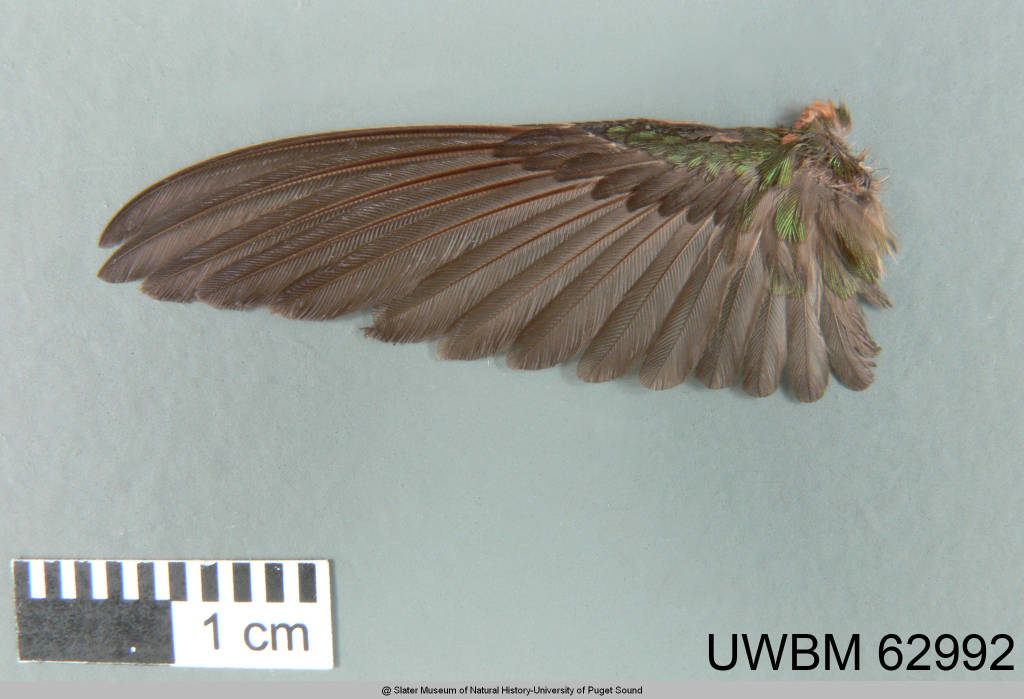 Wood DuckAllen's HummingbirdTennessee WarblerChimney SwiftQuestion 3
 Mexican Whip-poor-willNorthern FlickerMarbled GodwitBewick's Wren
 Once you are finished, click the button below. Any items you have not completed will be marked incorrect.
Get Results
There are 3 questions to complete.
You have completed
questions
question
Your score is
Correct
Wrong
Partial-Credit
You have not finished your quiz. If you leave this page, your progress will be lost.
Correct Answer
You Selected
Not Attempted
Final Score on Quiz
Attempted Questions Correct
Attempted Questions Wrong
Questions Not Attempted
Total Questions on Quiz
Question Details
Results
Date
Score
Time allowed
minutes
seconds
Time used
Answer Choice(s) Selected
Question Text
All doneNeed more practice!Keep trying!Not bad!Good work!Perfect!
$gf_formid_number
Discussion
Wings come in a tremendous array of sizes and shapes, but they all share the same basic structure. The primaries are the long feathers that form the wingtip, and are attached to the "hand" bones. The secondaries are the big feathers forming the inner part of the wing, attached to the "arm" bones. Each of these big flight feathers has a greater covert, and each greater covert has a smaller median covert, and so on up to the very small coverts at the leading edge of the wing.
The three species shown here – Black Skimmer, Allen's Hummingbird, and Northern Flicker – all have ten primaries (the outermost primary on the flicker is very small and nearly hidden). The secondaries always differ slightly in shape and color from the primaries, and you can probably guess where the change happens just by looking. To confirm, try counting the ten primary feathers back from the leading edge of the wing, and you will be able to see the subtle shift to the secondaries.
The number of secondaries is much more variable. Small land birds like flickers have about ten (passerines have nine), hummingbirds (with a very short "arm") have only six, while long-armed species like Black Skimmer can have twenty or more.
To understand wings and appreciate the differences more, try studying these three wings and thinking about the things they all have in common.


David Allen Sibley's Blog

- David Allen Sibley's profile
- 151 followers

