
Textual Variants within the Tefillin shel Rosh
Mathematically, there are 24 possible ways to arrange four different texts. Applying the halakha presented in the sources given to us in the texts included in this compendium reduce the possibilities to four and, not surprisingly, all four options have notable proponents. Many don both Rashi/Rambam and Rabbeinu Tam tefillin, and the last Lubavitcher Rebbe donned all four shitot (versions).
Rashi & Rambam: [1] kadesh li, [2] vehaya ki, [3] Shema, [4] vehaya im shamoa
Rabbeinu Tam: [1] kadesh li, [2] vehaya ki, [3] vehaya im shamoa, [4] Shema
Shimusha Rabba: [1] vehaya im shamoa, [2] Shema, [3] vehaya ki, [4] kadesh li
Ra'avad: [1] Shema, [2] vehaya im shamoa, [3] vehaya ki, [4] kadesh li
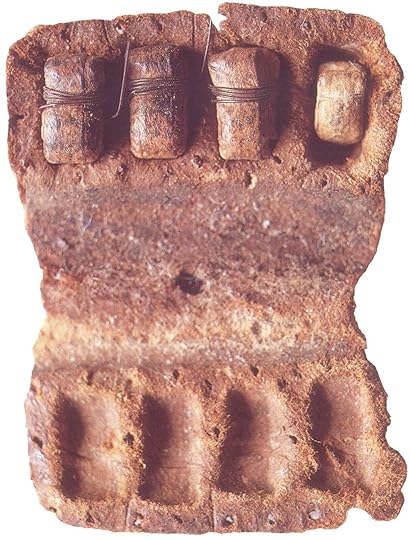 The tefillin found at Qumran (site of the Dead Sea Scrolls), over two dozen scrolls in total, are not helpful in resolving this makhloket as they do not match any of the above traditions. The order in one set (left) is [1] kadesh li, [2] Shema, [3] vehaya ki, [4] vehaya im shamoa (not original; a Beduin seller, apparently supposing that vehaya im shamoa belonged there, supplied it post facto). Three sets from Cave 4 bear texts which were not among the passages prescribed in the Talmud. One scroll was found containing Exodus 12:43-51, 13:1-10 (kadesh li), and Deuteronomy 10:12-19; another presents Deuteronomy 5:22-33, 6:1-3, and 6:4-6 (Shema); and on a third is inscribed Deuteronomy 5:1-21 and Exodus 13:11-16 (vehaya ki). In another set, the portions were removed before the order could be documented. It is worthy of note, however, that the sects associated with Qumran, i.e. the Yachad and the Damascus Covenant community, were non-normative communities, so any traditions found there which deviate from later Judaism might also have been aberrant with regard to normative Judaism of the Second Temple Era.


Halakhically and Hashqafically Historical

- Brian Tice's profile
- 8 followers

