
On solving the worldwide shipping crisis
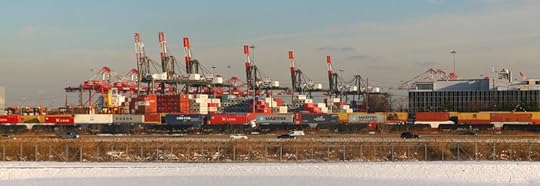
The worldwide shipping crisis is bad. Here are some reasons:
To wrap one’s head around all of those (and more), it might help to start with Aristotle’s four “causes” (which might also be translated as “explanations”). Wikipedia illustrates these with a wooden dining table:
Its material cause is wood.Its efficient cause is carpentry.Its final cause is dining.Its formal cause (what gives it form) is design.Of those, formal cause is what matters most. That’s because, without knowledge of what a table is, it wouldn’t get made.
But the worldwide supply chain (which is less a single chain than braided rivers spreading outward from many sources through countless deltas) is impossible to reduce to any one formal cause. Mining, manufacturing, harvesting, shipping on sea and land, distribution, wholesale and retail sales are all involved, and specialized in their own ways, dependencies withstanding.
I suggest, however, that the most formal of the supply chain problem’s causes is also what’s required to sort out and solve it: digital technology and the Internet. From What does the Internet make of us?, sourcing the McLuhans:
“People don’t want to know the cause of anything”, Marshall said (and Eric quotes, in Media and Formal Cause). “They do not want to know why radio caused Hitler and Gandhi alike. They do not want to know that print caused anything whatever. As users of these media, they wish merely to get inside…”
We are all inside a digital environment that is making each of us while also making our systems. This can’t be reversed. But it can be improved.
One way might be to build ways to fully (or at least adequately) comprehend whole systems that subsume and transcend the scope and interests of any part, whether those parts be truckers, laws, standards, or whatever. Global aviation has some of this, but it’s also a much simpler system than the braided rivers between global supply and demand.
Is there something like that? I don’t yet know. Closest I’ve found is the UN’s IMO (International Maritime Organizaiton), and that only covers “the safety and security of shipping and the prevention of marine and atmospheric pollution by ships.” Not very encompassing, that. If any of ya’ll know more, fill us in.
By the way, Heather Cox Richardson (whose newsletter I highly recommend) yesterday summarized what the Biden administration is trying to do about all this:
Biden also announced today a deal among a number of different players to try to relieve the supply chain slowdowns that have built up as people turned to online shopping during the pandemic. Those slowdowns threaten the delivery of packages for the holidays, and Biden has pulled together government officials, labor unions, and company ownership to solve the backup.
The Port of Los Angeles, which handles 40% of the container traffic coming into the U.S., has had container ships stuck offshore for weeks. In June, Biden put together a Supply Chain Disruption Task Force, which has hammered out a deal. The port is going to begin operating around the clock, seven days a week. The International Longshore and Warehouse Union has agreed to fill extra shifts. And major retailers, including Walmart, FedEx, UPS, Samsung, Home Depot, and Target, have agreed to move quickly to clear their goods out of the dock areas, speeding up operations to do it and committing to putting teams to work extra hours.
“The supply chain is essentially in the hands of the private sector,” a White House official told Donna Littlejohn of the Los Angeles Daily News, “so we need the private sector…to help solve these problems.” But Biden has brokered a deal among the different stakeholders to end what was becoming a crisis.
Hopefully helpful, but not sufficient.
Bonus link: a view of worldwide marine shipping. (Zoom in and out, and slide in any direction for a great way to spend some useful time.)


Doc Searls's Blog

- Doc Searls's profile
- 11 followers

