In Desert and Wilderness Acknowledgements and Insperation
I knew that translating my favorite novel, Henryk Sienkiewicz’s adventure, In Desert and Wilderness, was a project that I had in the pipeline for a while now. It was originally published in Polish 110 years ago; the other translations into English were done shortly thereafter. They make the text seem more dated than it actually is.
I wrote more about the process and challenges that I faced in translating it in the back of my translation of the book for those interested. However, here, I’d like to talk about how it became my favorite novel as well as the work that ultimately inspired me to put pen to paper.
My first thank you has to go to Pani Kamila, my first Polish teacher. There was no way she knew what she started when she gave a copy of In Desert and Wilderness to an over-stressed third year high school student – who, thanks to that, is now a PhD and novelist with 20 books in print.
Back then, I had just started learning Polish; despite whatever translation I had, I fell in love with the story. It was like a parody of Indiana Jones, if Indiana Jones were a fourteen-year-old Polish kid. It was over the top in an awesome way, I’d like to think, kind of like the stuff I write.
The story stuck with me; I finally read it in the original when I was studying for my Master’s degree at Uniwersytet Wrocławski in Poland. It was still my favorite novel. I picked up a hardcover copy of it at a flea market in Katowice, while traveling between Wrocław and Vienna.
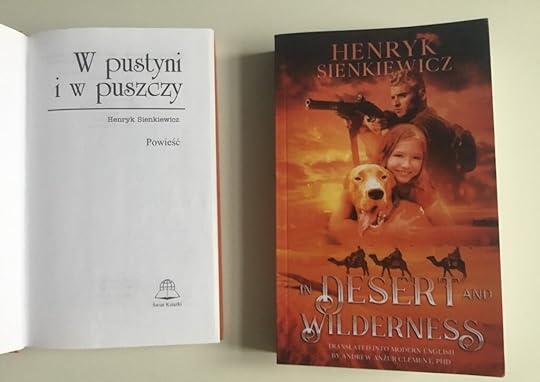 My well thumbed copy pictured left.
A few more years later, while I was a PhD candidate in England, I found out that my family was going to travel to Egypt, where much of the novel takes place. In Desert and Wilderness was the first thing I thought of. I discovered that someone had written a sequel to it, which called attention to the fact that Staś, the main hero, grew up in Africa and had never even been to Europe, let alone Poland.
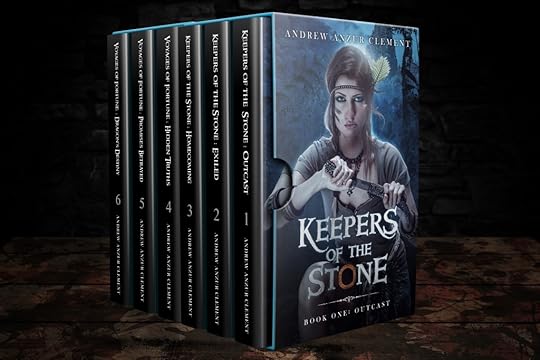
As I was doing a dissertation on European identity formation at the time, I started to write a fantasy story, which explores how much of an ‘upstanding Pole’ Staś really is. That turned into an entire trilogy, Keepers of the Stone, and then the sequel to that, Voyages of Fortune.
During this time, I needed to refer back to the original text. I found something — I don’t remember what — confusing, and wanted to know how others had referenced it in English. I found a translation on line.
I as absolutely shocked at what I saw and couldn’t believe that I’d fallen in love with the book in the first place. The translation was bad in such a way that it magnified certain outmoded attitudes which were common at the time the original book was written, rather that minimize them so that the story could shine through. The dialogue, which is, at times, quite funny in Polish, came across as stiff and stilted. I thought: “Why did I bother looking this up? I could do a better translation than this.”
Still, the book is in some respects a product of it’s time. Part of the reason I started to write my own continuation, was to have the characters from In Desert and Wilderness confront these attitudes as they go to Europe for the first time. I had many more of my own ideas for stories after that. The translation would have to wait.
As I was finishing up The Russia Chronicles — a darker thriller series about Russian street kids, in which the main protagonists would traditionally be considered societal problems — I decided that I needed a break from that gritty world. It was time to get back to my roots.
I sat down with my trusty copy of the book and got to translating. After the close reading that this required, I found that the book was subtly anti-colonial in many ways that I had previously realized. It felt like I was working with Sienkiewicz in a way, updating the story how it would be told today.
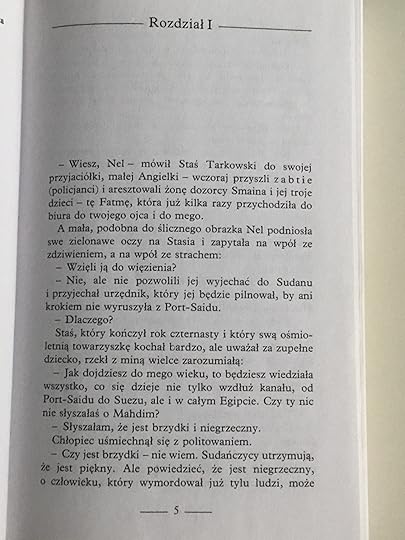
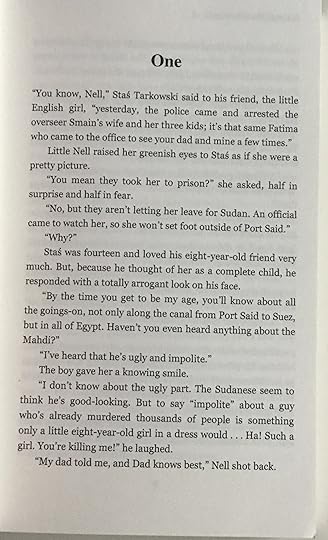
My thanks also go out to my mom, who is normally my first-line beta reader, but in this case sat down with me on Skype and went through the entire 450 page manuscript line-by-line with me, editing it, with me being able to refer back to the original text as needed, before it was sent to the editor.
At least I can say now that I have my own translation of the book that got me to put pen to paper, now ready to be enjoyed and re-discovered by a whole new generation of English-speaking audiences.
It’s the gift that keeps on giving, too. I’m currently working on another continuation of the story, which follows the fortunes of Kali and Mea, Staś’s African friends, after they return to rule Kali’s tribe. After that, I’m planning to do a completely modern re-telling of the story set in Pakistan and Afghanistan during 2020 and 2021.
Pani Kamila, wherever you are, you created a monster. Serdecznie Dziękuję!
In Desert and Wilderness is available here.