
Abrahams on the carpet
Here’s another “hand over your badge and your gun” moment, but without a badge or a gun. It comes from the movie Chariots of Fire, which won the Oscar for Best Picture and Best Original Screenplay in 1981.
I cite this to illustrate the “hero’s journey” beat in so many novels and movies, in which the hero is stripped of his institutional approval, in whatever form that may take, and must make the choice to continue his journey entirely on his own hook.
To set the stage:
Harold Abrahams (Chariots of Fire is a true story, by the way, and Abrahams a true historical character) is a Cambridge undergraduate slated to run in the hundred-meter dash at the 1924 Olympics. He’s also a Jew, experiencing all the subtle and not-so-subtle prejudices we might imagine in that era in an institution that represents the centuries-old soul of the English class system.
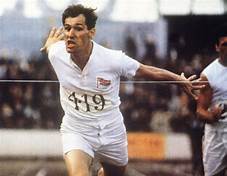 Ben Cross as Harold Abrahams in “Chariots of Fire”
In one scene, Abrahams is summoned to dinner with the Master of his college at Cambridge (Caius College, pronounced “keys”) played by Lindsay Anderson and the Master of Trinity College, played by Sir John Gielgud—both at their stuffy Old English best. Abrahams himself is played by Ben Cross. The three men meet in the Masters’ Rooms, a book-lined Gothic setting radiating history and tradition. All are attired formally.
Why has Abrahams been called on the carpet? It takes a few minutes before the two Masters get to the point.
TRINITY
Abrahams, I’m afraid there is a growing suspicion
in the bosom of the University that in your enthusiasm
to succeed, you have, perhaps, lost sight of [Cambridge’s
loftiest traditions.]
ABRAHAMS
May I ask what form this disloyalty takes?
CAIUS
It’s been said you use a personal coach.
HAROLD
Mr. Mussabini, yes.
CAIUS
Do I take it that you employ Mr. Mussabini on a
professional basis?
HAROLD
Sam Mussabini is the finest, most advanced, clearest
thinking athletics coach in the country. I am honored
that he considers me worthy of his complete attention.
CAIUS
Nevertheless, he’s a professional.
HAROLD
What else would he be, he’s the best!
TRINITY
Ah, well there, Mr. Abrahams, I’m afraid our paths
diverge. The University believes that the way of the
amateur can produce the most gratifying results.
HAROLD
I am an amateur!
TRINITY
(suddenly vitriolic)
You are trained by a professional. You have adopted a
professional attitude. For the past year you have
concentrated wholly on developing your own technique,
in the headlong pursuit, may I suggest, of individual glory.
HAROLD
I am a Cambridge man first and last. I am an Englishman
first and last. What I have achieved, what I intend to achieve,
is for my family, my university, and my country, and I
bitterly resent your suggesting otherwise.
CAIUS
My boy, your approach has been, shall we say, a little
too plebeian. You are the elite, and, as such, must be seen
to run rather to the manner born.
HAROLD
Would you prefer I played the amateur — and lost?
CAIUS
To playing the tradesman? Yes!
Abrahams regards the two Dons—petrified, as they are, in a bygone age. He stands. He extends his hand to Caius.
HAROLD
Thank you, sir! The evening has been most illuminating.
(to Trinity)
And good-night to you, sir!
Abrahams starts toward the door, then turns and faces back.
HAROLD
You know, gentlemen, you yearn for victory just as I do.
But achieved with the apparent effortlessness of gods.
Yours are the archaic values of the Prep School play-
ground. You deceive no one but yourselves. I believe
in the relentless pursuit of excellence — and I shall
carry the future with me!!
Caius and Trinity watch Abrahams exit. Trinity turns to Caius.
TRINITY
There goes your Semite, Hugh. A different God.
A different mountaintop.
See how Abrahams has been called on the carpet and ordered to “hand over his badge and his gun”?
Prior to this scene, Abrahams had trained and competed believing he did so with the blessing of his college and his university. He felt like a fully-vetted Englishman competing under the banner of his beloved native land.
By the time he exits this evening, however (even though he did not hear the “Semite/mountaintop” comment), Abrahams feels that the scales have fallen from his eyes. He realizes that he will never be accepted, at least not by the deeply conservative masters of his universe, as a true Englishman and member of the elect. He will always be, by one definition or another, “the tradesman.”
In hero’s journey terms, the stakes have gone way up in this scene. Abrahams’ inclusion among the elite has been jerked out from under him, exactly like a police detective being forced to hand over his badge and his gun. From here on, Abrahams realizes, it is him (and Sam Mussabini) against the world.
Our hero has been forced to make a choice. Does he cave or does he dig in and fight?
It seems that this beat, or a moment very much like it, is necessary in any hero’s journey story. How much, the hero must answer, do I really want my objective? What price am I willing to pay? For us as storytellers, that price must be as high as possible. The higher the price, the better the story.
P.S. Abrahams (in the movie and in real life) goes on to win the gold medal in the Olympics. The filmmakers give us a brief scene in which the Master of Trinity College is informed of this. Sir John Gielgud delivers his line with supreme aplomb.
SERVANT
He did it, sir! Abrahams. He won!
TRINITY
As I always knew he would.
Chariots of Fire was conceived by David Puttnam, written as a screenplay by Colin Welland, and directed by Hugh Hudson. Its producers were Jake Eberts, Dodi Fayed and David Puttnam.
The post Abrahams on the carpet first appeared on Steven Pressfield.


