Set a thief to...
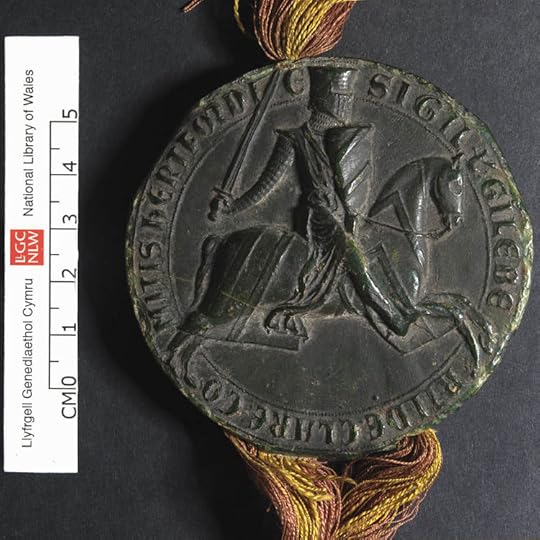 Attached is the seal of Gilbert de Clare (1180-1230), 5th Earl of Gloucester, 7th lord of Clare and 1st Earl of Glamorgan.
Clare succeeded to the lordship of Glamorgan in 1217, at a time when the lordship or honour was effectively split between English control of the lowlands and Welsh control of the upland region of Blaenau. The Welsh lords of Blaenau were being gradually drawn to the allegiance of Llywelyn ab Iorwerth, thanks in part to English inheritance policy. One bone of contention was the manor of Newcastle, which had been held by a Welsh lord, Leision ap Caradog. Upon his death the manor did not pass to his brother, Morgan Gam, but reverted to King John's former wife, Countess Isabel. This affront enraged Morgan, who was soon leading a revolt against Earl Gilbert.
Welsh incursions disturbed the lowlands in 1224, when the abbey of Neath was plundered. More widespread raids followed two years later, when the vills of Newcastle, Laleston and St Nicholas were attacked. These were probably led by Morgan Gam, who was captured and imprisoned by Clare in 1228. His kinsman Hywel ap Maredudd, lord of Misgyn, continued the fight and took a large war-band to Kenfig, where they sacked the town. Morgan was released in 1229, and the lowlands were still threatened when Clare died in 1230.
Morgan now joined hands with Llywelyn ab Iorwerth, who in 1231 brought his host into Glamorgan and destroyed Neath Castle. Kenfig was attacked and plundered a second time, although the castle managed to hold out. In 1232 the unpopular custodian of Glamorgan, Hubert de Burgh, was sacked by Henry III and replaced by Peter des Rivaux. This in turn – for various complex reasons, mostly involving money – triggered the revolt of Richard Marshal, Earl of Pembroke.
Marshal's rebellion was supported by most of the English knights of Glamorgan as well as Llywelyn ab Iorwerth and the Welsh lords of Blaenau. The handful of royalist knights, such as John de St Quintin of Llanblethian, were soon overrun. One of Marshal's chief supporters, Richard Siward, seized the St Quintin manors of Llanblethian and Talyfan, while Marshal granted lands to his Welsh followers. These included unspecified grants to Morgan Gam, Hywel ap Maredudd and Rhys ap Gruffudd of Senghenydd.
When peace was struck with the king in 1234, most of these lands were returned to their original owners. Siward, however, held onto his hands and 'persuaded' St Quintin to exchange them for lands in Wiltshire. Following the settlement, Siward was appointed royal custodian of Glamorgan: set a thief to catch a thief.
An uneasy peace reigned in Glamorgan until the death of Morgan Gam in 1241. His kinsman Hywel assumed leadership of the Welsh uplands, while the grasping Siward remained unsatisfied with his lot.


No comments have been added yet.