
CMP#55 Constance: the Weeping Heroine
 Clutching My Pearls is about Jane Austen and the times she lived in. The opinions are mine, but I don't claim originality.
Click here
for the first in the series. For more about other female writers of Austen's time, click the "Authoresses" tag in the Categories list to the right.
CMP#55: "Very good and clever, but tedious"
Clutching My Pearls is about Jane Austen and the times she lived in. The opinions are mine, but I don't claim originality.
Click here
for the first in the series. For more about other female writers of Austen's time, click the "Authoresses" tag in the Categories list to the right.
CMP#55: "Very good and clever, but tedious"
 As Austen scholar Devoney Looser points out in her Great Courses series, Jane Austen’s juvenilia shows that the young Austen was acquainted, not only with good books, but “with the opposite of great literature.”
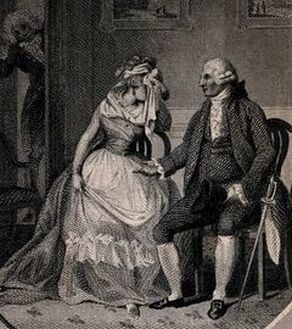
She read novels with “avidity” and wrote “incredibly perceptive send-ups of their tics and tropes,” such as the fainting heroine . If you haven't read Austen's juvenile burlesque of the sentimental novel, Love and Freindship, it's hilarious!
Austen loved novels, but she was also developing her ideas about what she wanted to avoid in her own novels. While she enjoyed a good sentimental novel, it seems that she decided very early on that writing sentimental novels with weeping heroines was not for her.
In contrast to the weepy, fainting, heroines of sentimental novels, it is notable how seldom Austen's heroines cry--and it's her sillier female characters who are rendered helpless by a crisis, as for example Henrietta and Mary Musgrove when Louisa falls off the Cobb in Persuasion.
Recently, I started in on the now-obscure novel Constance (1785), under the impression that it was written by Eliza Kirkham Mathews, an author I wanted to write a blog post about. I was well into the novel when I learned that Professor Jan Fergus had studied the account-books of the publisher and has shown that, in fact, Mathews is not the author of Constance.
The real author is Laetitia-Matilda Hawkins, but she kept her authorship a secret with the cooperation of the publisher. Reportedly, Hawkins' father wouldn't let her read novels so perhaps she also kept her authorship a secret from him! She didn't come forward as an author until after her father's death.
If I had planned to pick a Laetitia-Matilda Hawkins novel to read, I would have started with Rosanne, because we have Jane Austen's review of it: 'We have got "Rosanne" in our Society, and find it much as you describe it; very good and clever, but tedious. Mrs. Hawkins' great excellence is on serious subjects. There are some very delightful conversations and reflections on religion: but on lighter topics I think she falls into many absurdities...There are a thousand improbabilities in the story.' (Having been criticized for an improbability in my first novel , I do feel for Ms. Hawkins here.)
So this blog post will not be about Eliza Kirkham Mathews, but having gotten so far into the novel, I skimmed on to the end. Despite the occasional tediousness, I wanted to find out how Constance ended!
 Constance is a four-volume doorstopper with a “
picture of perfection
” heroine. In the first volume, Constance is engaged to her cousin, because her parents want the match and she's a dutiful girl. She likes him, but she gives him up promptly when he falls in love with someone else. This frees her cousin’s friend, Lord Calorne, to confess his love for her. And no wonder: Constance is beautiful, intelligent, and principled. But uh-oh, she’s so beautiful that rake-about-town Lord Farnford will not stop pursuing her. At this point Constance is living with her vulgar aunt. I thought she was a Mrs. Jennings type at first, but she turned out to have a more sinister side. The aunt incessantly pesters Constance to marry Lord Farnford, scorning the girl's scruples about this character and pointing out that he is wealthy, good-looking and popular. This is the heroine's best moment: like Fanny Price, she stands up to everybody.
Constance is a four-volume doorstopper with a “
picture of perfection
” heroine. In the first volume, Constance is engaged to her cousin, because her parents want the match and she's a dutiful girl. She likes him, but she gives him up promptly when he falls in love with someone else. This frees her cousin’s friend, Lord Calorne, to confess his love for her. And no wonder: Constance is beautiful, intelligent, and principled. But uh-oh, she’s so beautiful that rake-about-town Lord Farnford will not stop pursuing her. At this point Constance is living with her vulgar aunt. I thought she was a Mrs. Jennings type at first, but she turned out to have a more sinister side. The aunt incessantly pesters Constance to marry Lord Farnford, scorning the girl's scruples about this character and pointing out that he is wealthy, good-looking and popular. This is the heroine's best moment: like Fanny Price, she stands up to everybody.Farnford is willing to go to any lengths to obtain Constance's hand in marriage. He travels to her father’s estate and sweet-talks her dad (who needs money) into giving his consent to the match. Lord Farnford triumphantly brings dad's letter back to London and gives it to Constance.
After Constance has a good cry (naturally), she indignantly tells him, with a magisterial sentence that spools out into clause after clause: “If your lordship could be mean enough to rely on my father’s authority, you would soon see your error, he has an undoubted right to control all my actions, but he can have no dominion over my mind, nor will he, I am convinced, one moment urge the purport of his letter, when he knows how contrary it is to my inclination—his parental anxiety for my happiness, and the description of specious appearances have misled him; he will soon be better informed, and I hope, as you thought his patronage necessary in this influence, you will pay equal deference to his authority when he desires you to desist; your lordship was not ignorant of my opinion on the subject, and I must tell you that I cannot look on this privately obtaining the sanction of his approbation as any other than a very unhandsome method of endeavouring to impose on my judgement, and such as no gentleman would have adopted: it has however failed, and ever will fail.”
I enjoyed Constance's speeches in the first volume; by the third, the conversations between Farnford and Constance become tedious and interminable and made me wish she would just bash him over the head with a heavy vase. In this respect, Hawkins is like Richardson. We recall Henry Austen saying of his sister: "Richardson's power of creating, and preserving the consistency of his characters, as particularly exemplified in Sir Charles Grandison, gratified the natural discrimination of her mind, whilst [Austen's] taste secured her from the errors of his prolix style and tedious narrative." There are the usual timely and untimely parental deaths and amazing coincidences in Constance, but the suspense and drama of the plot mostly relies upon misunderstanding . Both the hero and heroine are “imposed upon,” that is, they are deceived about one another, not once but several times. You would think that the fourth time somebody tells Constance that Lord Clahorne has betrayed her, she’d say, “well, wait a minute, the first three times it was either an honest misunderstanding or somebody was actively deceiving me. I’ll check with him directly.”
Further, if you are contemplating inviting a heroine like Constance to be your house guest, you might want to think again, because of the drama she brings in her wake. Like Amelia Mansfield, she’ll take over your well-ordered peaceful life with crises, weeping, fainting spells and illnesses which will have you summoning physicians and clergyman at all hours, when you were hoping for a quiet evening in with a pot of tea and a book.
No amount of weeping, fainting, or falling into convulsions deprives our heroine of her striking beauty. Remember how Sir Thomas decided not to take Fanny Price down to see Henry Crawford: "when he looked at his niece, and saw the state of feature and complexion which her crying had brought her into, he thought there might be as much lost as gained by an immediate interview."
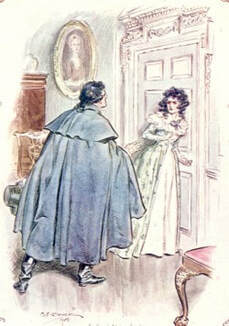 “I mean”—said he, with serious energy—“if I can, to make you hate me one degree less than you do now. By the end of volume 3, after several incidents in which Constance is unfairly persecuted, she is on the eve of marrying the man she loves. Farnford abducts her (for the second time!) and tricks Constance into a marriage ceremony.
 Volume 4 is devoted to cleaning up the mess and reuniting Constance with Lord Clahorne. This includes a long letter of apology from Lord Farnford, reviewing and explaining his actions.
(If Sense & Sensibility was originally an epistolary novel , as scholars believe, then Willoughby's dramatic explanation/apology would likewise have been a letter in the original version, a long monologue without Elinor's interjections.)
Four volumes gives Ms. Hawkins enough time and space to bring her heroine and hero to the brink of death and back, and nearly kill off her bad guy as well. Lord Farnford is redeemed by Constance’s sterling moral virtue. Basically we have our cake and eat it too; we nearly have a tragic ending with three dead people, followed by a happy ending with two marriages, plus a restored fortune.
Hawkins must have been encouraged with the reviews she got for her debut novel. The Monthly Review said Constance was “one of the best-written productions of this sort that has appeared since Cecilia.” The Critical Review said: “In this artless narrative, the incidents are numerous and striking, the situations interesting and pathetic, the morality unexceptionable (that is, no-one would take exception to the moral lessons).” The novel reminds us what a constrained life young women led in those days; how impossible it was to travel without an escort, or even leave your box at the opera and get to your carriage without an escort. This close supervision helped to preserve ladies from “insult,” and kept their reputations above suspicion.
In an earlier quote of Hawkins I referenced , she is very sympathetic to the situation of “fallen woman.” Likewise, there are two fallen women in Constance, and the heroine behaves with compassion toward them and wants to hold the men who seduced them accountable.
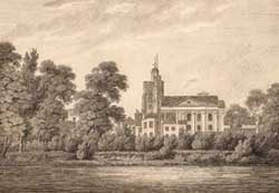 St. Mary's Church, Twickenham. Laetitia-Matilda Hawkins (1759-1835) acted as her father’s secretary when she was still a child. He was a magistrate, and the first biographer of Samuel Johnson (although his book was severely panned by the critics, unlike Boswell's). Hawkins is identified as a conservative writer. She weighed in on the French Revolution debates of the late 18th century. Perhaps her first-hand experience of the Gordon Riots of 1780 in London in made her especially wary of populist uprisings. Also, she spoke out sharply against the exploitation of India, which goes to show that the issues of slavery and colonialism crossed the left-right divide. Through her father, she knew many of the prominent people of the 18th century, including Johnson, and she wrote several books of anecdotes about them. The
Twickenham Museum
describes her as "a local gossip." There is a memorial plaque to her and her brother in St. Mary's church, Twickenham. I could not find a portrait of her, but she is described as being very tall, with strong features. Fergus, Jan. “Laetitia-Matilda Hawkins's Anonymous Novels Identified.” Notes and Queries, vol. 54, no. 2, 2007, pp. 152–156.
St. Mary's Church, Twickenham. Laetitia-Matilda Hawkins (1759-1835) acted as her father’s secretary when she was still a child. He was a magistrate, and the first biographer of Samuel Johnson (although his book was severely panned by the critics, unlike Boswell's). Hawkins is identified as a conservative writer. She weighed in on the French Revolution debates of the late 18th century. Perhaps her first-hand experience of the Gordon Riots of 1780 in London in made her especially wary of populist uprisings. Also, she spoke out sharply against the exploitation of India, which goes to show that the issues of slavery and colonialism crossed the left-right divide. Through her father, she knew many of the prominent people of the 18th century, including Johnson, and she wrote several books of anecdotes about them. The
Twickenham Museum
describes her as "a local gossip." There is a memorial plaque to her and her brother in St. Mary's church, Twickenham. I could not find a portrait of her, but she is described as being very tall, with strong features. Fergus, Jan. “Laetitia-Matilda Hawkins's Anonymous Novels Identified.” Notes and Queries, vol. 54, no. 2, 2007, pp. 152–156.


No comments have been added yet.


