
 Could not find Kindle Notes & Highlights for that user.
CMP#52 In Defense of Colonel Brandon
 Clutching My Pearls
is my ongoing blog series about my take on Jane Austen’s beliefs and ideas, as based on her novels. Folks today who love Jane Austen are eager to find ways to acquit her of being a woman of the long 18th century. Further, for some people, reinventing Jane Austen appears to be part of a larger effort to jettison and disavow the past. Click here for the first in the series.
Colonel Brandon: Old-Fashioned Guy or Moral Monster?
Clutching My Pearls
is my ongoing blog series about my take on Jane Austen’s beliefs and ideas, as based on her novels. Folks today who love Jane Austen are eager to find ways to acquit her of being a woman of the long 18th century. Further, for some people, reinventing Jane Austen appears to be part of a larger effort to jettison and disavow the past. Click here for the first in the series.
Colonel Brandon: Old-Fashioned Guy or Moral Monster?
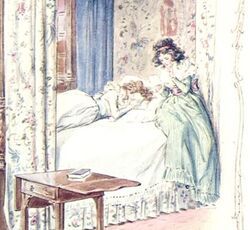 Marianne gets a letter from Willoughby Scholars generally agree that Sense & Sensibility began life as an epistolary novel, a novel in letters. This is a form of novel which was rapidly losing popularity at the time, which may be why Austen re-drafted it as a narrative.
It is puzzling to try and backwards-engineer the Sense & Sensbility we have today as an epistolary novel – who is writing letters to whom? The critic Brian Southam surmised that Elinor and Marianne each had a girl friend, a confidante, that they wrote to, which means that in the re-write these best friends were excised. I doubt it; I don't think Austen would eliminate two major characters from a book. I think it's more likely that Marianne and Elinor are separated for most of the time and are writing to each other. Perhaps only Marianne went to London with Mrs. Jennings, in pursuit of Willoughby, and poured out her hopes, her fears, and her final betrayal in letters to Elinor.
With such a version, you wouldn't need Margaret, the third sister, as a character because as I noted in my Mother's Day post , Margaret's only useful function in the novel is to keep her mother company when both of the older girls go to London. So perhaps Austen didn't edit out two female friends, maybe she edited in Margaret.
The novel as we know it is told through Elinor’s consciousness. And since she doesn’t confide in anyone, what would her letters say? “Having a quiet time in Devon, I visited with Lucy Steele, everything's fine, don't worry about me”? I can't explain how Austen would have handled the Edward-Lucy-Elinor plot with letters.
But there are some recognizably 18th century vestiges in the novel. One is the frequency of the Johnsonian cadence .His abilities in every respect improve as much upon acquaintance as his manners and person.In showing kindness to his cousins therefore he had the real satisfaction of a good heart; and in settling a family of females only in his cottage, he had all the satisfaction of a sportsman…My gratitude will be insured immediately by any information tending to that end, and hers must be gained by it in time. We met by appointment, he to defend, I to punish his conduct.Do not, my dearest Elinor, let your kindness defend what I know your judgment must censure. Another 18th century remainder is the “inset narrative.” That’s when one character takes center stage and explains their backstory, as Colonel Brandon does in Sense & Sensibility. The device of the inset narrative would have been a familiar one to Austen's readers; it appears in other 18th century novels. In Jane Austen and the Fiction of Her Time, Mary Waldron gives the examples of the novels of Henry MacKenzie, or Maria Edgeworth's Belinda. Austen breaks up this story-within-a-story with exclamations and reactions from Elinor, and she tells us that Brandon has to interrupt himself to try and regain his composure. In the original version, his tale could have been told in more detail in a series of letters to Elinor, with breaks at the dramatic parts: ("even now the recollection of what I suffered—”)
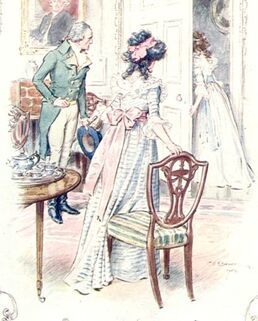 Marianne has no time for Colonel Brandon In the inset narrative, Colonel Brandon tells Elinor about how his elopement with Eliza, the girl he loved, was thwarted. He left England with a broken heart and went with his regiment to the East Indies. He came back to find Eliza dying, and she entrusted her illegitimate daughter to him. He brought her up, that is, he provided for her in the same way that Harriet Smith was provided for in Emma. Who knows what he planned to do for her when she grew up and got engaged? But instead, Eliza was seduced by Willoughby. “Such,” said Colonel Brandon, after a pause, “has been the unhappy resemblance between the fate of mother and daughter! and so imperfectly have I discharged my trust!”
 Brandon fought a duel with Willoughby: “we met by appointment, he to defend, I to punish his conduct. We returned unwounded, and the meeting, therefore, never got abroad.” Perhaps Willoughby fired first and missed, and Brandon fired his pistol into the air in a gesture of contempt. And for what it's worth, Brandon has presumably faced danger in battle while Willoughby loafed around in England.
The man that Marianne thinks is her beau ideal turns out to have feet of clay. As Mary Waldron says, Willoughby talks romantically but acts rationally in abandoning Marianne for a wealthy heiress.
Colonel Brandon's story, then, is like the plot of a sentimental and tragic novel. He loved Eliza, and now he loves Marianne, with a chivalric kind of love. He has an elevated, idealistic view of Womankind. He is horrified when he hears of Eliza’s divorce because he knows it means she’s committed adultery. This is enormously painful to him; better that she had died like a sentimental heroine than stooped to this kind of dishonour. On top of that, he gives a valuable living away to Edmund Bertram – a man he barely knows -- in the assumption that he is helping him marry the girl he loves.
Brandon loves Marianne silently and hopelessly. It's so poignant when John Dashwood says to him: “one must allow that there is something very trying to a young woman who has been a beauty in the loss of her personal attractions. You would not think it perhaps, but Marianne was remarkably handsome a few months ago; quite as handsome as Elinor. Now you see it is all gone.” Austen doesn't give us Colonel Brandon's answer. He's just standing there quietly, his heart bleeding for Marianne.
Willoughby never was the romantic hero. Willoughby was an imposter. Colonel Brandon stands revealed as the true romantic hero.
But not according to Helena Kelly, who casts a jaundiced eye on all of Austen's heroes except for Darcy in her book, Jane Austen: the Secret Radical. She suspects Brandon of lying about his relationship with Eliza. She thinks he seduced Eliza and got her pregnant, then scampered off to India when she got married to his brother. When he judges Eliza for slipping from the paths of virtue, he's covering up his own guilt in the matter.
Brandon is already in Kelly’s bad books because of his India connection. Serving with the army or with the East India Company’s army in India means that he’s a colonial exploiter. "Brandon is tainted by association."
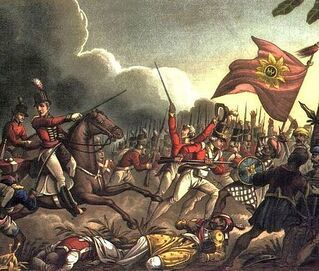 Battle of Assaye in India It's true that public opinion about India was mixed in Austen's time and it became a long-standing political issue as well. I could go on a long digression about India and colonialism. But the question is, how did Brandon's colonial connection go down when Austen published the book? The knock
against "nabobs"
-- guys who got rich in India -- is that they were vulgar social climbers. Some people also condemned the exploitation of India. But on the other hand, the East Indies was an outlet and an opportunity for the younger sons of the gentry, and Austen's readers were the gentry.
Battle of Assaye in India It's true that public opinion about India was mixed in Austen's time and it became a long-standing political issue as well. I could go on a long digression about India and colonialism. But the question is, how did Brandon's colonial connection go down when Austen published the book? The knock
against "nabobs"
-- guys who got rich in India -- is that they were vulgar social climbers. Some people also condemned the exploitation of India. But on the other hand, the East Indies was an outlet and an opportunity for the younger sons of the gentry, and Austen's readers were the gentry. I'll refer you again to historian Rory Muir's book, Gentlemen of Uncertain Fortune: How Younger Sons Made Their Way in Jane Austen's England. Our Colonel Brandon, like all younger sons, had to find a profession, and in those days, his options were severely limited: basically the army, the navy, the church or the law. He was limited by social strictures and, because it was a pre-industrial age, there weren't that many job choices out there. Brandon can't start his own environmental consultancy or IT start-up. So he did what thousands of younger sons did -- he joined the army. Austen's readers would have been thoroughly familiar with this scenario -- it was what many of the young men in their own families had done or would do. It would be a mistake to think that many readers blamed Brandon for going to India, even if British involvement with India was criticized at the time.
Brandon is not a "nabob" -- that is, he didn't go to India to get rich, he went over as an officer in an army. So too did the foremost hero of the age, Arthur Wellesley, 1st Duke of Wellington . He was a younger son, too.
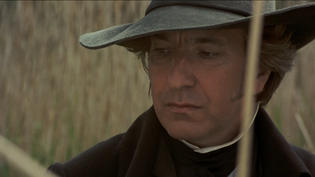 Austen sent Brandon abroad for plot purposes, then elevated him from younger son to estate owner by killing off his brother. That's just straightforward plotting stuff. Brandon inherited the estate five years before the commencement of the book, which would have been when his ward Eliza, the daughter of Eliza, was ten years old or so. Dr. Kelly suggests that Eliza Jr. had a moral right to her mother's inheritance, which Brandon's father snagged for the family. We're left to surmise how Eliza Jr. and her daughter live out their lives. Mrs. Jennings thinks Eliza Jr. would have been apprenticed out at small cost -- apprenticed to a milliner, perhaps. I've no doubt Eliza Jr. and her child would be well-supported financially by Brandon, but socially, she's off the board in terms of making a genteel marriage.
But the real question is, does Austen portray Colonel Brandon as a secret villain, or does she portray him with sympathy? In both of these things -- his excursion to India and his reaction to Eliza's fall from virtue, Brandon is behaving as a man of his time. So I doubt that Austen's readers would have condemned him for it. In the beginning of this series, I tried to make the case that we may think of ourselves as morally better than 18th century people, but we are certainly much, much, richer . We have birth control and a social safety net and the consequences for someone like Eliza are very different today.
The practical objection to recasting Colonel Brandon as a moral monster is that it makes no sense in terms of the emotional payoff and the narrative structure of Sense & Sensibility. And while Austen does have an ironic tone, you don't write a paragraph like this at the end of your book and intend it ironically:
"Colonel Brandon was now as happy, as all those who best loved him, believed he deserved to be;—in Marianne he was consoled for every past affliction;—her regard and her society restored his mind to animation, and his spirits to cheerfulness; and that Marianne found her own happiness in forming his, was equally the persuasion and delight of each observing friend. Marianne could never love by halves; and her whole heart became, in time, as much devoted to her husband, as it had once been to Willoughby."
My final argument in favour of Colonel Brandon? Two words. Alan Rickman. Ellen and Harriet, the podcasting ladies behind Reading Jane Austen, have a great series on Sense & Sensibility (and they have done Pride & Prejudice too!) Click here for their website. They did a deep dive on the Colonel Brandon/Eliza Williams timeline and you can find it here.
Dame Emma Thompson changed Eliza William's backstory in the 1995 movie. (Here is the scene where Mrs. Jennings tells Elinor about Eliza). She wasn't an heiress, so no-one filched her money. "Eliza was poor," says Mrs. Jennings.
The real-life abolitionist, James Stephen, tells his backstory to Fanny Price in my novel, A Contrary Wind. Stephen was quite the scamp in his youth! Click here for more about my novels.


No comments have been added yet.


