A Pow Wow With Kitty Sutton

Today I Pow Wow with Kitty Sutton, who writes historical fiction based on her Cherokee heritage. Her stories are mysteries, for the most part, and feature exceptional vignettes of Cherokee life. Kitty was my guest on The Book Junkies Interview Livecast on 2/15/2012. Please take some time and listen to that amazing interview here:
1. When did you decide to get serious about your writing?
I had actually been writing for many years, but it was more for myself. In 2010 I joined an online writing group called Writing.com. It was there that I discovered my preferred genre. On that site there is always something going on that can challenge your abilities, to write in ways you had not tried before. I entered a couple of contests that required short stories based on Native American or First Peoples themes. I wrote my stores and was surprised to find out that I won both contests. Finding my niche was an important step, because before that I was not sure and did not have any confidence in my abilities. It was ironic in a way because I am Cherokee and so is my husband, but it had not occurred to me to try to write in that genre before.
2. Which writers have inspired and influenced you?
I have a wide range of writers that I feel inspired me. First would be Charlotte Bronte' who wrote Jane Eyre. That book set me on the road to loving literature. Then in 2004 I had to quit my show in Branson because of illness and I found myself with some time on my hands with restrictions to what I could do physically. I began to read historical fiction books by Anne Perry. She has been a huge inspiration to me. Then I began to notice books about pre-history and the First Peoples of North America. Inspiration came from writers such as Kathleen and Michael Gear and their People series of books, and Richard S. Wheeler who writes historical fiction about the plains tribes during the fur trading years.
3. Share some information about your books with us:
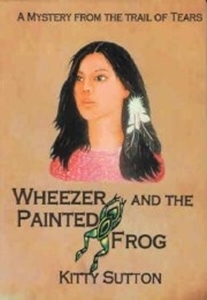
Wheezer And The Painted Frog is a Native American historical fiction mystery set in Indian Territory, now Oklahoma. It begins in the spring of 1839, immediately after the last group of Cherokees, removed from their homeland in the east, were unceremoniously left to fend for themselves after an over 1,100 mile march called the Trail of Tears, where over 4,000 Cherokee died.
Sasa (Swan) a thirteen year old Cherokee girl finds herself alone after all in her family dies. She finds and saves a lost dog who she names Wheezer. He is an extremely smart dog and he soon smells a human rat, but struggles to find a way to communicate what he senses is dangerous. His original owner, Jackson Halley, looks desperately for him, and when he finds Sasa and Wheezer together, they all become fast friends and soon set about solving the mystery of the reason why her five year old brother Usti Yansa (Little Buffalo) died.
Healthy little boys shouldn't grow weak and die when they have shelter, food and the care of their families, yet Sasa's little brother, the last of her family, sickens, mumbling the mysterious "I didn't do it right, I didn't do it enough. Why didn't it work?" Left alone, mourning and trying to survive in a new place with new ways, Sasa seeks answers with the help of her new friends, Wheezer and Jackson. The Jack Russell Terrier seems too wise, too fierce and too loyal to be just a dog. Did the Creator send Wheezer to Sasa and if so, how can a dog, albeit a smart one, help to solve a murder? Together, they discover a vast network of systematic plundering of the government funds earmarked for the Cherokee called the Allotment. Can they discover who is at the root of it all?
4. What started you on the journey to write this stories?
I had been working on my ancestry and was having a hard time running down some facts about my Cherokee roots. I wondered if there had been any stories written about what the families experienced once they were left in that very different land. The more I looked, the more I became indignant that there had not been anything written and I started doing some research. I found out that the newspapers had received many letters of disgust over the horrible things they printed about the deaths on the Trail of Tears. The paper companies were afraid of losing their readership, so they removed all of the newsmen out of the Territory. There was no one there to document what was about to happen.
This is a story based on an event that has never been written about before. I know this because the months of research I did to find out about this event revealed the absence of either fiction or historical literature. The event began in 1839, so that is where I began my story. The Cherokee were promised by Treaty to receive food supplies that would get them through the first year. Some of the Cherokee camps, though, did not receive food supplies that were edible. In fact they were rotten or full of bugs, the meat putrid. The reason for this was that the funds for these allotments were being drained off by greedy white men. The same men who were charged with protecting them. Their greed caused the deaths of another 1,000 Cherokees in that first year. They died of starvation.
5. How would you describe your literary voice and what do you think makes it unique?
I prefer to speak in the voice of each character instead of picking one POV. The name for this POV is Omniscient. With this POV I can say what the person thinks as well. I change scenes and it becomes a new POV of a different character. In this way I can reveal what is in the mind and heart of even the villain. Wheezer, the Jack Russell Terrier in my book also has his own POV. It is extremely freeing to me to write this way. I had a reviewer say that she had never read a book that used this technique, but she said it was extremely exciting. It made the story more real to her and she got closer to the characters than she normally would have. I have heard that same comment from several readers of my book.
6. What is your process for creating characters? What do you do to get them to feel genuine to your readers?
Since I must make sure I relate the historical part correctly, I must devise a likely scenario of how these things came about. I wanted my main character to begin the series as a child, and much of the book is seen through her eyes. I had to find characters to fill out the plot of land grabbing and the conspiracy to skim off the funds for the allotments so I added the villains and their "support" staff. In that day it would have been in the south and slaves were common. In the Characters of Jackson Halley and his father Andrew Halley I was able to establish how the money was handled from the government and passed down to the suppliers in order to demonstrate where the money could be skimmed off. There are Cherokee in the same camp as Sasa that I created in order to give the feel of the confusion and depressed feelings within the camps in the Territory. Each character has a need to be there including Wheezer.
7. What genre do you most love to read? Are your books exclusive to that genre?
I love to read pre-historical fiction about the First Peoples. In other words the ancestors of the Native Americans. Both of the short stories I told you about earlier were of that genre. I, too, could have written a book based on the archaeological finds of today, but, I chose to write about these untold events in the not too distant past because I felt they would be lost if I do not.
8. What does writing do for you, personally? How does it make you feel?
It satisfies the creative desire. No, it is not like performing in front of a huge audience, but it does satisfy some of that desire. In 1979 I began writing for the first time as a type of therapy. That book is not finished yet, however my publisher has read what I have and we are planning it's release after the Mysteries From the Trail of Tears series of done.
I was able to write the things I could not say. I used other characters to play the parts so it was happening to someone else and not me. It was probably the things that helped me progress and get past a black period of my life.
9. Are there other genres of fiction that you would like to explore in the future?
Yes, I would like to do some comic or humorous stories. I hope I will be able to do that some day.
10. What new projects are you currently working on?
I am working on the second book in the series and it is called, Wheezer And The Shy Coyote. It will cover another little known event that has played a huge part in the lives of all Native Americans today. I don't want to reveal too much. Wheezer will still be there doing what he does best.
11. What is the story you remember best from childhood, and does it still influence your writing today?
Jane Eyre by Charlotte Bronte. Yes it does influence me today. She wrote about a similar experience of the life that I lived and it felt comforting to know it.
12. Where do you see yourself as a writer five years from now?
I hope by then that I will have several books under my belt and that I have figured out the best way to promote them.
13. Is there anyone you'd like to give a a shout out to?
Yes, two actually. First would be to Inknbeans Press and all their other authors. They noticed me on Facebook and invited my manuscript, I will never forget it. Second would be to Annarita Guarnieri in Italy. After I had been approached by the publisher, even though she was in Italy and English was her second language, she offered to help me with my first edit and she asked nothing from me. She is an amazing person.
14. Any last words for our readers?
I am hoping that they will see how important historical fiction really is. In my case, I hope that I can preserve obscure events which have left barely a footnote behind, but are extremely important to our learning about our ancestors. I hope they will want to read all the books in the series.
Find Kitty here:
InknBeans Press Kitty's Blog