Our Fascination with Secret Codes
Lastweek a helpful reader sent me a link to a website about secret codes. The site, run by Elonka Dunin, hasinteresting stories about codes and ciphers, both the solved and the unsolved.
Fora novel writer, the concept of a code is difficult to understand. We write stories, and then try to share themwith readers. Most novelists strive forclarity--we want the reader to understand the story so we work hard to make itclear. And the more people that read it,the better.
Acode is something very different. Whether it's a secret message between lovers or governments or criminalconspiracies, there is a deliberate effort to make sure others don't readit. Should the message fall into thewrong hands, the coders hope their methods are strong enough to resist beingcracked.
It'sa very odd mindset, and yet secret codes stir our imagination. And people have been using codes for a verylong time. In some cases what we label acode may simply be an ancient language system we haven't figured out. For example, the Phaistos Disc or Linear A,both discovered on clay tablets on the island of Crete from about 1800 BC. Or the Indus Script, which contains 400 signsfrom the Indus Valley civilization of 2600 to 1800 BC. These may be ancient languages rather thanpurpose-built secret codes.
Butmost codes are designed to hide information. The famous Voynich Manuscript is a good example of a code we've yet tosolve. The manuscript is named after abook dealer named Wilfrid Voynich, who discovered it in a collection of ancientmanuscripts in Italy in 1912.
TheVoynich Manuscript not only has pages of text in a language no one has everseen, it also has strange drawings of plants, astronomy, and people. One drawing looks like seven naked women in alarge hot tub, which may mean this is the oldest known example of an eighthgrade boy's spiral notebook.
However,the Voynich Manuscript also contains an interesting spiral drawing that isclose to a mirror image of our galaxy, the Milky Way. Even the history of the manuscript isodd. A mysterious stranger arrived atthe court of King Rudolph II of Bohemia in 1586 with an old, indecipherablemanuscript. Now Rudolph was fond ofastrology and other forms of weirdness, so he paid the stranger 300 gold piecesfor the book. A note with the manuscriptstated that Roger Bacon, the English astronomer of the 13th century, hadwritten the coded work.
Fourhundred years later, and we still don't know who wrote it or what it says. But some codes have been solved.
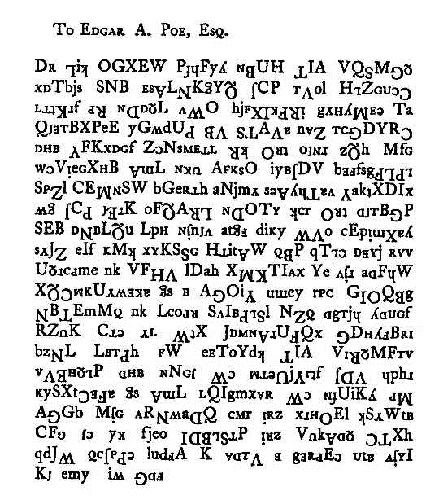
EdgarAllan Poe was fascinated with codes, and issued challenges in magazines toother amateur cryptographers in the late 1830s. Poe eventually released two ciphers in a magazine, claiming they'd beensent in by a reader, but he may have designed them himself. These two codes remained unbroken until 1992,when the first was solved, and 2000 for the second code.
Ithink this is part of the lure of codes--that clever amateurs can design theirown and crack those of others. It's nota realm completely restricted to governments and their vast resources. Anyone who has an interest can learn about codesand try to make their own.
Orattempt to solve a historical code that has confounded others for hundreds ofyears. Maybe you'll solve one.
(By the way, there are no hiddencodes in this blog post. Sorry. However, you can find Elonka's interestingsite here, plus an article on the Voynich Manuscript, and one on Poe'schallenge and how it was solved. The pictureis from Bokler and shows E. A. Poe's second code.)


No comments have been added yet.