What was an Anchorite?
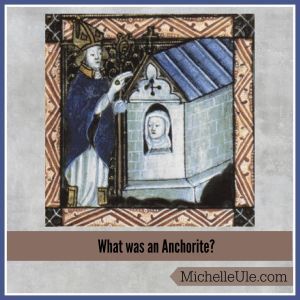
Anchorite?
What kind of word is that, much less what was it?
Long ago, I heard stories of women who voluntarily had themselves sealed up into the walls of a church.
Their holiness was so profound, they wanted to be hidden away into a life of prayer.
Similarly, I heard stories of the “church fathers” who lived in the desert. (Some were called “desert fathers.”)
These included impossible-seeming tales of men who isolated themselves on the tops of tall platforms, removed from the world.
Both types of people could be called “anchorites.”
Anchorite and anchor?Anchorite comes from the word anchor.
As in, staying anchored to one place.
Unlike hermits who could wander, and usually did, anchorites took a vow of “stability of place.”
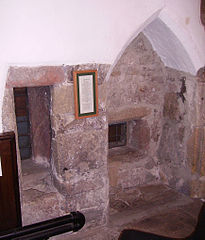 View of an Anchorite’s cell
 (Immanuel_Giel at
Wikimedia Commons)
They devoted themselves for prayer in the general sense but also for the particular church community in which they “dropped anchor.”
In doing so, they “attached” themselves to a church and the local bishop performed a service akin to a funeral.
Thus they became “dead to the world,” a type of living saint.
They may or may not have been nuns or priests, but obviously were devoted to God. Becoming an anchorite was considered a form of “Christian monasticism.“
The first anchorites were recorded in the third century. After Henry VIII of England’s Dissolution of the Monasteries circa 1540, the tradition ended for the most part.
How did it work?As a child, I couldn’t imagine how a woman lived as such a holy person.
Wouldn’t she die from lack of food? How big was her hole? What about waste products? What happened when she died?
It wasn’t as confusing as I thought.
A devout person who wanted to be isolated from the world for prayer and meditation needed a sponsor.
A sponsor, usually a wealthy landowner, agreed to pay the anchorite’s expenses in return for prayers.
(During that period before the Protestant Reformation, requested prayers were not only for the present but also for family members locked in purgatory.)
They sought a church community willing to have them attached to the church building.
Once the local bishop agreed, the sponsor paid to have a small room or “cell,” generally about 10 feet by 12 feet, attached to the church.
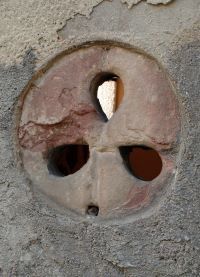 Squint Hole
(Wikimedia Commons)
The cell had three windows. A small “squint hole” (or hagioscope) looked into the church, focused on the altar, and was large enough for the anchorite to receive the sacraments.
(The anchorite couldn’t see anyone except the priest. No one in the congregation could see her).
A window large enough to afford personal needs–a bucket for waste, food, laundry, the occasional book–opened into an attached room or cottage where attendants lived.
The last window, probably not large, had shutters or thick curtains for local residents to speak with the (unseen) anchorite.
She heard their prayer requests and perhaps answered spiritual questions. It was not a social opportunity. The anchorite hid from the world for a purpose: devotion to God.
What were these holy people good for?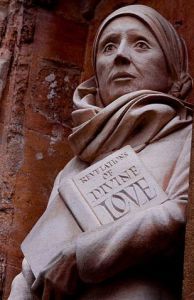 Julian of Norwich
 (Wikimedia Commons)
Attached to a village, listening to prayer requests, and praying meant the anchorite understood the local community.
Visiting priests might stop by to ask about the village’s needs. (One teacher said John Wesley’s evangelism success was due to visiting the local anchorite when he arrived to learn of needs).
They meditated on the Bible, catechism, or prayer books. Some, like Julian of Norwich, had visions and wrote them down.
According to Veronica Rolf in An Explorer’s Guide to Julian of Norwich:
Julian called her mystical experiences shewings, an older English word that meant “manifestations.”
These came to her as bodily sights of Christ on the cross; in locutions or words that she heard spoken directly by Christ; and in intellectual and spiritual understandings that continued to develop throughout the rest of her long life.
Julian considered all her mystical experiences to be direct shewings from God.
An Explorer’s Guide to Julian of Norwich, p. 7
People still read Julian of Norwich’s writings in the 21st century.
Julian, who lived in the 14th century, was the first woman to write in English. Attached to the parish church in Norwich, England, she was Geoffrey Chaucer’s contemporary.
She lived during a plague and her prayers brought solace to many.
Why did they seek to be locked away?
‘all shall be well, all shall be well, and all manner of things shall be well,’
Julian of Norwich, Revelations of Divine Love
Obviously, they felt they had a prayer vocation.
In her novel The Anchoress, scholar Robyn Cadwallader agreed prayer was the first reason.
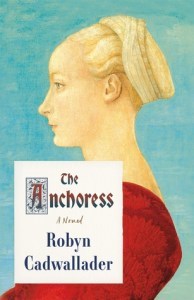
But the novel also pointed out the few choices women had during the middle ages.
Cadwallader’s heroine prayed, read, and meditated, but she also sought escape from an arranged marriage.
Many nuns over the centuries ended up in a nunnery not because they had a vocation, but because their fathers or brothers didn’t want to pay their dowry.
Probably a widow, Julian of Norwich’s vocation came from a devout love of God. Money, at least to her, was immaterial.
Many of us love God, Jesus, and the Holy Spirit.
But, how many of us would be willing to live in a small cell for the rest of our lives praying, meditating, and listening to prayer requests?
Tweetables
What was an anchorite? Click to Tweet
Would you be willing to be walled into a church? Click to Tweet
The post What was an Anchorite? appeared first on Michelle Ule, Author.