
Show ’em where the bullets strike
I never realized till I worked on movie sets that it’s not the director who shoots most of the action stuff. It’s the Second Unit Director. (Not always, but most of the time.)
The Second Unit Director often comes up via the stuntman/stunt coordinator/stunt choreographer route. Here’s something I learned one day from one of these gentlemen.
Always show ‘em where the bullets strike.
He was filming a shoot-out in a warehouse. Two good guys vs. ten bad guys. Pistols, machine guns, high falls, squibs of blood … hundreds of different camera set-ups. “How do you keep it all in your head?” I asked.
The Second Unit Director showed me a shot list that looked like War and Peace. Everything had been thought out and mapped out.
Bad Guy #6 pops up from the rafters, Good Guy #2 shoots him from below, Bad Guy #6 does a high fall into a dumpster.
But the key item to remember when filming such a sequence, the director said, was
When one guy shoots, always get coverage (meaning film) of where the bullet hits. (Even though, obviously, there is no real bullet.) Otherwise the action looks fake. It looks like you’re cheating. And the audience will see it and know it.
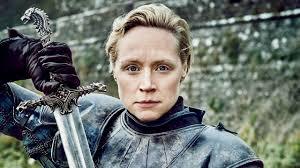 Gwendoline Christie as Brienne of Tarth in “Game of Thrones”
I’ve been binge-watching Game of Thrones lately and the filmmakers violate this principle all the time during the swordfights—to their detriment. Brienne of Tarth will swing her sword, Oathkeeper, and the camera angle will cut to her opponent ducking or falling or parrying … but it won’t be in response to that specific blow. This happens again and again, whether it’s Jon Snow dueling with Dolorous Ed in the yard at Castle Black or even a deep flashback sequence with the young Ned Stark slugging it out with other rival swordsmen.
The result is the fights look fake. I cringed. I kept thinking, “The filmmakers must’ve decided they didn’t have the time or the budget to put the actors (or their stunt doubles) through a really serious fight choreography preparation.”
But the bigger lesson here goes way beyond shootouts and swordfights.
When a character in a book or movie takes an action (or expresses some thought in dialogue), we must see (somewhere, at some time) the consequence of that action or speech.
We must see a reaction.
Maybe the reaction doesn’t come till thirty scenes later, as Tom Courtenay’s actions in 45 Years only pay off with Charlotte Rampling’s reaction in the final twenty seconds of the story. But one way or another, we cannot allow ourselves to portray an action or a speech that just sails off into nowhere and is never heard from again.
For every action, we must see a reaction.
We have to see where the bullets strike.
The post Show ’em where the bullets strike first appeared on Steven Pressfield.


