
Hello hellsite
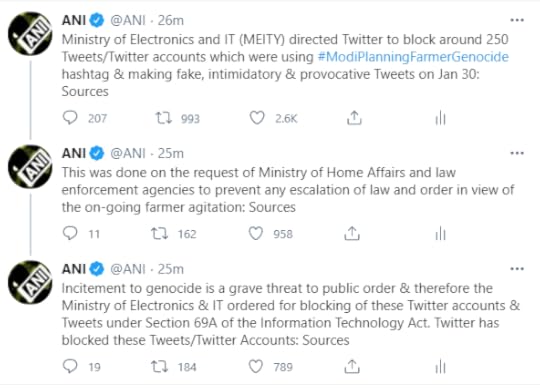
Leaving aside the burning question of why there’s a Y in the acronym for ministry of electronics and IT and also sidestepping the detail of how “ministry of electronics” sounds like the place you show up at to buy a new TV, this is where freedom of expression stands in today’s India. At around 2.30pm today, around 250 Twitter accounts were no longer accessible, including the accounts of the Caravan magazine and Kisan Ekta Morcha, a collective representing the farmers who have been protesting the recently-passed agricultural laws. They were given no reason for this gag order and neither have they been told how long their accounts will be withheld. Twitter issued a vague statement that said the company was responding to a “legal request”.
Some time later, ANI put up the tweets seen above.
Of late, many have applauded Twitter for its liberal values and readiness to resist authoritarianism because first, it started fact-checking tweets by President Donald Trump and his supporters and then, after the January insurrection, it was the first to kick Trump off the platform. In India, Twitter acceded to the government of India’s “request” instead of fact-checking the allegations the state had levelled. I don’t know if there’s a master list of all the accounts that have been withheld, but it’s clear that a lot of them belong to people or organisations that have been critical of the government.
This is censorship, by the government and facilitated by a (foreign) corporation.
And I find myself wondering what the hell I’m doing on a site that’s colluding with the state to stifle dissent. Is it just a bad habit? Do I stick with Twitter because it’s (ostensibly) free and GIF-friendly*? Because there are a few thousand bots and a handful of humans following me on it?
The real answer is: my Twitter timeline.
While Caravan‘s account being withheld is (probably) the first time that an Indian publication has been officially gagged since the Emergency era, subtler forms of censorship have become normal in India today. For many, the first reaction to intimidation is to protest on Twitter in an effort to ensure more people know how state institutions are making a mockery of our constitutional rights and liberties. The weird and miserable truth is that the platform that is helping silence critics and dissenters is also the one bringing together critics and dissenters.
Stand-up comedian Munawar Faruqui being denied bail; the Supreme Court suggesting an actor could be held liable for what a script requires their character to say; photographs of Delhi Police arming themselves with swords; videos of barricades being built in the capital; screenshots to prove 250-ish Twitter accounts have been withheld — I saw all these updates first on Twitter. Today, it was there that people asked whether Twitter USA would withhold the account of a publication like the Atlantic the way Twitter India had done with the Caravan. It’s on Twitter that people pointed out that tweeting in solidarity with protesting farmers is considered “provocative”, but neither the government of India nor Twitter appeared to be bothered by the hate speech that had flowed freely on January 30 when fans of Nathuram Godse celebrated the death anniversary of MK Gandhi. It’s because of journalists on Twitter that I know the Kisan Mazdoor Sangharsh Samiti has asked the “police DJ” to stop blasting songs (from the film Border) close to the protest site at the Singhu border; that Hirokazu Kore-eda’s new film will mark his Korean debut (and star Bae Doo-Na and IU!); and that there’s a Dutch footballer named JizzHornkamp. All this is why I remain on that hellsite.
Despite everything that Twitter fails at and thanks only to a minority of its users, the platform is a place to access reliable information, informed analyses and thought-provoking arguments. For journalists in particular, it’s become an almost invaluable tool for researching, reporting and promoting their stories. Particularly for those who have to contend daily with obstacles like time limits and word counts, Twitter offers something precious — the freedom to explore a subject at length from any angle you want and the possibility of an engaged, interested audience. For readers (like me), Twitter is the magazine that doesn’t exist in the offline world, complete with breaking news, arguments, opinion pieces and feature writing on a dazzling array of subjects. When it isn’t shutting people and conversations down, Twitter can be a vibrant, hopeful space. Somehow, in the middle of this dumping ground for propaganda, deliberate misinformation and toxic conservatism, communities of dissenters don’t just exist but thrive.
When the government of India wants Twitter accounts withheld (indefinitely?**) and when individual accounts get suspended unfairly, it is precisely this culture of dissent that is attacked. The government is hoping that if it can force publications and people off a platform, the loudest voices in the critical chorus will be scattered across the internet. They’ll lose volume and everyone else will feel nervous/ scared. The government is banking on the idea that if dissent is inconvenient, it will fizzle out; that we don’t care enough about the state of the nation to go hopping from site to site to remain informed. The government is hoping Twitter has made everyone lazy.
It’s probably not logical, but I’m suddenly missing Google Reader with proper violence. I’m swamped with nostalgia for that bygone era when things we wanted to share didn’t have to be constrained by character limits or structured into threads; when everyone seemed to be setting up blogs and the internet felt like a never-ending conversation that you could pop in and out of — especially if your own personal internet, made up of the sites you followed, was on Google Reader. It feels as though the good things of the internet may have been relatively harder to find because they were scattered, but they were easier to keep safe.
But the Google Reader is dead and for better or for worse, Twitter (or Facebook/Instagram, if that’s the hellsite of your choice) is what we’ve got at the moment. So that’s where we’ll stay, mostly to hold on to whatever little patch of the virtual space we can claim for dissent.
*It sounds terribly shallow, but the reason I abandoned Mastodon was its incompatibility with GIFs. That and the fact that for the life of me, I can’t remember my password. Sigh.
** Caravan, Kisan Ekta Morcha and quite a few of the withheld accounts were restored at night, around 9pm. I don’t know if all the accounts were restored, but I’m guessing they were. No explanation was given about the restoration, which makes it obvious that this whole exercise had everything to do with harassment and intimidation; and nothing to do with maintaining “public order”.


Deepanjana Pal's Blog

- Deepanjana Pal's profile
- 34 followers

