
First Look at Ireke Onibudo (a book written by D.O. Fagunwa)
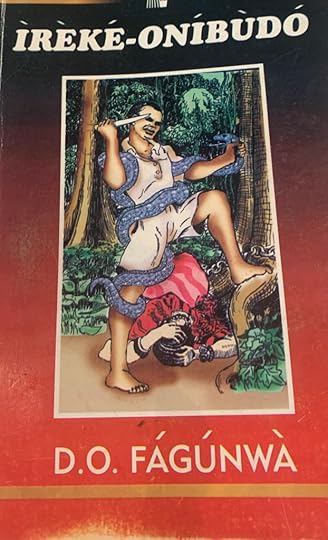 Ireke Onibudo delivering a princess from a flying Snake
Ireke Onibudo was the fourth book written by D.O. Fagunwa, a pioneering author from the South West of Nigeria. There is a pattern to most of Fagunwa’s books. There is a narrator, who had a very fascinating story to tell about his adventures in life, who turned up unannounced and instructs the author to write his biography.
The book opened up with “Enyin Ore Mi”, the equivalent of “Dear Friends”. Fagunwa has a very distinctive manner of writting: long sentences with commas and semi colons used to break the sentences. The first sentence in Ireke Onibudo was 181 words long. Ireke Onibudo was published in 1949.
Although Fagunwa was writing the book in 1949, it is probably the case that the first chapter drew heavily on his own school days. He was born in 1903, therefore, it is likely the accounts he gave of South West Nigeria portrayed life at a time much earlier, probably as early as 1920.
Using the voice of the author of the story, we see a picture of life in South West Nigeria in 1920. The author remembered his school days when he lived in town during school term but traveled to the farmstead during the holidays. It was not uncommon in those days that children of farmers were educated away from their parents, returning to the farm stead during the weekends and holidays. The author described his times on the farmstead as enjoyable because of the following: fresh maize, pounded yam wrapped in banana leaves, mushroom broth, eating meat you hunted, snails, etc. He also described his love for fishing in a big river near their farmstead. These days pounded Yam is no longer wrapped in banana leaves, nevertheless, its appeal remains as strong as ever.
I think Fagunwa’s belief system (as seen from his books) is very complex, a mixture of Yoruba religions and Christianity. This is not surprising: it was probably in his teens that his family converted to Christianity. Therefore, unlike most inhabitants of South West Nigeria today, Fagunwa had a direct experience of practicing Yoruba religion. Coupled with his exposure to Christianity both at school and when his family converted, his books reveals a complex integration of both.
God and his awesomeness is often emphasized in a Fagunwa book. Just over a page into Ireke Onibudo, we read:
Oba ni Olodumare fi awon agbe je si inu oko, oniruru awon nkan ti oni iyi ni oju awon ara ile, yepere in ju won: igi gbigbe ko jamo nkankan, ewe ko ni iyi rara, onje si po lo yanturu
The translation here is “God has made farmers king in their domain, surrounded with abundance of food and other things that people who are not farmers marvel at.” This gives us a glimpse into Fagunwa’s ontology, his understanding of reality: everything derives from God, a very biblical and Yoruba ontology.
In the same paragraph, Fagunwa launched into the awesomeness of God:
Bi enikan ko ba mo bi Olodumare ti lagbara to ki oluware lo wo oniruru nkan abami ti mbe ninu oko, bi igi giga ti mbe beni igi kukuru mbe, bi eiye kerere ti mbe beni eiye nla mbe, ibiti erin wa ibeni ijapa wa, ibiti ejo ti nsare kiri lo ni igbin unroral lo, alantakun n ranwu, ikan nba ise lo lori okiti ogan, awon eiye miran gbe inu igi, omiran ngbe inu ile, omiran ngbe inu ite, adan ndorikodo sun, owiwi nkigbe kiri larin oru, adaba nso akoko fun awon agbe, on duro bi agogo ti Olodumare so lojo sarin igbe, igbati awon agbe ban jeun tan, nwon a bu omi tutu mu
In the quote above, Fagunwa extolled the power of God as revealed in nature. He alluded to the mysterious beings in the forest bringing out a series of contrasts: very tall trees and very short ones; tiny birds and big birds; elephants and tortoise; fast moving snakes and snails. Furthermore, he wrote about spiders spinning their webs, the variety of birds that dwell in a variety of places, bats that sleep in an inverted position, owls disturbing the peace at night and so on. This sentenced showed that Fagunwa was a keen observer of nature. Like the Psalmist (Psalm 8, Psalm 19), he attributes the diversity of creatures under the sun to the awesomeness of a creative God.
The forest is always a very strong presence in Fagunwa’s books. The forests in Fagunwa’s books are no ordinary ones. Those were not just forests where dangerous animals lurk. Instead, they were also centres of supernatural activities where supernatural beings, powerful humans and animals interact. In fact, in one of these mythical forests, Igbo Olodumare, a snail was several factors bigger than a tortoise. It was not unusual for animals to speak and for humans to travel directly to heaven or hell via these forests.
It is in the encounters that Fagunwa’s characters had in these forests that we see a very strong departure from biblical ontology and the ontology of Yoruba religion emerges in its distinct form. For example, Ireke Onibudo’s dead mother often visited in his dreams to assist him in times of trouble. Arogidigba, the mermaid , who was half fish and half human, set up various challenges for Ireke Onibudo. Those challenges were a set up for failure but Ireke Onibudo’s dead mother would come back to earth to provide wisdom and insight. In a final epic encounter, Ireke Onibudo’s dead mother came back with the host of heaven to finally destroy Arogidigba.
Fagunwa’s books reflected where people in South West Nigeria were in the period during which he lived. The belief that supernatural things happen in forests was widely held by many. Some of the indigenous churches that were thriving in those days held similar beliefs and would go into those forests to minister deliverance to the land and cast out demons they believed inhabited those forests.
If you compare our Christian beliefs in the South West of Nigeria and many countries in the African continent to the ones in Europe for example, the influences of the Yoruba religion (and similar religions across the continent) are still palpable. Knowledge and experience (whether spiritual or secular) are situated socially, culturally, and historically.


