
Jane Austen: Caught in the act of cleverness #2
 Those of us who read and re-read Jane Austen admire her for many reasons, and that includes her cleverness in constructing her plots. In an earlier post I gave an example of Austen's cleverness in using a rain shower to move some characters about on the stage. In Mansfield Park, she uses gout.
 I've loved reading Jane Austen for years, and occasionally found a critic (in the sense of literary criticism) that I've also enjoyed reading and have learned from. Tony Tanner comes to mind, and David M. Shapard, Robert Rodi and of course John Mullan. They offered insights into Austen's life and times, her characters and also they have got me thinking about how Austen does it -- how the plots are constructed. Since I became a fiction writer myself, I've developed a new appreciation for how Austen sets up situations and back-stops her plot points. This example is a bit long and detailed, but here goes:
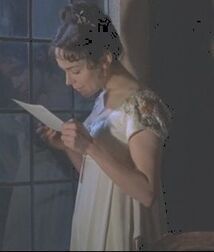 Frances O'Connor as Fanny Price in the 1999 Mansfield Park During the sequence in Portsmouth, much of the action happens offstage and we learn of it through letters. For example, Tom Bertram, the oldest son of the family, falls dangerously ill. Mary Crawford is in London. She is extremely anxious for updates about Tom's health, but not because she is cares about him! She knows that if he dies, his younger brother Edmund will become the heir to Mansfield Park and the baronetcy. This letter really gives the most shocking insight into Mary's callousness and it amps up the tension -- what if Tom dies and Mary snags Edmund so she can be the future Lady Bertram?
In the normal course of things, Mary could write to her half-sister Mrs. Grant, who lives at the parsonage in Mansfield, to ask about what is going on with the Bertrams. There would be no reason to write to Fanny, who isn't even at Mansfield Park at this point in the novel. Basically, this is a plot hole that Austen has to fix. We want Mary turning to Fanny for news, not to her sister Mrs. Grant and not to Tom's sisters either.
So to set up a scenario where Mary is forced to ask Fanny for news, Austen has to remove the Grants from the picture. How does Austen do this without appearing obvious? With sleight of hand, where the emphasis is placed on Lady Bertram: Everybody at all addicted to letter-writing, without having much to say, which will include a large proportion of the female world at least, must feel with Lady Bertram that she was out of luck in having such a capital piece of Mansfield news as the certainty of the Grants going to Bath, occur at a time when she could make no advantage of it, [that is, she had probably just written to Fanny when she learned about the trip and was saving the news for her next letter] and will admit that it must have been very mortifying to her to see it fall to the share of her thankless son, and treated as concisely as possible at the end of a long letter, instead of having it to spread over the largest part of a page of her own...
There was a rich amends, however, preparing for her. Lady Bertram's hour of good luck came. Within a few days from the receipt of Edmund's letter, Fanny had one from her aunt, beginning thus--
“My Dear Fanny,—I take up my pen to communicate some very alarming intelligence, which I make no doubt will give you much concern”.
This was a great deal better than to have to take up the pen to acquaint her with all the particulars of the Grants' intended journey, for the present intelligence was of a nature to promise occupation for the pen for many days to come, being no less than the dangerous illness of her eldest son, of which they had received notice by express a few hours before.
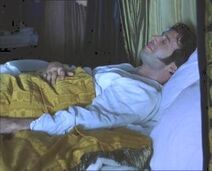 James Purefoy as Tom Bertram in the 1999 Mansfield Park (This joke about "isn't it great that Tom's sick? Now Lady Bertram really has something to write about!" is one of Austen's more breath-taking specimens of dark humor! It's almost on a par with Mrs. Musgrove's "large, fat, sighings" over her worthless son Dick in Persuasion.)
Austen then gives us a sample of Lady Bertram's vapid, cliché-ridden style of writing. After that, the narrative goes on with bulletins from Lady Bertram when Tom Bertram is brought home to Mansfield by Edmund.
When Mary Crawford left Mansfield Park, she asked Fanny to establish a correspondence with her. Fanny agreed, but she knew that Mary was only asking so that her brother Henry Crawford can stay in touch with her through Mary's letters (because Henry can't write to Fanny because they are not engaged). Fanny knows that if Henry is not in London with Mary, bugging her to write, she won't write. Fanny is correct, Mary's letters dwindled away. Then suddenly, a letter arrives, and sure enough, it's not because of affection for Fanny, it's because of Mary's self-interest: “Forgive me, my dear Fanny, as soon as you can, for my long silence, and behave as if you could forgive me directly... I write now to beg an immediate answer. I want to know the state of things at Mansfield Park, and you, no doubt, are perfectly able to give it... To have such a fine young man cut off in the flower of his days is most melancholy... Fanny, Fanny, I see you smile and look cunning, but, upon my honour, I never bribed a physician in my life. Poor young man! If he is to die, there will be two poor young men less in the world; and with a fearless face and bold voice would I say to any one, that wealth and consequence could fall into no hands more deserving of them... Had the Grants been at home I would not have troubled you, but you are now the only one I can apply to for the truth, his sisters not being within my reach. Mrs. R. has been spending the Easter with the Aylmers at Twickenham (as to be sure you know), and is not yet returned; and Julia is with the cousins who live near Bedford Square, but I forget their name and street. Could I immediately apply to either, however, I should still prefer you, because it strikes me that they have all along been so unwilling to have their own amusements cut up, as to shut their eyes to the truth. So Jane Austen sets up in scene in such a way to make it impossible for Mary to get her information from the Grants. But instead of simply narrating "One day, the Grants went to Bath," to shuffle her characters around, she turned it into a comic riff about letter-writing and Lady Bertram.
Mary's letter is also important because she is in London, and she gives us a foreshadowing of the disaster to is about to come with Maria and Henry Crawford. At the end of the letter, she mentions that Henry has just come from visiting Maria [Mrs. Rushworth]. Mrs. R. knows a decline [in Tom's health] is apprehended [that is, feared]; [Henry] saw her this morning: she returns to Wimpole Street to-day; the old lady [her mother in law] is come. Now do not make yourself uneasy with any queer fancies because he has been spending a few days at Richmond. He does it every spring. Be assured he cares for nobody but you.
 Mary Crawford, so witty, charming and self-assured, tottering between selfishness and virtue, is such a brilliant creation. When I look back over the things she says and the way she says them! When she congratulates Fanny on winning Henry's heart, she assures her that all the girls back in London are jealous, as though that would matter at all to someone like Fanny.
 And by the way, my short story, "The Address of a Frenchwoman," covers what happened to Tom during the period of time he was away from Mansfield. He goes to the Basingstone races where he meets an enigmatic Frenchwoman. It's part of the Dangerous to Know Anthology from Quill Ink, available in Kindle, paperback and audio.
I'll resume my Clutching My Pearls series after Christmas.


No comments have been added yet.


