Review #28: Hamlet, Prince of Denmark
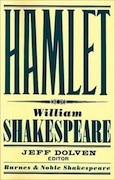
I have always known Hamlet as "the play where everyone dies at the end." That moniker isn't far off the mark, and almost from the first scene, you can tell that something being rotten in the state of Denmark will lead ultimately to death, death, death.
As the play begins, the ghost of Prince Hamlet's father appears to some soldiers, and eventually to Hamlet himself, bringing the news that he was poisoned—murder most foul—by his brother Claudius, the current usurper of Denmark and new husband to young Hamlet's mother, the queen. The late king didn't come all that way just to correct the record. He wants revenge, and his son vows to provide it.
Hamlet hits upon a bold plan: pretend to be crazy. Despite it being a major plot point, his supposed lack of sanity doesn't itself lead to any revenge. But with the help of a local theater troop, some friendly palace guards, a misguided army from nearby Norway, and a chance encounter with pirates in the North Sea, the young prince manages to kill everyone (and then some) even remotely attached to the new king's control of the throne. Before Hamlet himself shuffles off this mortal coil, he is preceded in death by King Claudius, Queen Gertrude, Hamlet's girlfriend Ophelia (along with the girl's brother, Laertes, and father, Lord Polonius), and two friends who were used by the king as spies against Hamlet.
Despite it being known as Shakespeare's greatest play, I wasn't as impressed with the story as I have been with other of the Bard's stories. But I did enjoy stumbling across one famous English expression after another that came from this play, including some now used as movie and book titles. Here are a few of the famed phrases you might recognize:
Frailty, they name is woman!
Neither a borrower nor a lender be
To thine ownself be true
To be, or not to be: that is the question
The slings and arrows of outrageous fortune
There's the rub
What dreams may come
The undiscover'd country
Get thee to a nunnery
The lady protests too much, methinks
I must be cruel, only to be kind
Infinite jest
The play is filled with important lessons, but few of them apply to my daily life. Don't kill your brother and usurp his throne; that's always good advice. If you put poison in a drink, make sure you keep it away from loved ones. I'll keep that in mind. But perhaps the most important point is one of self-awareness, or the lack of it in Hamlet's case. If you are in a place in life where pretending to be insane seems like a good strategy, then perhaps you weren't really pretending.