Write what you know
 “How was your day, honey?”
“Oh, pretty good. I spent the afternoon elbows deep in rotting corpse. Let me shower before you hug me.”
I was always reluctant to talk about my forensic cases because, let’s face it, the stuff is pretty macabre. It’s not exactly appropriate dinner conversation. And yet, it always surprised me how often people would ask about the details. Of course, I downplayed it substantially on the premise that people would think I’m sort of a ghoul – which I’m not. I promise.
It is only now, years later, that I actually admit that my daily grind, so-to-speak, was a lot more unique than the average worker bee. I could spend the morning crawling under a house with a cadaver dog looking for a presumed murder victim, the afternoon cleaning off a skeleton to look for signs of sharp force trauma, and the evening lecturing my college students about the effects of juvenile nutrition on long bone fusion (more than once my students asked me to “bring in a case,” and I happily obliged until the trunk of my car started to smell of decomposition. Hard lessons learned).
But a forensic scientist was not what I dreamed of being as a kid. What I really wanted to do was write. But I never knew exactly what I should write. Fiction? Nonfiction? I always leaned toward fiction but felt that I didn’t have anything interesting to commit to paper. Not to mention the existential questions like, am I a good enough writer to write? Would the universe give me permission? These questions plagued me, literally, for decades. Silly, I know.
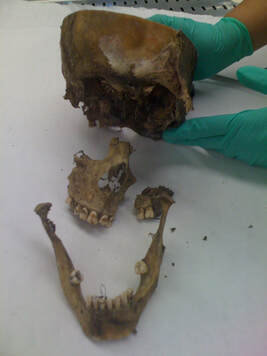
But after those decades the two parts of me began to overlap, resulting in a significant “aha!” moment. I could use my forensic work as a framework for the type of fiction that I want to write. I could also use the specific elements of actual cases in my books. If people seemed to be interested in that stuff – and they clearly were – then maybe I do have something worthy of a novel. And that’s what I’ve done with The Comfort of Distance. Each of the cases in this book is based on an actual case that I have worked, from the standpoint of forensic analysis and/or recovery (with the exception of Mickey “Tiny” McCallister. Poor guy). As an example, one of the victims in the book suffered a “Lefort Fracture.” Though rare in homicides, they do happen. The photo is from an actual case, and those are my hands holding the skull.
Fortunately for me – but unfortunately for dozens of my hapless “customers” – I have plenty of material and book two in the Sebastien Grey series is already in the works. I thank the universe for giving me permission.


No comments have been added yet.