The Message of Monuments
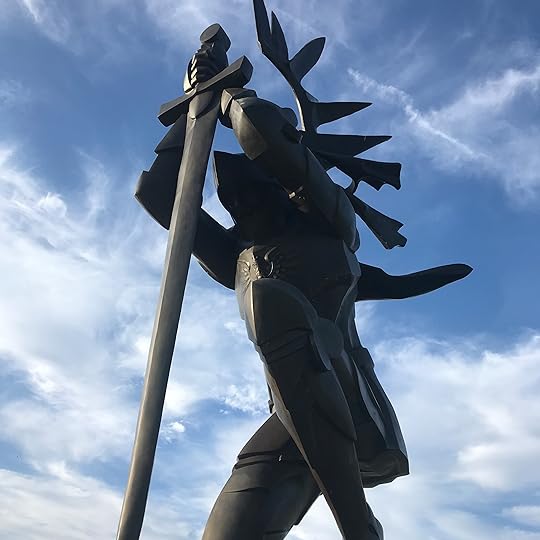
About a year ago I had a booth at the Polish American Festival at The National Shrine of Our Lady of Czestochowa in Doylestown PA. I was selling my Polish themed historical fiction novels. Quite incidentally, I listened to James Michener’s “Poland” on the drive up, only to find out upon arriving that Doylestown is Michener’s hometown. I really don’t believe in coincidences, so I took it as a sign of providence that I was meant to be at that show.
While I manned our booth, my lovely wife Marie slipped into the adjacent church memorial gardens and took the photo above. The image is of a massive sculpture of a Polish Winged Hussar, kneeling in a reflective pose above row after row of memorial markers. I was so impressed with it, I used it on the back cover of my latest release, “The Life of Marek Zaczek Vol. 1” (with the permission of the shrine). It synced up well with the story of a young boy born in 1772 who was raised on stories of Poland’s past might as manifested in the elite winged knights.
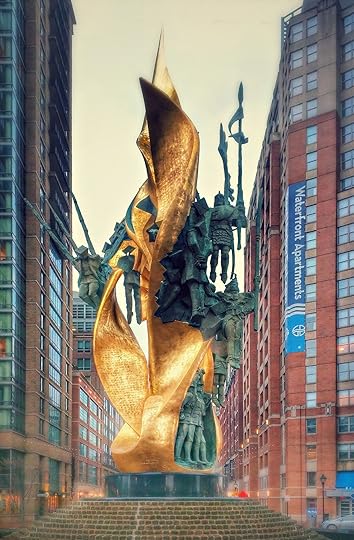
What I did not know about the statue is that it is the work of the same sculptor, Andrzej Pitynski, who had created the massive Katyn National Memorial in my hometown of Baltimore, Maryland. My readers might remember this latter sculpture is featured on the cover (again with the Katyn Memorial Foundation’s concurrence) of my novel “Chasing the Winter’s Wind.” In fact, the sculpture plays a critical role in the storyline of the novel.
Both works are visually dramatic, dominate their surroundings and tell the story of Polish heritage in an unforgettable way in a static medium which seems to burst forth with life..
This incredible sculptor, Andrzej Pitynski, was born in Poland two years after the end of World War II, and he was raised in that country under the oppressive yoke of Communism . His works also include, among others, Polish themed monuments in Jersey City, NJ, Boston, MA, as well in Poland itself. He died this month (September 2020), and I just wanted to take. a few minutes to acclaim his artistic genius and his love of the history and heritage of his homeland.
During World War II, both the Nazis and the Communists attempted to break the spirit of Poland by defacing and removing the monuments in her parks and upon her boulevards. Statues of Chopin and Copernicus was removed, but thankfully were recovered and reinstalled after the war in Warsaw.
May the works of this master’s mind and hands stand forever to remind us all of the true oppression of Nazi Germany and the Communist Soviet Union, and more importantly of the Polish people’s ability to sustain their culture and heritage throughout this terrible period.