
How separating your thinking from your feelings helps solve problems
 Image from @JoshStyle on @Unsplash
Can you remember being both nervous and
excited by a new idea? It’s common to have multiple reactions to a new opportunity
or problem and for these mixed reactions to stop us in our tracks from
taking action. Today I want to talk about a tool that will help you, and your
team to separate your thinking from your feeling.
The Six Thinking Hats process helps individuals and teams to organise and classify information about a problem so that its complexity can be better understood. It also enables the team to have a conversation where everyone thinks in the same way – at the same time. As a result, everyone considers the problem from many different points of view. This is very important for a complex problem.
It was developed by Edward De Bono more than twenty years ago, and is valuable as it helps everyone to contribute, and for a problem or opportunity to be analysed from numerous perspectives. The value of the concept is in separating information, emotions and hopes so that thought processes and discussions can be more easily facilitated. You can probably remember a meeting which got out of hand because there were different aspects discussed at once and the conversation may have become adversarial. For example, one person may have been discussing the possibilities inherent in the idea while someone else felt the need to be the devil’s advocate so kept identifying problems with the idea. The discussions may have become overwhelming, confrontational and/or ‘stuck’ as a result.
The Six Thinking Hats process supports use
of the brain’s different modes of thinking. Everybody’s information, perspective
and feelings are separated into one of six categories for discussion. In each
of these directions our brain works to make us conscious of issues being
considered, such as our gut instinct, pessimistic judgement or neutral facts. As
Edward de Bono himself says,
The main difficulty of thinking is confusion. We try
to do too much at once. Emotions, information, logic, hope, and creativity all
crowd in on us.
The problem or opportunity is considered in
six ways, with each pass associated with a hat of certain colour.
Blue
Hat thinking is typically considered first. In this
phase the current situation/problem or opportunity is described along with the
goal for the activity.
The next hat you choose and the type of
thinking you engage in depends on the objective of the session. I’ll give you a few choices in a moment based
on your objectives. But first let’s look at the White Hat.
When a team puts on their White Hat, they are presenting all the
facts, figures and statistics related to the problem. Just the data is
discussed here: no opinions allowed. This information should be neutral and
objective, and an outcome could be that more objective data is needed.
When we put on our Red Hat the team is encouraged to declare how they feel about the
idea or problem. These feelings will include their ‘gut instinct’, intuition,
offering all the emotional stuff, ‘warts and all’. For example, they may say ‘I
feel nervous’ or ‘I feel angry’.
Black
Hat requires the team to think cautiously as they
explore the risks associated with the problem or opportunity. Later, once the
risks are identified, a further conversation on the steps to mitigate the risks
is important.
Yellow
Hat is when everyone thinks about the idea from a
positive perspective only. For example, ‘What is great about this idea?’ This
will help to identify the opportunities and possible benefits.
Green Hat requires the team to do their best creative or out-of-the-box thinking. Stretch thinking is applied here to imagine new futures and possibilities. Consider, ‘What could be a wonderful outcome here?
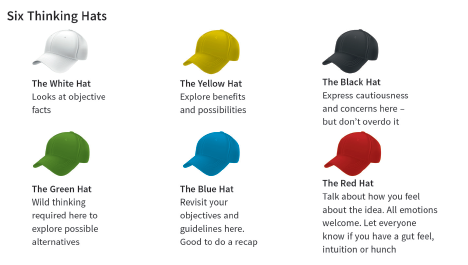
A summary of the objectives of each ‘Hat’
phase is provided below.
Tips on getting started
Run a practice Six Thinking Hats process with your team on a problem outside their area so that they become familiar with the methodology before they use it for a problem more real for them.Check in on everyone’s mindset prior to starting because people arriving in a bad mood will influence the outcomes.Hold the event off site, to stimulate new thinking in a new space.
The different ways to manage a six thinking hat session are described in the book I co-authored with Barbara Wilson called Creativity Cycling: Help your team solve complex problems with creative tools
Barbara and I discuss Six Thinking Hats and the Creative Problem Solving process on our April podcast.
The post How separating your thinking from your feelings helps solve problems appeared first on Tracy Stanley.


Ten tips for writing a book

Keep a diary
Embrace imposter syndrome
Identify your audience – Who are you writing for?
What voice do you want to write in?
Develop an outline before you start
Read ...more
- Tracy Stanley's profile
- 6 followers

