
the flavor equation - how to illustrate a book
Based on my experience with Season, I had some sense of what to expect in terms of work flow and how things would more or less proceed during the production process of my second book, The Flavor Equation but when it came to the illustration process, I was swimming in unchartered territories. It’s easier for me to work on photography, styling, and writing but the illustrations simply aren’t my skill (no matter how hard I try).
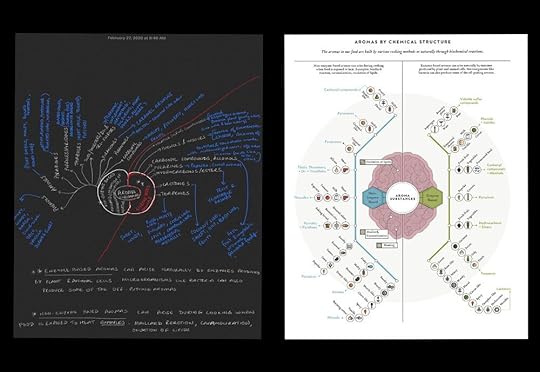
The Flavor Equation is a science based cookbook and some ideas and examples are easier illustrated than conveyed through long sentences and sometimes a photograph might not be best option. Illustrations made science fun for me in school and provided an easier way to conceptualize science in a more tangible way. Hence, early on when I sold my book proposal to my publisher, Chronicle Books, I brought up the need for an illustrator. While working through my manuscript, I turned in several hand drawn sketches that I drew out on my iPad (Notes and The Concepts App were lifesavers) that I shared with my book designer, Lizzie Vaughn and my editor, Sarah Billingsley. They then looked through several portfolios of illustrators who had experience with science artwork but also for people who could make science through their art approachable, fun, and also tie in with my own style of photography and design. Among the portfolios, I looked at, one artist’s work immediately stood out and I connected with it immediately - Matteo Riva. Together we made a list of illustrations and worked through them together, finessing them with every iteration, and some how we managed to get all of this done as the COVID pandemic started to kick off everywhere.
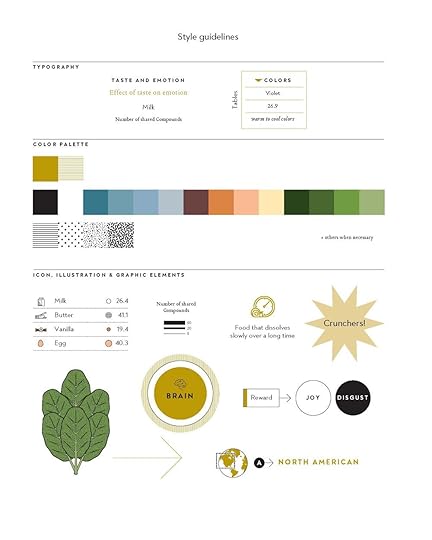
Lizzie worked out fonts, design concepts, etc with Matteo and one of the first things I received was the image you see on top with the design/artwork scheme for The Flavor Equation. They made my sketches and tables (somewhat crazy and all-over-the-place style) beautiful and I am so happy with how they turned out. In fact, I’m going to get a couple of them printed to hand in my kitchen and office.
You now know about my thoughts on illustrations but what about Lizzie and Matteo, I decided to ask them a few questions and this is what they had to say.
First up, my wonderfully talented book illustrator, Matteo Riva.
What is the process of choosing an illustrator like?
I generally start from some references/precedents where I can find inspiration. In the past I collected several books dedicated to infographics and they are still very precious, especially once you start a new project. Second step: I sketch some proposals on paper, in order to keep in mind the general structure of the artwork. Third step: finally, I start to make drawing with Adobe Illustrator. At the early stage I try to fit the page with all the contents required (ie. Text, charts). Then I move the elements inside the page space to find the best way to communicate the information. In the meanwhile, in my mind I try to visualize one ore more illustrated elements associated to the contents. It could be an icon, a big illustration, or typographical elements. The purpose is to design a well balanced artwork where texts and informations are exposed clearly using an illustrated language.
How did you tailor the art scheme/brand guidelines—colors and styles—to fit the book's science and food themes?
I can answer by giving you my definition of what an infographic is, in simple words. It’s a combination of graphics, typography and illustration to enable an interpretation of a specific information. So my job for this book was to convert Nik’s sketches in something more illustrated, clear and ruled by a general style guidelines that matched the book’s visual. In this phase was very helpful working with a great art director like Lizzie Vaughan. She made me feel free to propose my ideas, leading a complex project in a clear and safe way.
It was also interesting thinking these infographics as something where Nik’s double soul meets together (science and cooking). In terms of design that means building infographics as a mix of charts (the scientific side) and illustrated elements (the cook side), the perfect visual synthesis that figures Nik’s work.
Can you share a little about your history and experience, how you became so proficient creating infographics, and what inspires you?
I can remember, during my childhood being fascinated by big Atlas and Traveling guides. My father used to collect many of them since he was a member of the Touring Club, the most important Italian national tourist organization. Probably this unconsciously became a part of my early influences.
I graduated in Communication Design at Politecnico of Milano, a school were infographic design is key. I often designed infographics after graduation, but my principal job was for several years was as the art director of a little Italian magazine called Vita This experience was very useful for understanding the relationship between designer and art director. I finally decided to dedicate my job almost entirely to infographics in the last three years.
I think that the most important experience for me, was the one I gained with the La Repubblica creative team (the major Rome-based Italian Newspaper). In this newspaper the infographic design is really accurate, open to very creative solutions, and I step up as professional.
Last, if I have to give you some names for big inspiration, my choice is for Otto Neurath and his wife, Marie Reidemeister. Their work really inspired me, due to his clarity and modernist look. I love the icons system design for Neurath by Gerd Arntz, with its minimal approach. As you can see, I prefer the infographics where the illustrated aspect is dominant: the human brain is certainly facilitated to keep in mind the meaning of a specific content.
And here’s what Lizzie, my book designer had to say.
We really lucked out! In brilliant serendipity Matteo reached out to share his portfolio just as we were digging into the infographics for The Flavor Equation. The process of choosing an illustrator can entail hours of research, creating mood boards, and playing with visual samples in-situ. In the early stages of The Flavor Equation, Nik pulled examples of illustrations he liked from other books and sources, we did preliminary book design layouts, and narrowed in on a clear aesthetic direction. But we hadn’t committed to an artist. Matteo’s portfolio came in and we quickly agreed—his adept ability and enthusiasm for visualizing complex information with fun and friendly colors and textures—perfect! Exactly what we were searching for. From the get-go we wanted the art for The Flavor Equation to be approachable and useful, but also evocative of scientific charts and simply . . .BEAUTIFUL. Matteo nailed it and was so great to work with.
I am so proud of this book and how it came together and the entire team at Chronicle Books, Matteo, and my agent, Maria Ribas who helped bring this book to life.
You can find Matteo Rivas on Instagram and check out his portfolio to see more of his work. Check out Lizzie Vaughn’s portfolio and see what she’s up to on Instagram.
To learn more about The Flavor Equation (October 2020) and how to preorder click here .


