You Can’t Stop Nike Using Skateboarding Like a Marketing Mall...
You Can’t Stop Nike Using Skateboarding Like a Marketing Mall Grab
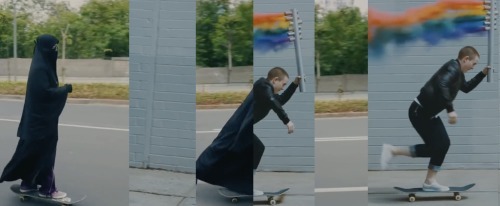
The recent release of a new Nike video in which a series of sporting images are edited into montages with elite athletes has caused quite a stir. We see a bricolage of identities, politics, and triumphs melded together. Many people are lauding the innovative editing techniques, and the inspirational message of the video. Others have created their own juxtaposition by highlighting the way that Nike has been using Uighur labour at Chinese factories for their own products. However, one image that strikes out is a Muslim woman skateboarder in a Niqab sutured on to Leo Baker skateboarding with a LGBTQ flag. The video gives the impression of a transformation in which the veiled woman progresses across the screen turning into Leo Baker. As this image hits the screen the voice over declares…
“And if we don’t fit the sport, we’ll change it”
Part of the ire surrounding this edit is the concern that there is a supposed connection, a pending trajectory between conservative religious dress and liberated sexual identities. Some have criticised that this is a misleading marriage, in which the interests of the two groups are not aligned, or even unproblematically juxtaposed. Similarly, the visual cue of transformation has made some suggest that this is a tacit wish of Nike, that it can liberate Muslim women and co-opt them into a consumptive catchall ‘Just Do It’ Nike utopia.
To be clear, I think this edit was misplaced and not thought through, but it seems quite evident that the intention was to critique skateboarding more than Islamic dress and values. The voice over points directly to the fact that some identities have not been historically welcome in skateboarding. This is true.
Nike are naively actually scratching the surface of a bigger issue. This issue is the way in which religion is dismissed from skateboarding. In recent years a vast amount of progress has taken place with women skateboarders becoming more visible, marketable, and powerful in the skateboard industry. Similarly skateboarding has started to shed its homophobic past and enthusiastically embrace the full spectrum of sexualities and gender identities. Even Thrasher ran an article earlier this year title ‘The Top 10 Women & Non-Binary Skaters of 2019.’ Yet, skateboarding and religion remain a somewhat taboo topic.
I do have sympathy for those that critique the advert as I feel the Nike is being somewhat callow in its choice of identities. They are pandering to orientalist notions of an oppressed Muslim woman. It would have been braver to include the skateboarding monk, Shaun Hover (an evangelical Christian skateboarder), or a skatepark bible group (yes they do exist). My research on skateboarding and religion reinforced the notion time and time again that religion was for many involved in skateboarding, a taboo subject. In many cases I spoke to Muslim skateboarders in Malaysia and Indonesia. Their experiences were vastly different to Christian skateboarders in the USA. My investigations revealed a stigma associated with religious affiliation, particularly Christianity and skateboarding. As a result, a subculture of evangelical skateboarders exist who are largely ostracised by the broader skateboarding culture. Let me emphasise, these are the sorts of skateboarders that would not receive Nike endorsement because, despite their abilities, a Christian identity is not a marketable asset in skateboarding. Christian skateboarders are essentially told to lose God in order to get sponsored.
So, I also welcome the critique of this new Nike advert. But I feel that an over-reliance on visual cues actually damages Nike’s message. These issues are trivialised by superficial celebration and end up reducing complex identities and political movements to marketing fodder. I take particularly issue with the insincerity of including a reference to skateboarding and religion. Yet the issue of Nike and Uyghur workers is particularly potent. How do these stories keep appearing? In truth Chinese factories are adept at conforming to a host of international standards. As soon as an inspection is announced factories are able to present an image that conforms to the international standard being assessed. Those doing the assessment are often aware of this duplicity, but they work to assess what is presented to them. In this way massive corporations are able to tick the box that they are doing all that is demanded of them and need not delve further. This is a beautiful metaphor for the Nike advert itself which is solely an act, a presentation of a set of images that they perceive to be most acceptable to the ideas and values of their consumers.