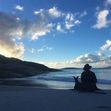
A Dawning Fascination with the Mabinogion
 My fascination with Wales, and ultimately with its ancient mythology, really began when I was seventeen years old. I was in the passenger seat of a rental car, reading the map, and it had just gone dark. My mother was in the back seat; my father was driving. All day, it seemed, we had been negotiating narrow, sunken lanes. Every few miles, a sign would warn that there were flood waters ahead, but there was never more than a puddle on the road. I could see on the map a shortcut to our destination: an attractive looking B-road which cut across a valley. We turned down it. There was another sign, and moments later, the water level was rising towards our knees inside the car.
My father slipped the car into reverse, miraculously without stalling, and we opened the doors to let the water out. My rare Bob Dylan tapes, just purchased, looked like spirit levels when I looked in their windows. Books, luggage, clothing: all were soaked, with the exception of a copy of Rachel Bromwich’s translations of the poems of Dafydd ap Gwilym, which I had also purchased that day. We decided to drive to the nearest village and get accommodation for the night in its pub. By chance, the village was Beddgelert.
And so, I learned the story of Gelert, Llewellyn’s hound, who saved a child from a pack of wolves, and then, by dreadful mistake, met a bloody end at the hands of his master. But before that could happen, when I saw the dog’s celebrated grave the next morning, I got a powerful muscle spasm in my neck, which left me pinned to the bed the whole evening. There was nothing to do but to lie there, reading the poems of Dafydd ap Gwilym for the first time.
That was the beginning of an obsession which would culminate in me writing English paraphrases of more than a hundred of the master bard’s poems. It was his love for nature which won my heart.
When I returned to Britain as an adult, and gradually realised that my stay was long-term, I forged a friendship with Kathryn Wheeler, a multi-instrumentalist and a composer who was as fascinated by folklore as I was. We began writing songs about the folklore of trees and birds, and I developed a voracious appetite for Celtic fairy-tales, hungrily turning them into song lyrics so that Kathryn could write the music. One day, she mentioned the Mabinogion.
I have been enthralled by the myths of the Four Branches of the Mabinogion ever since. The stories of Rhiannon, Branwen, Arianrhod and Pwyll never really left my consciousness when I was writing – but it was the account of Blodeuwedd’s creation and transformation that gripped me the most.
Dafydd ap Gwilym had a poem about Blodeuwedd. I paraphrased it once: a pretty grim portrayal of the hatred shown to her by all other birds once she had been transformed into an owl. It was easy to read her story as a simple one of marriage, adultery, betrayal and punishment, but Dafydd’s poem was full of pathos. I began to think a long time about Blodeuwedd, and invited her into my dreams.
A fully-grown woman, conjured out of flowers by two magi, Math and Gwydion, Blodeuwedd was purpose-built as a wife for a man who had been cursed with never being able to marry a woman born by natural means. Superficially loyal at first to her husband, Lleu, Blodeuwedd fell in love with a neighouring lord, Gronw, whilst her husband was absent. They conspired to kill Lleu: a feat which could only be achieved by engineering a perfectly ridiculous set of circumstances. But when Lleu, one foot on a bathtub and the other on the back of a goat, was speared by Gronw, he did not die; he soared off in the form of an eagle, only to be found and returned to human form by Gwydion. Blodeuwedd found herself transformed into an owl, and condemned to be eternally hated by all other birds.
I instinctively felt a lot of sympathy for Blodeuwedd, even reading the story at face-value. She had been created as a sort of automaton: Lleu’s sex-robot, if you like, but she had a will of her own. As is true with most Celtic legends, however, her story had a deeper meaning. She was also a seasonal goddess of sovereignty, and the killing of Lleu and then of Gronw was a re-enactment of the age-old battle between the spirits of winter and of summer. In a sense, she was flowers every spring and summer, and an owl every autumn and winter.
It dawned on me only slowly that of course, I had read Blodeuwedd’s story before as a child, in the form of Alan Garner’s extraordinarily beautiful and insightful novel, ‘The Owl Service’. But by the time I had made that connection, I had arrived at a different conclusion from Garner. Garner’s protagonist, Alison, who is possessed by Blodeuwedd and is gradually becoming more and more owl-like, “wants to be flowers, not owls”. The Blodeuwedd I had come to know was quite the opposite. She revels in her life as an owl, because now she is free, in charge of her own destiny, and well equipped for taking care of herself.
I probably arrived at this conclusion because I had worked with injured owls as a teenager. Falconers will tell you that owls are comparatively stupid compared with hawks and falcons. I disagree, because I don’t count a steadfast refusal to cooperate as a sign of intelligence. Anyone who has worked with an owl and afforded it the respect it deserves will know what I mean. It is also a creature which seems perfectly adapted to its environment, and to its way of killing and eating. The woman, Blodeuwedd, was also made to be fantastically beautiful. For me, it was therefore no coincidence that she was transformed into that most beautiful of birds: a barn owl.
Over the years, I have written about Blodeuwedd many times, in songs and poems, many of which appear in Slippery Elm’s wonderful Blodeuwedd inspired anthology, ‘Tu Muerte Liena De Flores/ Your Death Full of Flowers’. I knew, though, that Blodeuwedd wanted something bigger. Gradually, a longer poem, which would tell the whole story from Blodeuwedd’s perspective and in her voice, was crying out to be written. The narrative from the Mabinogion would be intertwined with passages about her life as an owl, and each page of poetry would be illustrated. My daughter would be the model for Blodeuwedd in her human form. There would also be pictures of Blodeuwedd as a barn owl, and of the landscapes in which her story is set – landscapes with precipitous mountainsides, white-water cascades and rushy lakes, which recall that journey through the hill country of Wales when I was seventeen.


No comments have been added yet.