Review of Theology and the Marvel Universe
I was recently asked to review Theology and the Marvel Universe edited by Gregory Stevenson. The review has just been published in the Journal of Graphic Novels and Comics.
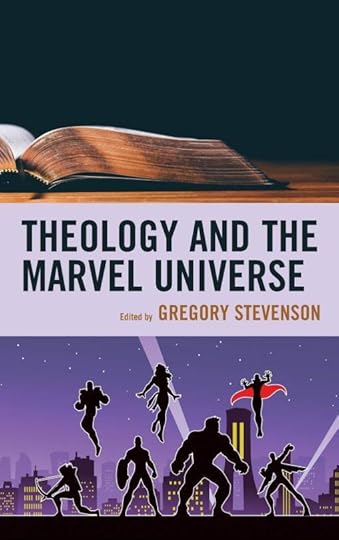
Here is an excerpt from my review.
The vast popularity of the Marvel Universe is hard to ignore. The enormous success of the Marvel Cinematic Universe (MCU) over the last 12 years, and the unprecedented popularity of Netflix Marvel spinoffs, means that the reach of Marvel comics has been deepened and extended. The various characters, either on the page or screen, play out relatable sagas with which we can identify. In no trivial way these comic book heroes have become a new pantheon of gods to which we relate personally. It is to this scenario that the collected essays within this book speak. Importantly Gregory Stevenson has brought together a collection of writers who read theology through the tales of the Marvel Universe. Quite unlike any other book to address comic books and religion, this collection deals with an array of connected characters and explores them through quite different media, comics, television, and film. Yet, despite this freedom the authors focus directly on how these stories can be read through theology. In the first half of the book the theme of violence is ever-present, while in the second half of the book it becomes more subtle as other themes branch out toward other paths…
In essence this is a book unlike other religious explorations of comics.(1) It keeps faithful to its emphasis on theology. For readers of popular culture and religion, this book deviates from more general readers (2) as it is focussed on Christian theology. In this respect readers should be aware that the book is wholly analytical and textually based with the Marvel Universe acting as a canvas to develop theological narratives. The scholarship throughout these chapters is largely erudite and engaging, and we are given much to reconsider both Marvel characters and also a range of theological perspectives. However, the explorations of the authors are not always consistent in what they are seeking to address. Are they aiding us in understanding the Marvel Universe, or helping us engage more familiarly with theology? Some appear to be validating Christian theological tropes through Marvel which could, perhaps, be better placed in an exploration of how fans might relate to the Marvel Universe. I was left curious about how fans and fandom might interpret and play with some of themes that are addressed within the book. Take for instance the engagement of Christian fans in the religious motifs of the Marvel universe, a theme that is touched upon in a recent collection by Cusack, Morehead, and Robertson.(3) While there are also efforts made to recognise some of the religious heterogeneity of Marvel characters, I was disappointed that there was no mention of Kamilla Kahn, the new Ms Marvel launched as a Muslim teen hero to balance some of the longstanding religious and ethnic bias in Marvel comics. Despite these misgivings, this is a commendable achievement and a welcome addition to extant work on comic books and religion. Its reach is far beyond this niche and is of more general interest to contemporary explorations of religion and popular culture.