Unf*ck the Police – Part One: My Story
I have very strong opinions about the history, role, and future of law enforcement in the United States—formed over the last 33 years of my life. I want to explain my often-unpopular opinions and make my case during this time when our country seems most ready to hear criticism of policing in America.
Disclaimer
The following is an article that begins with a personal experience that has led me to a lifelong distrust of law enforcement and of authority figures in general. It’s why I’ve been speaking out against police brutality and abuse of power for much of my life. I’m not going to ignore issues of race, but you might note I don’t emphasize it as much as others, and that’s for a simple reason: I’m white–I can’t exactly talk about my personal experience regarding racism and the police. That said, I want to make my position perfectly clear. I believe that white supremacy is unfortunately stitched into the fabric of American society and we have a lot of work to do in order to fix things. And the numbers are quite clear that it’s statistically far more dangerous for a person of color to encounter the police than for white people. I will do my best to amplify black voices; I will offer my support to address racial justice without trying to speak for communities I can only try to understand from the outside.
In other words, just because I’m sticking to my lane isn’t me ignoring or side-stepping the problem of racism related to law enforcement. Black lives matter.
“There are fundamentally two ways you can experience the police in America: as the people you call when there’s a problem, the nice man in uniform who pats a toddler’s head and has an easy smile for the old lady as she buys her coffee. For others, the police are the people who are called on them. They are the ominous knock on the door, the sudden flashlight in the face, the barked orders. Depending on who you are, the sight of an officer can produce either a warm sense of safety and contentment or a plummeting feeling of terror.”
– Christopher L. Hayes, A Colony in a Nation
It was Saturday, the first day of August, 1987 that my way of looking at the world and trusting people entrusted with power changed forever. I was twelve years old and absolutely thrilled that my annoying little sister was taking a trip out of state to stay with friends for a week. Our family headed for Hartsfield International Airport in Atlanta to put her on a plane. We were stuck in traffic near the drop-off point for ticketing, and after several minutes of going absolutely nowhere—while a traffic cop angrily blew his whistle and waved at cars—my mother decided she and my sister would exit the car to check my sister’s suitcase. The ladies got out and I stayed with my Dad to find a parking space.
Crossing the street from the parking deck only a few minutes later, I felt my father’s thick-fingered hand squeezing my arm. Something was wrong. My eight-year-old sister was screaming and crying and I saw a stranger holding her. There was a crowd and a lot of shouting. I was confused, and then I saw my mother—blood on her face, her arms behind her back. A man was roughly holding her from behind. Everyone was yelling, my father’s grip on my arm was painfully tight, and as I looked up at his face I saw his mouth go flat with steel resolve. He let go of me and started walking forward. My mother screamed.
“Jimmie!! We can’t both go to jail!” Blood trickled down her cheek from the scrape under her eye.
Only then did I realize that the man holding my mother captive was the same police officer who was whistling at traffic only minutes before.
Rather than give you Mom’s version of the story, which I was not present for, I’ll paraphrase what the officer later claimed in court:
He stated that after exiting the car, my mother approached him and asked him out on a date (my little sister at her side, apparently). And when he told my mother he wasn’t interested in her, she followed him around and called him an ass and demanded to know his name and badge number. He pulled out a citation he’d written when we were stuck in traffic—since my mother and sister exited the vehicle when it wasn’t parked—and handed it to her so she could identify him. And then, according to the officer, she unleashed a string of loud and angry profanity at him and got up in his face. At that point he had no choice but to arrest her, and while he was attempting to detain her she tripped and hit her face on the sidewalk—also injuring her neck, shoulder, and arm.
(Allow me to go on the record saying I do not believe the officer’s version of events.)
A witness at the time claimed he first noticed what was going on when the officer screamed “That’s it — you’re going to jail!” as he tackled my mother from behind and smashed her face into the pavement and violently jerked her arm up behind her back before putting her in handcuffs. The witness also stated the officer attempted to drag my mother away from my little sister, who was understandably hysterical and terrified—seeking comfort in the arms of a stranger. It took the intervention of the crowd to prevent my mother from being separated from my sister before my father and I arrived back on the scene.
I later learned that my mother committed what in America is an extremely dangerous crime: She disrespected a police officer.
My mother was charged with resisting arrest, disorderly conduct, and violating the city of Atlanta’s profanity code. (She used the word “ass,” you guys—in the 1980s!) She went to jail but begged us to put my sister on the plane for her trip, which we did. Then Dad and I spent the rest of the day bailing my mother out of jail.
I’ll spare you a lot of details, but this event wrecked my family and changed things forever. The bullshit charges against my mother were completely dropped and the officer who attacked her was fired. A win, right?
Over the course of the next year the officer who beat my mother up in front of a crowd—a man who had previously assaulted multiple women while in uniform—was restored to his position with full back pay. My mother’s lawsuit against the city of Atlanta was defeated in court. Her injuries healed, but her neck and shoulder have been a problem ever since.
Before my fourteenth birthday I learned that the police are not always the good guys and that if you’re looking for justice it’s not likely to be found inside a courthouse.
In the years since, I’ve been first- and secondhand-witness to cops lying, falsifying reports, and bragging about abusing prisoners. I’ve watched the police become increasingly militarized, buying up stockpiles of equipment with the idea that it would be used to fight terrorists—only to be used against the citizens they are sworn to serve and protect. I’ve come to understand why many communities would prefer to protect themselves rather than rely on the authorities.
Pop culture depictions of police have shifted dramatically over the years. Back in the old days, cops were never the heroes. In fact, the “Keystone Cops” were best known as bumbling comic relief more than anything else.
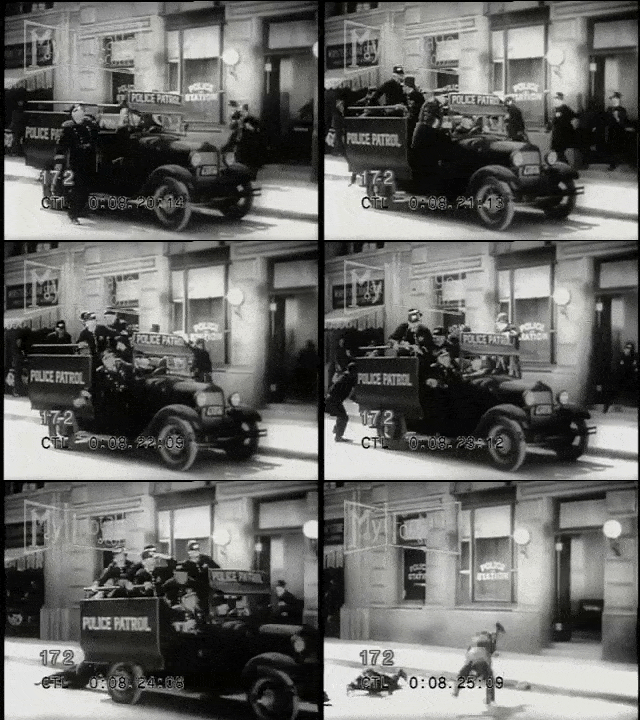
Keystone Cops
Crime fiction generally relied on a non-police protagonist—such as the private detective or an Everyman drawn into dark events. But as Hollywood and the Los Angeles police department developed a symbiotic relationship things changed with shows like Dragnet. Jack Webb created a show to depict law enforcement in a more positive light, with Sgt. Joe Friday working each case with diligence and fairness. (“Just the facts.”)
American televisions enjoyed a kind and fair sheriff with the Andy Griffith Show, depicting the county officers as pillars of the southern community and everyone’s friends. And while police procedural shows and cop movies have morphed with the times, the loose cannon bad-boy cop has become a stereotype we love in America. From Dirty Harry to Martin Riggs, we love a cop who doesn’t play by the rules but always gets the job done. These movies are fun—I enjoy them myself—but make no mistake: In the real world it’s never a good thing when cops break the rules and the law.
A lawyer friend of mine once told me that there is only one circumstance in which you call the cops: When you want someone arrested.
That’s it. You don’t call them to help a fighting couple to cool off. You don’t call them to rescue a kitten out of a tree. You only call the police if a crime has been committed and you want someone leaving in handcuffs. (And that’s the best case scenario, as we know sometimes the cops get rough.)
Ask yourself the following question and try to be really honest: If the police arrive when you didn’t ask for them, are you actually glad to see them?
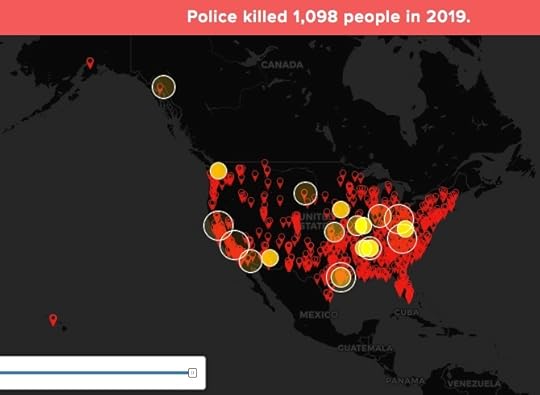
Source: Mapping Police Violence
Back in my 20s I knew a guy who always wanted to wear a badge—we’ll call him Jerry. He was on the short side, from a dirt-poor Alabama family, and was bullied as a kid. People knew him as the class clown, always able to make people laugh or turn any argument into a joke. Jerry was the guy you always wanted at your house party or backyard barbecue.
Then he got the job as a local sheriff’s deputy.
It was a sad transformation. Jerry went from being a guy I loved hanging out with to someone I couldn’t fucking stand. His “jokes” started to be telling stories of bullying and terrorizing prisoners in the county jail—where all first-year deputies work while they go through continuous training and certification. He bragged about breaking the rules to punish prisoners who pissed him off. He would say, “I love it when they give me an excuse” so he could beat on someone with his police-issue club. Jerry was a professional bully. I haven’t really spoken to him in decades, and I’m happy to say he didn’t last long in law enforcement.
Did the job change Jerry, or was this awful person always lurking under the surface?
Obviously I can’t tell you what’s in someone else’s heart, but my best guess it’s a bit of both. People aren’t just randomly drawn to careers; there are reasons. And besides excellent pay and potential early retirement, there is power and community respect in police work. Bullies are drawn to the job, as are some people who’ve always felt powerless. And of course, there are deep-rooted cultural problems inside of policing in America that make things worse—along with a code of silence that means even the “good cops” keep their mouths shut when a fellow officer breaks the law.
A Good Cop and a Dead Dog
A few years ago I had an encounter with a member of my local city’s police department. He was young, in his mid-20s I believe, and showed up after a neighbor called about loose dogs. A household down the street breeds and sells Cane Corsos, though they apparently did a terrible job socializing the breeding pair. A mother dog and a 12-week puppy began roaming through yards, the female growling and snapping at anyone who came close and was incredibly defensive of her pup.
I’m no Dog Whisperer, but I’ve been raising and dealing with dogs most of my life. I could see the female was nervous, not aggressive, so I slowly got the dogs to back up close to their own yard but couldn’t get them to return. Instead we opened the gate of their next door neighbor’s backyard so the dogs could be contained until someone could safely remove them. We walked back to the street to wait on the law.
He showed up minutes later, looking every inch the stereotype of a young southern cop—military-style haircut, aviator sunglasses. He was very friendly and quite courteous, but he also had a hero complex.
Animal Control was on the way, he said. But rather than wait the officer decided he could wrangle the animals himself. He told us to wait and he would come back for our full statements.
I turned to my neighbor and said, “I have a bad feeling about this.”
About three minutes later we heard the gunshot and one piercing yelp.
When we talked to him later he told us he had attempted to grab the mother dog’s collar and she turned and bit him. He immediately pulled his service weapon and shot the dog in the side. Animal Control rushed the dog to emergency surgery, but my understanding is she did not survive.
He had tears in his eyes when he told us what happened. He was a southern boy who loves dogs. But he was also a cop who was convinced he was the right man for the job even though his only tool was a lethal weapon.
It was incredibly frustrating to know that the Animal Control people, a team with training and equipment to safely handle dangerous animals, was only a few minutes away. The dogs were contained and posed no immediate danger.
On one hand, it was a justified shooting—the dog bit him. (I saw the superficial wound myself.) But on the other hand, the cop created the situation in which the gun came into play.
If you’ve followed the news at all in the past forever this scenario will sound familiar. Except instead of dogs, it’s human beings who are getting killed by police.
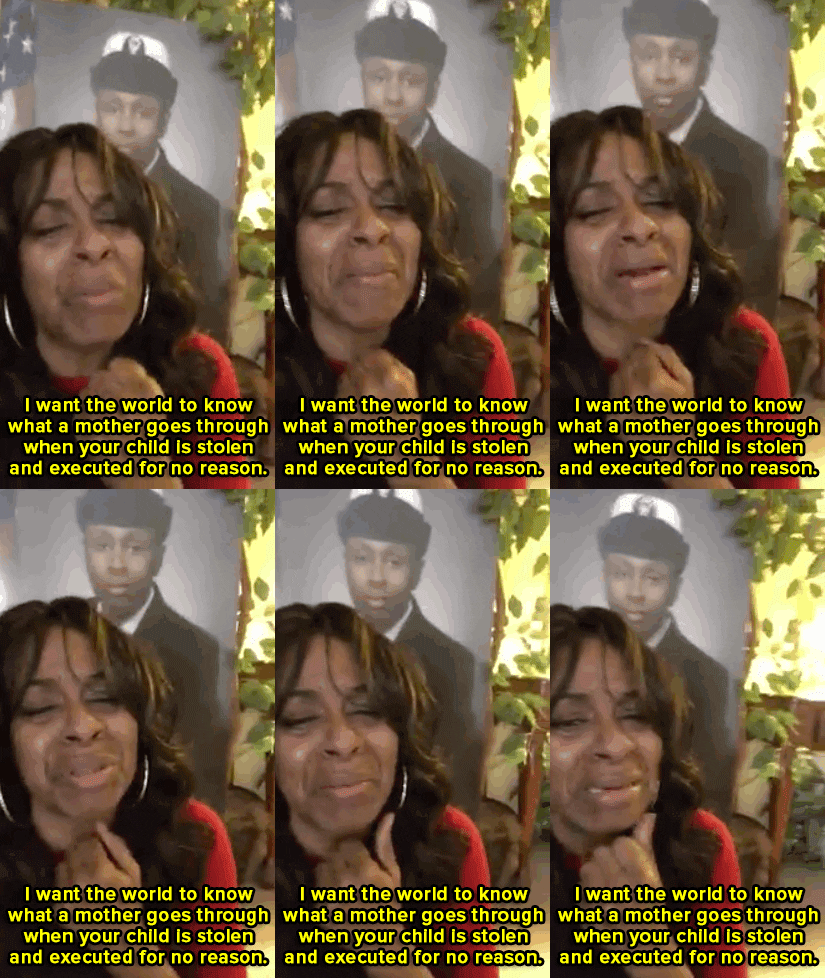
I have a lot more to say, but I’m going to tackle different slices of why police—as they currently exist—are broken beyond repair and need to be replaced with a different way of protecting our communities and enforcing our laws. I don’t want to write an endless article about my personal feelings and experience with police, because all of my stories are indirect. I’ve had cops yell at me but I’ve never been directly threatened or physically abused. (Then again, I’m a tall white guy who is very careful to always maintain eye contact, keep my hands visible, make no sudden moves, and answer questions directly and with clear signals of respect. Cops love to feel respected.) But I know lots of people who’ve truly suffered under people protected by the badge.
I know many women who’ve been harassed by male cops. I know more than one who was raped. (No, none of these men faced consequences for their crimes.) I know people who’ve been beaten and threatened by the police, and others who’ve been falsely accused of crimes or had evidence planted to justify an arrest. I’ve witnessed a cop lie under oath more than once.
And since the protests against police brutality and systemic racism broke out across the world, like so many others I’ve watched hundreds of instances of police attacking unarmed protesters with tear gas, pepper spray, and “less lethal” munitions have that permanently maimed people. I’ve seen clearly identified members of the press attacked as if they were the enemy. People who are shocked and horrified keep asking why the police are being so aggressive? The answer is simple, the protesters are committing the most dangerous crime of all:
The protesters are disrespecting the police.
And you know what? So am I.
Jamie Chambers
Canton, Georgia
June 19, 2020
The post Unf*ck the Police – Part One: My Story appeared first on Jamie Chambers.